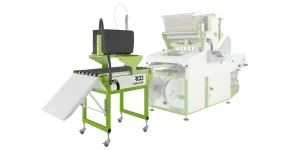
The Critical Final Step in Textile Fulfillment: Error-Free Labeling
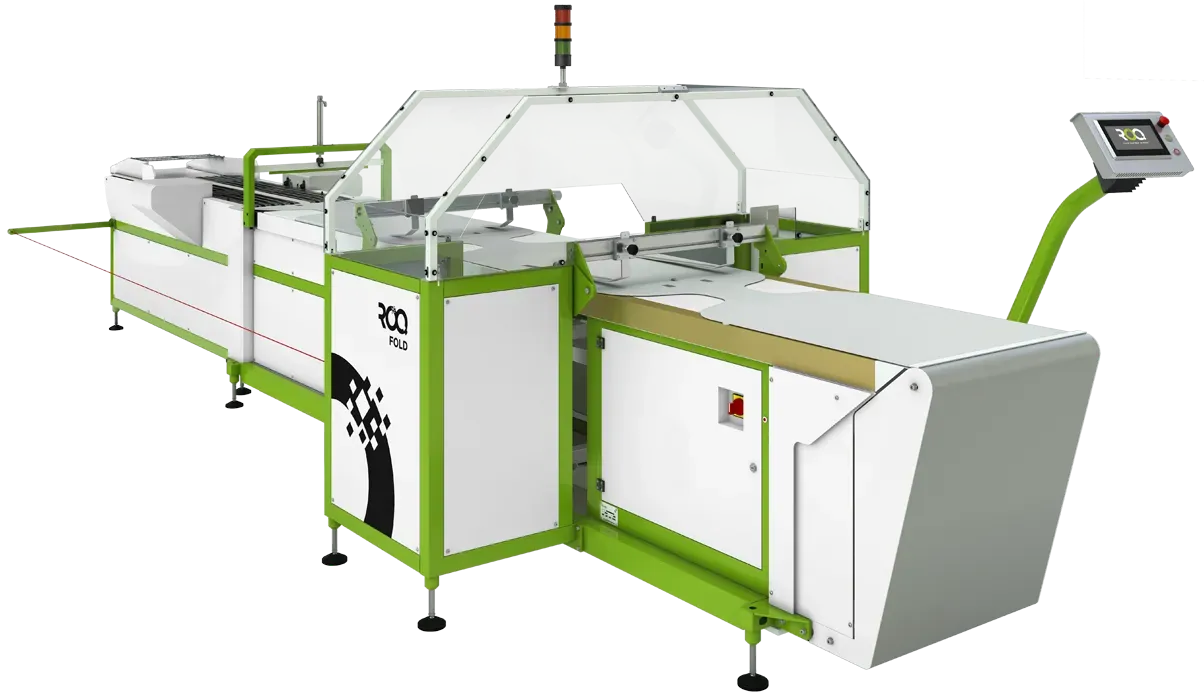
In today’s textile and screen printing industry, everything revolves around speed, accuracy, and efficiency. While we often invest in state-of-the-art automatic screen printing machines, advanced drying tunnels (such as the ROQ DRY), and precision folding machines (like the ROQ FOLD), the very last step in the production chain—applying shipping or barcode labels—is surprisingly often overlooked. Yet, attaching the correct barcode or address label is the most critical phase in your logistical chain.
An incorrectly applied label doesn’t just mean a delayed shipment; it immediately results in a return, loss of margins, a dissatisfied customer, and last but not least: extra ecological impact due to unnecessary transport movements. The ROQ LABEL is an advanced, inline labeling module (print & apply) specifically designed to completely eliminate such errors in the finishing line of your screen printing business or B2B textile hub. By automating the process, you guarantee absolute accuracy from production right to your customer’s doorstep.
The Hidden Costs of Manual Labeling: An ROI Calculation
In B2B textile printing facilities and fast-growing e-commerce fulfillment centers, hundreds, if not thousands, of garments are produced, folded, packaged, and shipped daily. When employees manually apply labels based on packing slips, the error rate inevitably fluctuates around 1% to 2%. This might seem low, but the financial impact is substantial.
Let’s make a realistic calculation for a textile printer shipping 2,000 packages per day:
- Volume: 2,000 packages per day (approx. 40,000 per month across 20 working days).
- Error Rate: 1.5% = 600 incorrectly labeled packages per month.
- Cost per Error: A return shipment including transport costs (both ways), administrative processing, customer service time, repackaging, and possibly the write-off of personalized items is estimated at an average of €15 to €25 per piece.
- Total Hidden Costs: 600 errors x €20 = €12,000 per month in avoidable losses.
In addition to the direct financial losses, manual labeling weighs heavily on labor costs. An employee can manually label an average of 200 to 300 packages per hour, provided they correctly match the packing slips with the physical goods. This means that for 2,000 packages, almost an entire full-time equivalent (FTE) is required daily.
The introduction of the ROQ LABEL eliminates both the error rate and the labor intensity. The ROI (Return on Investment) for an automated print-and-apply system in the textile printing industry is often achieved within 6 to 12 months.
Technical Deep Dive: How the ROQ LABEL Integrates Perfectly
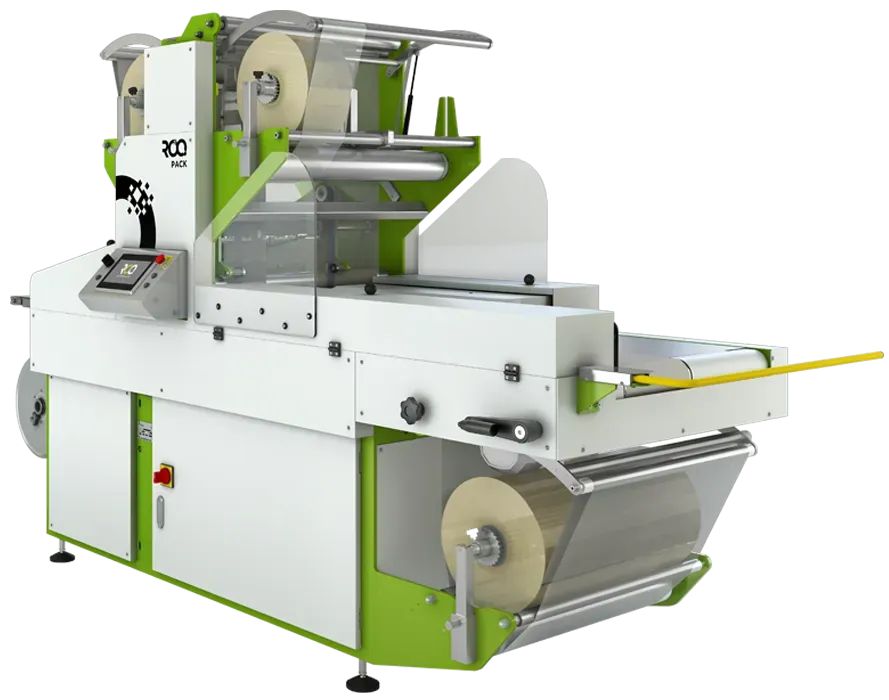
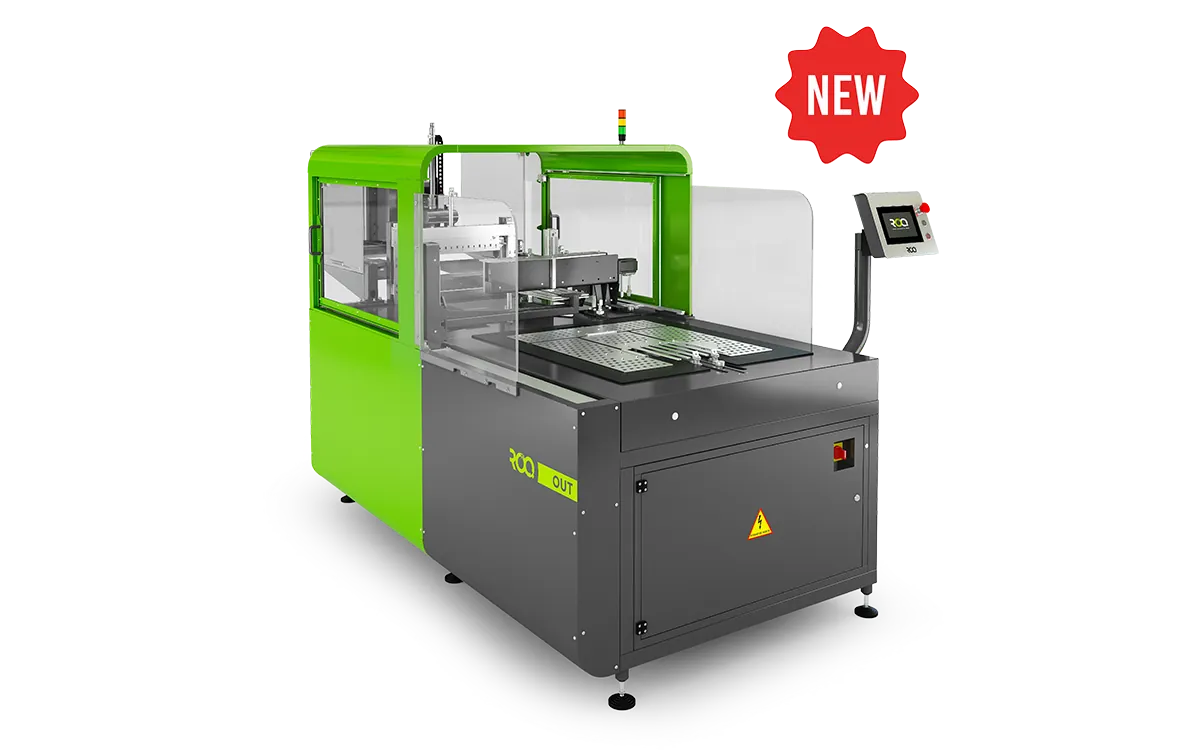
The ROQ LABEL is not just an ordinary label printer; it is an intelligent ‘print-and-apply’ unit that integrates seamlessly into ROQ’s automatic finishing lines, such as the ROQ PACK (packaging machine) and ROQ BAG.
The 5-Step Operation:
- Identification: The garment (e.g., a freshly printed hoodie or t-shirt) enters the packaging phase via the conveyor belt from the folding machine. The garment is often already identified internally via a barcode on the neck label or an RFID tag linked to the production order.
- Data Retrieval (API): The machine scans the internal ID and sends a signal within milliseconds to your WMS (Warehouse Management System), ERP package, or e-commerce platform (like Shopify or WooCommerce).
- Generating the Label: The system receives the exact, up-to-date shipping information or retail barcode and sends it directly to the industrial print head of the ROQ LABEL.
- Printing & Dispensing: The label is printed in high resolution using thermal-transfer technology and transferred to the pneumatic tamp applicator.
- Application: As soon as the polybag with the garment reaches the correct position under the applicator, the pneumatic cylinder presses the label onto the package at lightning speed and with the correct pressure, without interrupting the flow of the conveyor belt.
Advantages of Automated Print-and-Apply
- Constant Positioning: Every label is placed perfectly straight and in the exact same spot on the packaging. This is crucial for retail compliance (where large brands have strict requirements for label positions) and ensures a highly professional and uniform appearance.
- Unparalleled Speed: The ROQ LABEL is built for industrial capacities and effortlessly processes up to 1,200 items per hour. The applicator is calibrated so that it never slows down the speed of the packaging line.
- Direct and Dynamic Data Linking: Because the label is printed only a fraction of a second before it is applied, you always work with real-time data. If a customer cancels their order five minutes before packaging, the system will block the order and no shipping label will be printed.
Integration with ERP and E-commerce Platforms
An automated system is only as powerful as the software driving it. A common mistake in the screen printing industry is creating data islands. Manually exporting CSV files from your webshop to load them into a standalone label-printing software still carries a high risk of human error and data corruption.
The ROQ LABEL is designed with connectivity in mind. The control software can be linked via modern APIs to popular print shop management systems (like Printavo or DecoNetwork) or directly to e-commerce platforms. This means:
- No more batch printing where rolls of pre-printed labels sit next to the machine (and can get mixed up).
- Dynamic allocation of carriers (e.g., DHL, UPS, FedEx) based on the most favorable rates at that moment.
- Automatic feedback to your webshop that the package has been labeled and is ready for shipment, instantly triggering an automated email with tracking information to the end customer.
Best Practices for Setting Up Your Labeling Station
For screen printers taking the leap into fulfillment automation with the ROQ LABEL, there are several best practices to maximize performance:
- Choose the Right Backing Materials: Are you using polybags, paper bags, or cardboard boxes? The ROQ LABEL can handle variable heights and materials, but the choice of adhesive for your labels must be tailored to the packaging to prevent labels from peeling off during transit.
- Thermal Transfer vs. Direct Thermal: Make an informed choice in print technology. Direct Thermal is cheaper (no ink ribbon required) but sensitive to heat and UV light, which can lead to fading during summer in delivery vans. Thermal Transfer (where resin is burned into the label) offers maximum durability, scratch, and smudge resistance. For B2B retail orders where boxes sometimes sit in warehouses for months, Thermal Transfer is highly recommended. The ROQ LABEL supports high-quality print heads specifically for this application.
- Establish Maintenance Routines: Although the machine is extremely robust, preventive maintenance is crucial. Regularly cleaning the print head with isopropyl alcohol prevents streaks in barcodes (which cause unreadability at sorting centers) and significantly extends the lifespan of the print head.
Technical Specifications and Reliability
The reliability of your dispatch department cannot be compromised. That is why the ROQ LABEL is built with high-quality industrial components. The sensors and pneumatics are resistant to the dusty environments typical of textile print shops, where cotton fibers often shorten the lifespan of cheaper office printers.
- Sensors: The machine is equipped with smart photocells that not only detect the product but also continuously monitor the status of the label roll. It indicates well in advance—via a clear light signal or interface alert—when the roll is almost empty or when the ribbon needs replacing.
- Ergonomics: Replacing consumables takes only tens of seconds, allowing operators to get the machine running again swiftly and keeping the OEE (Overall Equipment Effectiveness) of your line exceptionally high.
- Variable Height Accommodation: With apparel, package thickness can vary greatly (from a thin t-shirt to a thick winter coat). The applicator dynamically adjusts itself to always apply the correct tamping pressure without damaging the product inside.
Future-Proof Your Textile Printing Business
The competition in the personalized clothing and merchandise market is fierce. To remain competitive, efficiency is no longer a luxury, but a necessity. Where many businesses stagnate due to rising labor costs and logistical complexity, automation offers the key to scalability.
With the ROQ LABEL, you put the crowning touch on your production process. You bridge the gap between the printing carousel and the delivery driver with a seamless, data-driven flow. This results in less stress on the work floor, drastically reduced returns, significant cost savings, and ultimately, a happier end customer who receives their printed textiles flawlessly and lightning fast. Investing in the perfect finish of your product means investing in the growth and future of your textile printing company.
Want to learn more about these screen printing solutions?
Explore the technical specifications of Drucktech PHP-45 V2 Maxima and Drucktech PHP-45 2N or contact the specialists at Dimix.Screen for tailored advice or a live demonstration.
Featured & related machines
Discover the industrial systems and solutions related to this topic:
ROQ FOLD & PACK / Folding & Packaging Machines
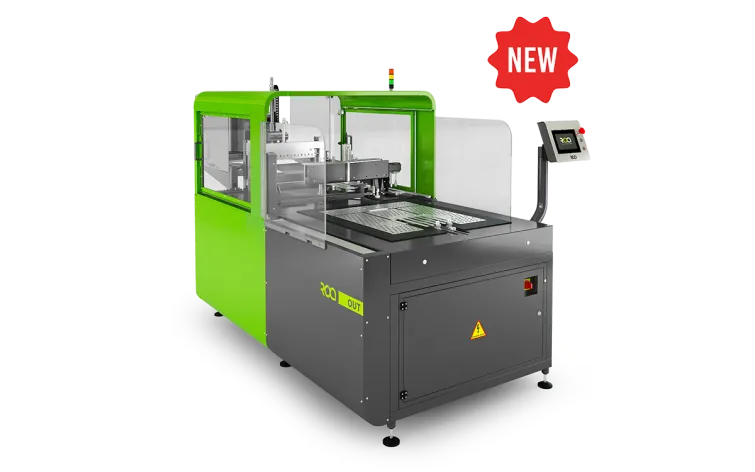
Fully automated garment folding, bagging, sealing, and labeling lines (ROQ FOLD, ROQ PACK, ROQ OUT & ROQ LABEL) for screen printers and fulfillment centers.
ROQ Sahara
High-efficiency industrial conveyor drying tunnel operating on gas, electricity, or dual MIX energy.
ROQ PULL+
High-speed dual-arm automatic unloader for the fastest carousels and oval machines.