The Hidden Bottleneck in Textile Printing and Fulfillment
In the dynamic world of screen printing, transfer printing, and textile decoration, everything revolves around speed, precision, and efficiency. Modern screen printing presses and direct-to-garment (DTG) printers are technological marvels capable of producing hundreds, if not thousands, of garments per hour. However, what happens once these beautifully printed garments exit the curing tunnel? In many print shops, this is where a significant bottleneck emerges: the finishing and packaging process.
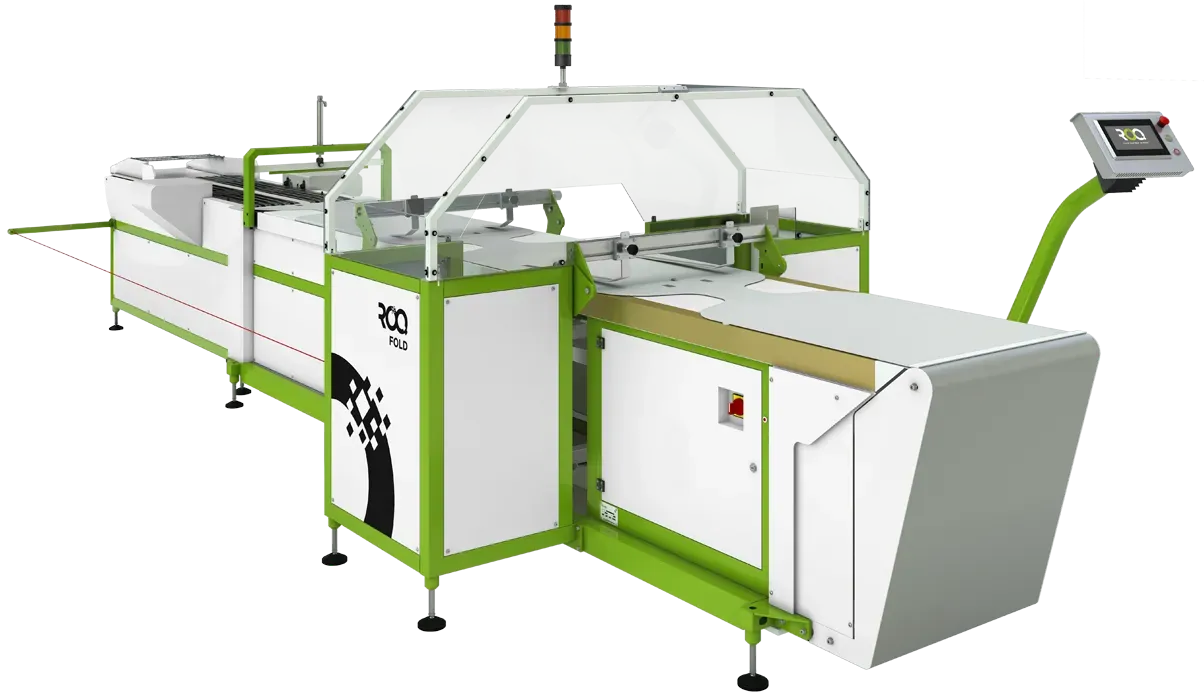
Manually folding garments is undeniably one of the most repetitive, labor-intensive, and time-consuming processes within a screen printing facility or e-commerce fulfillment center. While your machines run at full speed, freshly printed shirts pile up at the end of the conveyor belt, waiting for employees to manually fold, sort, and pack them. This not only slows down your turnaround time but also drives up your operational costs unnecessarily. The ROQ FOLD folding machine is specifically designed to tackle this challenge, fully automate this process, and drastically reduce your handling costs by up to 70%.
The True Cost of Manual Folding: A Detailed Analysis
To truly understand the impact of automation, we must first analyze the real costs of the current manual process. An experienced and motivated employee manually folds an average of 150 to a maximum of 200 garments per hour, assuming optimal conditions. For a medium to large order of 5,000 T-shirts, you quickly lose 25 to 33 man-hours purely on folding work.
When we translate this into current labor costs, including social security, insurance, and other employer expenses, it represents a significant cost item per order. Moreover, human productivity is not constant. As the day progresses, fatigue sets in. This inevitably results in a lower throughput rate and, more importantly, a decline in quality. Sloppy folds, uneven package sizes, and sorting errors can lead to dissatisfied customers, especially in the demanding B2B retail and direct-to-consumer e-commerce markets, where the ‘unboxing experience’ is critical.
Additionally, finding and retaining reliable staff for repetitive manual labor is a growing challenge in today’s labor market. By relying on manual labor for finishing, you make your production process vulnerable to absenteeism, high turnover, and seasonal peaks.
Meet the Solution: The ROQ FOLD Folding Machine
The ROQ FOLD is not just a folding board with a motor; it is an advanced piece of industrial engineering, designed to integrate seamlessly into the most demanding production environments. This machine elevates the concept of garment folding to an unprecedented level of speed and precision. With the capacity to process up to 800 garments per hour (depending on the type of garment and the chosen folding program), one ROQ FOLD effectively replaces the work of four to five manual folders.
Technical Perfection: How the ROQ FOLD Works
What sets the ROQ FOLD apart from simpler alternatives on the market is its robust build quality combined with smart, adaptive technology. The machine utilizes a series of advanced optical sensors that scan and measure every garment fed into it in real-time.
As soon as the garment is placed on the conveyor belt, these sensors determine the exact length and width of the textile. This data is transmitted in milliseconds to the machine’s PLC (Programmable Logic Controller). The PLC then controls the pneumatically driven mechanical folding blades and belts. Because the machine knows the exact dimensions of the specific garment, it automatically adjusts its folding strokes to fold the item exactly in the middle with micrometric precision.
This process guarantees a 100% consistent and tight presentation, regardless of any variations in fit or sizing (from XS to XXXL). Even if you mix different sizes in a single run, the ROQ FOLD adapts instantly without the operator needing to intervene.
Flexibility for Every Type of Textile
The strength of a professional textile print shop often lies in the diversity of its offerings. Therefore, a folding machine must be able to process more than just standard T-shirts. The ROQ FOLD is designed with maximum versatility in mind. The system effortlessly folds a wide range of garments:
- Short sleeves (T-shirts, polos)
- Long sleeves (sweaters, long sleeves, shirts)
- Heavy garments (thick hoodies with zippers, jackets)
- Pants and shorts
- Textile accessories such as towels or aprons
Thanks to the adjustable speed of the belts and the adjustable pressure of the folding mechanisms, the machine can carefully handle both delicate, light fabrics and heavy, stiff materials without damaging or creasing them.
B2B versus E-commerce: Tailor-Made Folding
Different end customers require different packaging standards. The ROQ FOLD offers the ability to switch between various pre-programmed folding programs within seconds via its user-friendly color PLC touchscreen.
For the B2B Market (Retail and Wholesale): When supplying physical stores or distributors, it is crucial that the garments can be stacked perfectly in bulk boxes to minimize transport costs. The ROQ FOLD can apply a wider, traditional fold that beautifully presents the chest print and ensures stable, flat stacks in the box.
For the E-commerce Market (Direct-to-Consumer): For online stores, the focus is often on individual packaging in polybags, mailers, or compact letterbox packages. This requires a more compact and tighter fold. The operator simply selects the e-commerce program, and the ROQ FOLD instantly adjusts the number of strokes and the final width of the package, optimized for the automatic bagging process that follows.
Return on Investment (ROI): The Numbers Speak for Themselves
Purchasing automated finishing equipment is an investment, but one with a surprisingly fast payback period. Let’s look at a simplified Return on Investment (ROI) calculation for a medium-sized print shop.
Suppose you currently process 10,000 garments per week that need to be manually folded.
- Manual (150 items/hour): 66.6 hours of work per week.
- ROQ FOLD (average 600 items/hour in practice): 16.6 hours of work per week.
You immediately save 50 man-hours per week. Assuming a modest hourly rate (including employer costs) of €25 / $25, that’s a saving of €1,250 / $1,250 per week, or about €60,000 / $60,000 annually, purely on folding labor costs (based on 48 workweeks).
Moreover, thanks to the higher processing speed, you can take on more orders without having to expand your workforce, which further stimulates your company’s profitability. Depending on your order size and frequency, an ROI within 12 to 24 months is a realistic standard for many of our customers.
Seamless Integration into Your Existing Workflow
The true power of the ROQ FOLD is revealed when it is integrated into a broader workflow. To get the most out of the machine, its placement on the shop floor is essential. Best practices dictate placing the machine directly at, or in line with, the outfeed side of your curing tunnel (dryer). This creates a continuous inline flow where the catcher can place the fresh garments almost directly onto the folding machine’s belt.
Furthermore, the ROQ FOLD has a fully modular design. This means you can easily expand your finishing line in the future by connecting the folding machine to other ROQ modules:
- ROQ PACK: For automatically bagging and sealing the folded garments.
- ROQ STACK: For automatically stacking folded garments in preset quantities.
- ROQ LABEL: For fully automatic printing and applying of barcodes and shipping labels to the packaging.
This modularity ensures that your investment grows with your business needs, from a standalone folding solution to a fully automated packaging line.
Ergonomics and Better Human Resources Management
In addition to the hard financial numbers, automation also offers significant benefits in terms of human resources and workplace ergonomics. Repetitive manual labor like folding often leads to physical complaints (RSI), neck, and back pain among employees. By taking this heavy, monotonous work off their hands, you create a healthier and safer working environment.
The hours you save do not necessarily mean you have to lay off staff. On the contrary, many successful print shops reassign their valuable, experienced employees to areas where human insight and craftsmanship are irreplaceable. Think of stricter Quality Control before the garments enter the folding machine, optimizing prepress, or operating more complex printing equipment. This elevates the overall print quality of your products and provides a more challenging, satisfying set of tasks for your team.
Checklists for a Successful Implementation
Are you considering the switch to automated folding? Keep these practical matters in mind for a smooth integration:
- Air Supply: The pneumatic components of the ROQ FOLD require a clean, dry compressed air supply with a constant pressure of at least 6 bar.
- Power Supply: Check whether your production floor has the correct electrical connections (typically 230V or specific three-phase power depending on the configuration).
- Space and Routing: Map out the routing of your products and ensure there is enough space around the machine for both the infeed of garments and the outfeed of boxes or packages.
Conclusion: An Indispensable Link for Growth
In a competitive market where margins are under pressure and customers expect increasingly shorter delivery times, automating your fulfillment is no longer a luxury, but a necessity. The ROQ FOLD folding machine proves itself as an indispensable link for ambitious screen printers and textile businesses. By lowering your handling and labor costs by up to 70%, maximizing the consistency of your packaging, and accelerating throughput, the ROQ FOLD gives you the edge needed to scale profitably and exceed your customers’ expectations.
Discover the ROQ FOLD & PACK garment folding and packaging line or request a quote from Dimix Screen.
Featured & related machines
Discover the industrial systems and solutions related to this topic:
ROQ IMPRESS
Automatic rotary carousel heat press for DTF, vinyl, and screen-printed transfer application.
ROQ FOLD & PACK / Folding & Packaging Machines
Fully automated garment folding, bagging, sealing, and labeling lines (ROQ FOLD, ROQ PACK, ROQ OUT & ROQ LABEL) for screen printers and fulfillment centers.
ROQ Sahara
High-efficiency industrial conveyor drying tunnel operating on gas, electricity, or dual MIX energy.