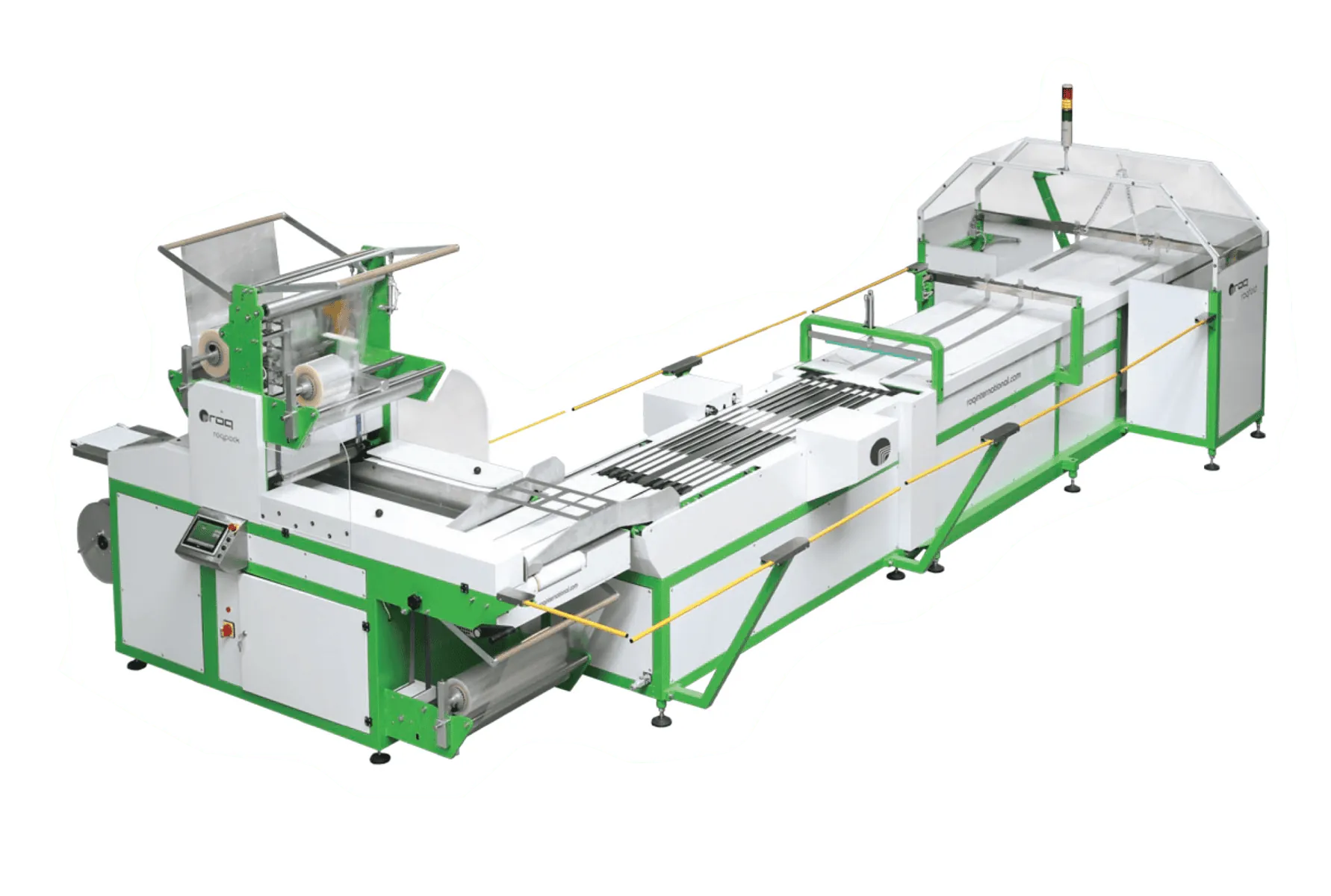
The modern B2B textile printing company faces a major challenge. While automatic carousels and high-speed oval presses print hundreds, if not thousands, of garments per hour today, the finishing department often lags hopelessly behind. The manual folding, bagging, and labeling of textiles is a massive bottleneck that relentlessly drags down the net capacity of the entire production line.
In this comprehensive guide for 2026, we dive deep into the world of fulfillment automation for screen printers and textile decorators. We not only discuss why this step is crucial for your growth, but also analyze the underlying technologies, best practices for implementation, and the true Return on Investment.
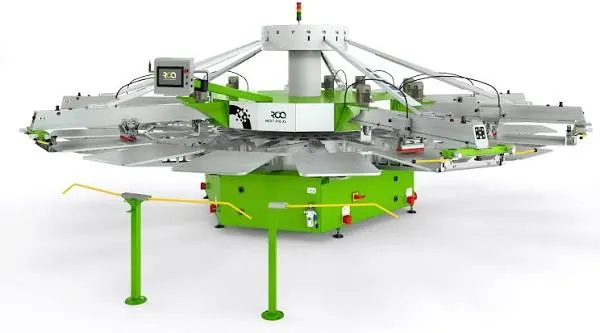
The Bottleneck of Manual Finishing in Textile Printing
Manually folding a T-shirt, sweater, or hoodie takes a trained operator an average of 15 to 25 seconds. When we scale this up to large industrial batches of thousands of pieces, it results in a huge labor cost and inevitable delays.
Let’s look at a calculation example. If your screen printing machine produces 800 T-shirts per hour, you need at least three to four fast employees just to fold and pack to keep up with the output of a single press. This means your labor costs increase exponentially the moment you decide to add an extra shift or purchase a new printing carousel.
Furthermore, the chance of human error in counting, sorting, and labeling is significant. Incorrectly labeled packages lead to expensive returns and dissatisfied customers. Automatic folding and packaging lines solve these bottlenecks by catching garments directly from the curing oven and making them completely ready for shipment within seconds, with absolute consistency.
The Evolution of Textile Finishing: From Manual Labor to High-Tech
The transition from manual work to automation in finishing has taken a massive leap in recent years. Where simple folding boards were once used to achieve a certain degree of uniformity, in 2026 we are talking about intelligent machine systems that communicate with your ERP (Enterprise Resource Planning) software and WMS (Warehouse Management System).
Contemporary systems use advanced sensor technology to detect the thickness, size, and type of fabric. This allows the machine to make “on-the-fly” decisions about how a specific garment can best be folded and packaged, without the operator having to stop the line for manual adjustments.
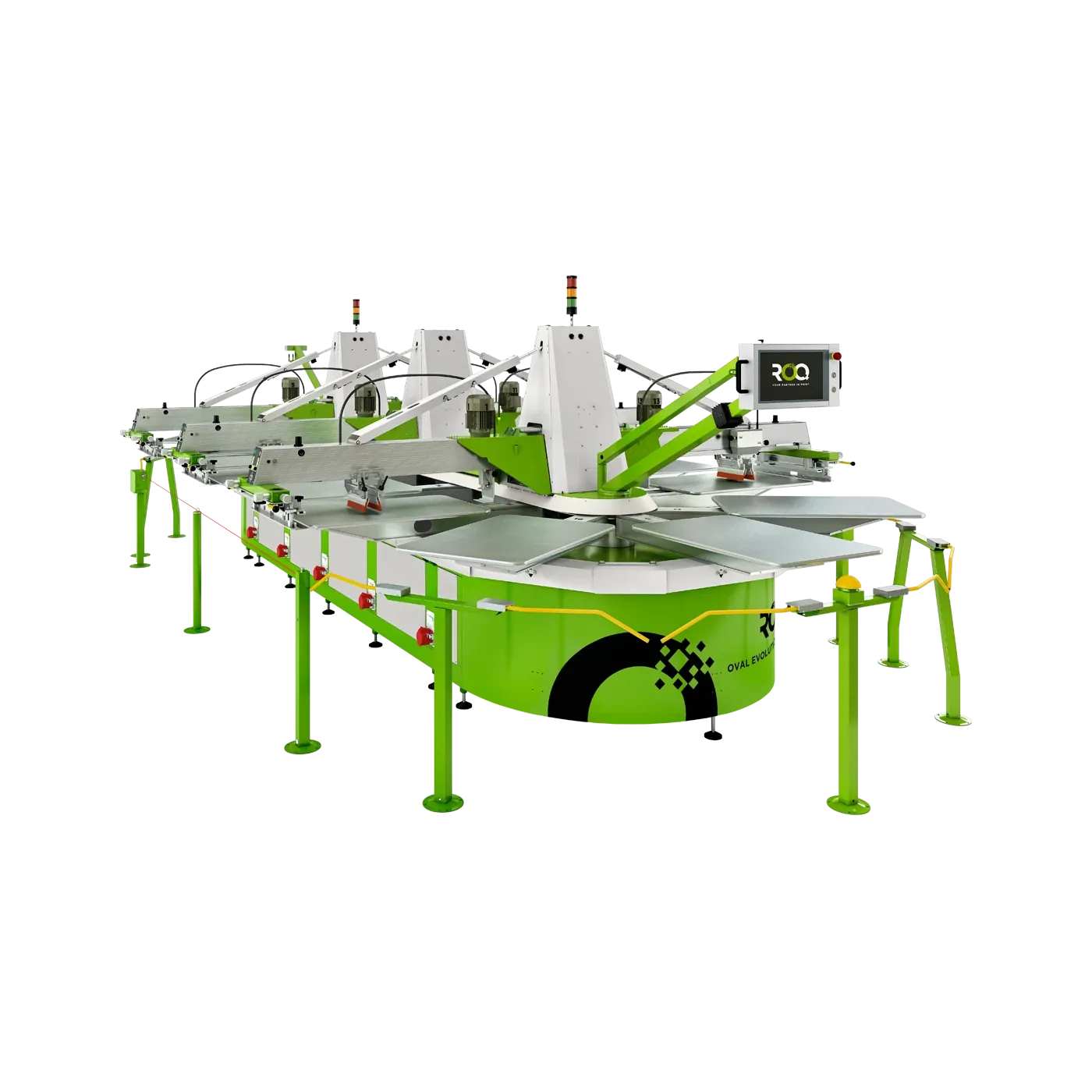
What Does a Fully Automatic Fulfillment Workflow Entail?
A complete, integrated finishing line is not a standalone device, but consists of various modular steps that communicate seamlessly with each other. Well-known brands such as ROQ offer modular ecosystems that can grow with you. Let’s look at the critical components in detail.
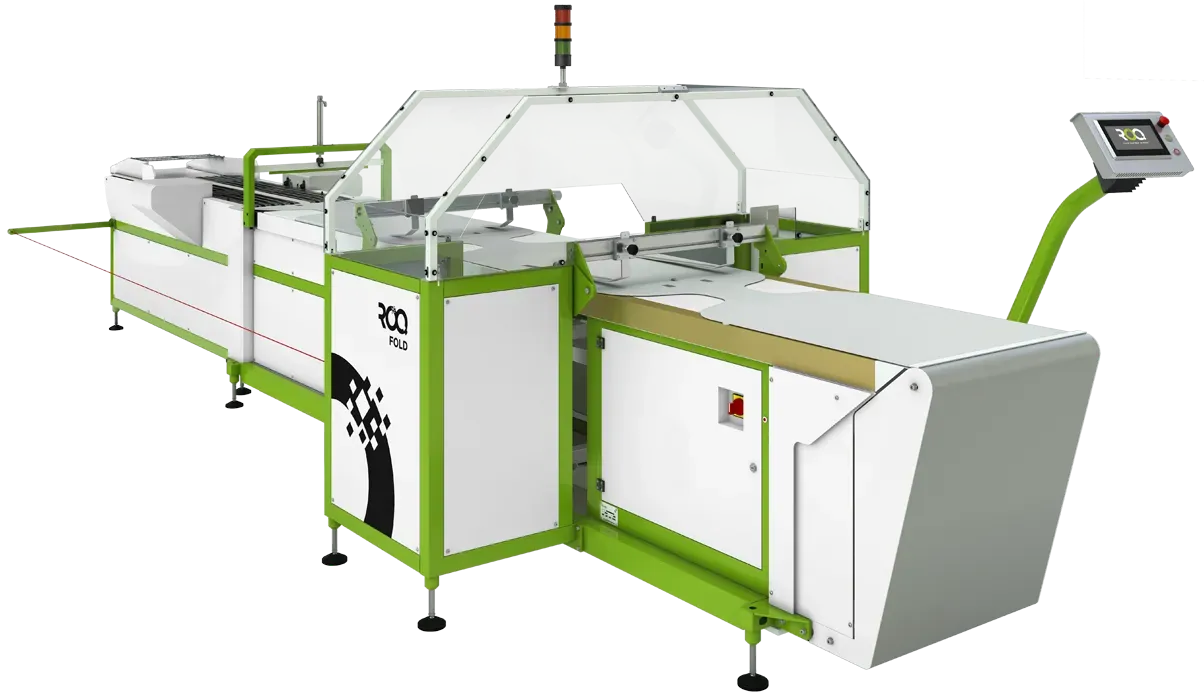
1. Folding (ROQ FOLD)
The first step is folding. Advanced systems like the ROQ FOLD use servo-controlled mechanical folding blades in combination with compressed air to fold garments crease-free and with extreme precision. Sensors measure the length and width of the inputted item, whether it’s a child-size t-shirt or an XXL heavy long-sleeve hoodie. The folding speed is often 700 to 1200 pieces per hour, depending on the complexity of the garment. The perfect fold not only ensures a better presentation but also minimizes the required packaging material and shipping volumes.
2. Stacking (ROQ STACK)
After folding, it is crucial to group orders correctly. Folded textiles are transported by a belt to the ROQ STACK module, which automatically counts and stacks the items. This system can be programmed to create stacks of specific quantities (e.g., stacks of 5, 10, or 12 pieces). This eliminates counting errors, which is essential for B2B deliveries to retailers who expect exact numbers per box.
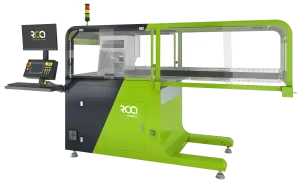
3. Packing and Sealing (ROQ PACK / BAG)
Packaging is the first physical interaction an end customer or retailer has with your product. The stack of clothes (or individual items) is automatically slid into a polybag or eco-friendly paper bag. Systems like ROQ PACK wrap the textile in tight PE film and thermally seal it all around. Another commonly used method is the use of pre-formed bags (bagging). In both cases, this step protects the clothing against dirt, dust, and moisture during transport. In 2026, we also see a strong shift towards biodegradable or recycled films, and modern packaging lines are designed to process these more sustainable materials without loss of performance.
4. Labeling (ROQ LABEL)
A logistics process is only complete when traceability is guaranteed. An inline print-and-apply labeling module automatically applies a barcode, SKU, size indication, or even a complete address label to the packaged clothing. Because the printer is connected in real-time to the order database, the right label is always applied to the right bag, in the right orientation. This prevents costly “mis-picks” in the warehouse.
Technical Integration and Best Practices
Simply placing a packaging line in your hall is no guarantee of success; the logistical integration into your existing layout is at least as important.
- Placement Behind the Curing Oven: Ideally, the infeed conveyor of the folding machine is located close to the outfeed of your curing tunnel. Operators who take the shirts off the belt after the ink has cured can feed them directly into the folding machine, eliminating double handling.
- ERP/WMS Integration: Ensure your labeling module can seamlessly talk to your software. The barcode on the label must act as the key in your warehouse management, so scanning it immediately updates the shipping status.
- Maintenance and Compressed Air Quality: Pneumatic folding and packaging machines require dry, clean compressed air to prevent malfunctions in valves and cylinders. Invest in good compressors with air dryers.
The ROI (Return on Investment) of Packaging Automation
One of the most frequently asked questions in the screen printing and textile world is: “When will I recoup this heavy investment?” The answer lies in a detailed ROI calculation.
Suppose you currently employ four full-time finishing staff, at a gross labor cost of €30,000 per person per year. That is €120,000 per year, solely for folding and packing. A fully automatic line (e.g., ROQ FOLD + PACK) costs on average between €60,000 and €120,000 depending on the configuration. This machine replaces the manual work of three operators, while one operator feeds and monitors the machine.
The savings amount to roughly €90,000 per year in labor costs. This means the equipment often pays for itself within 12 to 18 months. And this is only based on labor costs. The calculation becomes even more favorable when we consider the following indirect benefits:
- Increased Throughput: You can handle much larger orders in the same time frame, increasing your total revenue capacity.
- Fewer Returns: Counting errors and wrong labels drop to virtually zero.
- More Professional Appearance: The crisp, machine-made fold and packaging significantly increase the perceived value of your product.
- Reduced Absenteeism: Manually folding thousands of shirts a day leads to RSI and other physical complaints. Automation reduces heavy repetitive work.
The Impact on E-commerce and Print-on-Demand
For companies focusing on e-commerce fulfillment and Print-on-Demand (POD), automation is no longer a luxury today, but an absolute necessity. Consumers expect their online clothing orders to be shipped at lightning speed and arrive in impeccable packaging.
An automatic line allows printing companies to drastically shorten lead times. A shirt printed in the morning can literally be machine folded, sealed, labeled with the end customer’s data, and be in the shipping container the same afternoon. This “single-piece workflow” principle fits perfectly into the modern e-commerce strategy.
Frequently Asked Questions About Textile Fulfillment Automation
To further assist you in your decision-making process, we address some practical frequently asked questions below.
Is an automatic folding line suitable for mixing different clothing sizes and types? Yes, this is one of the biggest innovations of recent years. The advanced sensors in modern machines (like the ROQ FOLD) instantly measure the length of the garment placed on the belt. The servo motors adjust the position of the folding blades in milliseconds. This allows you to smoothly place a children’s shirt directly followed by an XXL men’s hoodie on the belt. The machine adapts without delay.
How many operators are actually needed? In an optimized setup, a complete folding, packing, and labeling line can be operated by a single operator. This operator lays the garments flat on the infeed belt. At the end of the line, the finished, sealed packages fall into a box, or a second operator stacks them on a pallet for shipping.
What maintenance do these lines require? Modern finishing machines are built for 24/7 industrial use. Daily maintenance is usually limited to keeping the photo sensors clean, emptying any waste bins (for film remnants), and weekly lubrication of the moving parts. Most systems today are also equipped with remote diagnostics, allowing the manufacturer to read errors or perform software updates via an internet connection.
Conclusion
In the competitive market of 2026, efficiency is the key to profitability. Optimizing production speed at the front end (the printing press) makes little sense if the back end (the finishing) cannot handle the flow. By investing in solutions such as the automatic folding, stacking, packaging, and labeling modules from ROQ, you eliminate structural bottlenecks in your workflow.
You dramatically lower your operational costs, reduce error margins to a minimum, increase the quality of your end product, and improve working conditions for your staff. Whether you operate in traditional high-volume markets or serve the dynamic world of on-demand e-commerce; a seamlessly integrated fulfillment line is the investment that prepares your textile printing business for a successful future.
Want to learn more about these screen printing solutions?
Explore the technical specifications of ROQ FEED and ROQ PULL or contact the specialists at Dimix.Screen for tailored advice or a live demonstration.
Featured & related machines
Discover the industrial systems and solutions related to this topic:
ROQ PULL
Automated take-off arm that unloads printed garments from platens directly onto conveyor dryers.
ROQ FEED
Automated garment feeding arm ensuring consistent placement and continuous press productivity.
ROQ IMPRESS
Automatic rotary carousel heat press for DTF, vinyl, and screen-printed transfer application.