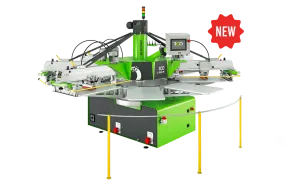
The rising energy rates in Europe and across the globe have placed unprecedented pressure on the profit margins of manufacturing companies in recent years. For industrial textile printing companies, this reality is even more poignant. Within a typical print shop, screen printing presses, intermediate dryers (flash cures), and the accompanying air compressors are responsible for a massive portion of monthly overhead costs. Monitoring and reducing power consumption has evolved from a noble sustainability goal to a hard-core economic necessity. Companies that fail to invest in energy-efficient technologies risk pricing themselves out of the market in the long run. ROQ, a global pioneer in screen printing machinery, initiated this transition early on. By equipping its latest generation of presses with high-efficiency AC servo motors and intelligent drying systems, ROQ offers textile printers a powerful weapon in the battle against skyrocketing electricity bills and unnecessary operational costs.
The Hidden Costs and Inefficiencies of Pneumatic Systems
To understand why the shift to electrical drives is so crucial, we must first examine the traditional way of working. For decades, automatic screen printing presses primarily relied on pneumatic cylinders to drive the print heads, the squeegee movements, and the central indexer (the carousel’s rotation mechanism). While compressed air was a reliable and relatively cheap technology to produce and maintain historically, from an energetic standpoint, it is one of the most inefficient forms of power transmission available.
When an electric air compressor draws in and compresses air, an immense amount of energy is lost. Thermodynamic laws dictate that during this compression process, up to 80% to 90% of electrical energy is converted into heat, rather than usable compressed air. On top of that come the inherent disadvantages of a compressed air network. Old pipes, worn-out couplings, and defective valves invariably lead to air leaks. A relatively small hole of just one millimeter in a compressed air line can cost hundreds of euros in wasted electricity annually, as the compressor must continuously engage to maintain system pressure, even when the screen printing press is not actively running.
Furthermore, compressed air requires extensive conditioning. The compressed air must be cooled, filtered, and dried to prevent condensation from corroding the pneumatic components of the expensive screen printing press. Refrigerated dryers and advanced filtration systems are energy consumers themselves, further increasing the total ecological and financial footprint of a pneumatic system.
The Rise of AC Servo Motors in Screen Printing
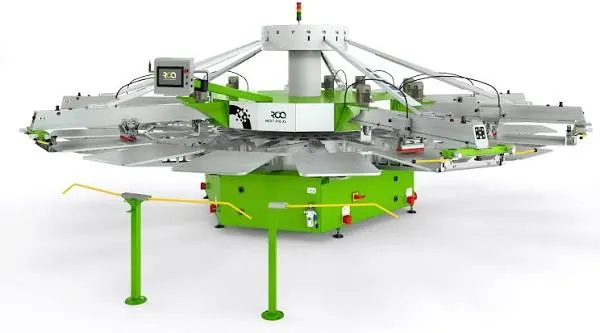
In direct response to the pain points of pneumatic drives, the textile printing industry has increasingly turned to electromechanical solutions. ROQ has positioned itself as a frontrunner by outfitting its machines, including popular models like the ROQ YOU, ROQ NEXT, and ROQ ECO, with advanced alternating current (AC) servo motors.
An AC servo motor is fundamentally different from a standard electric motor or a stepper motor. Servo motors operate in what is known as a ‘closed-loop’ system. They are equipped with an encoder, a sensor that continuously feeds back the exact position, speed, and acceleration of the motor shaft to the control computer. This not only ensures unparalleled precision in pallet rotation and print head movement—which is crucial for multi-color printing with perfect registration—but it is also the key to drastic energy savings.
Unlike a pneumatic system that requires constant system pressure to remain operational, a servo motor consumes electricity exclusively at the exact moment a movement needs to be executed or a force needs to be maintained. During the print cycle, when the pallet briefly stops and the squeegee pushes the ink through the mesh, the power consumption of the central indexer’s drive drops to virtually zero. Moreover, a servo motor generates high torque over a wide speed range, allowing for highly efficient acceleration and deceleration without energy waste. On average, implementing AC servo drives can result in power consumption reduction of up to 50% compared to older, purely pneumatic or hybrid models.
The ROQ E: A 100% Electric Gamechanger Without a Compressor
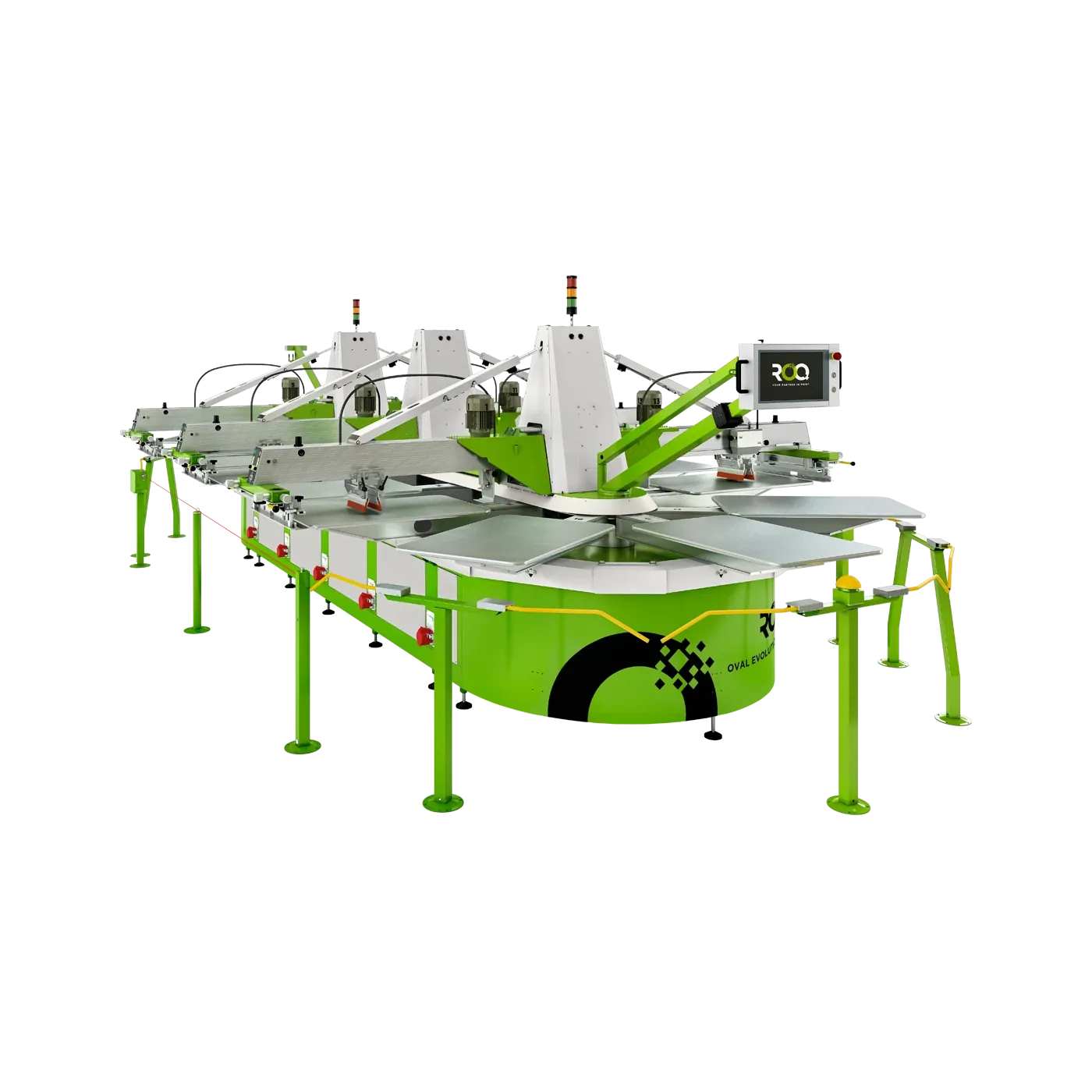
For companies striving for the absolute pinnacle of energy efficiency, ROQ developed the ‘ROQ E’. This revolutionary model is the world’s very first fully automatic carousel screen printing press that is 100% electrically driven and operates entirely independent of external compressed air or compressors. Every squeegee, every floodbar, every pallet lift, and the central rotation are seamlessly controlled by advanced electronics and servo motors.
This not only delivers a streamlined, air-free production process but also brings a gigantic financial advantage regarding the grid connection. The ROQ E has a consumption of only 5.5 to 6 kVA, depending on the configuration. For many starting or expanding textile printing businesses, available grid capacity is a massive bottleneck. Upgrading a 3-phase power connection (e.g., from 3x25 Amps to 3x63 or 3x80 Amps) entails significant investment costs and exorbitant annual fixed capacity tariffs in many regions. Thanks to the extremely low power demand of the ROQ E, this machine can often be installed on standard industrial or even heavier residential power connections. This opens doors for entrepreneurs to house their production in smaller commercial properties or retail environments where a heavy industrial power supply is simply unavailable or too expensive.
An additional, often underestimated advantage of the 100% electric drive is the drastic reduction in noise emissions. Compressors and the hissing escape of compressed air from pneumatic valves cause significant noise pollution. The whisper-quiet operation of the servo motors contributes directly to a more pleasant, safer, and more productive working environment for your operators.
Intelligent Power Control for Intermediate Dryers (Flash Cures)
While the drive of the press is an important factor, it is a universally acknowledged truth in the screen printing world that the intermediate dryers, the so-called flash cures, are the real power guzzlers. When working with plastisol or water-based inks, different ink layers must be intermediately dried or ‘flashed’ before the next color is applied.
Older or cheaper infrared dryers often work on an ‘all or nothing’ principle. They continuously radiate heat at a fixed temperature, regardless of whether a garment is actually underneath the lamp. This is a massive waste of energy and also leads to an undesirable temperature rise in the workspace, forcing any air conditioning systems to work even harder, resulting in even more power consumption.
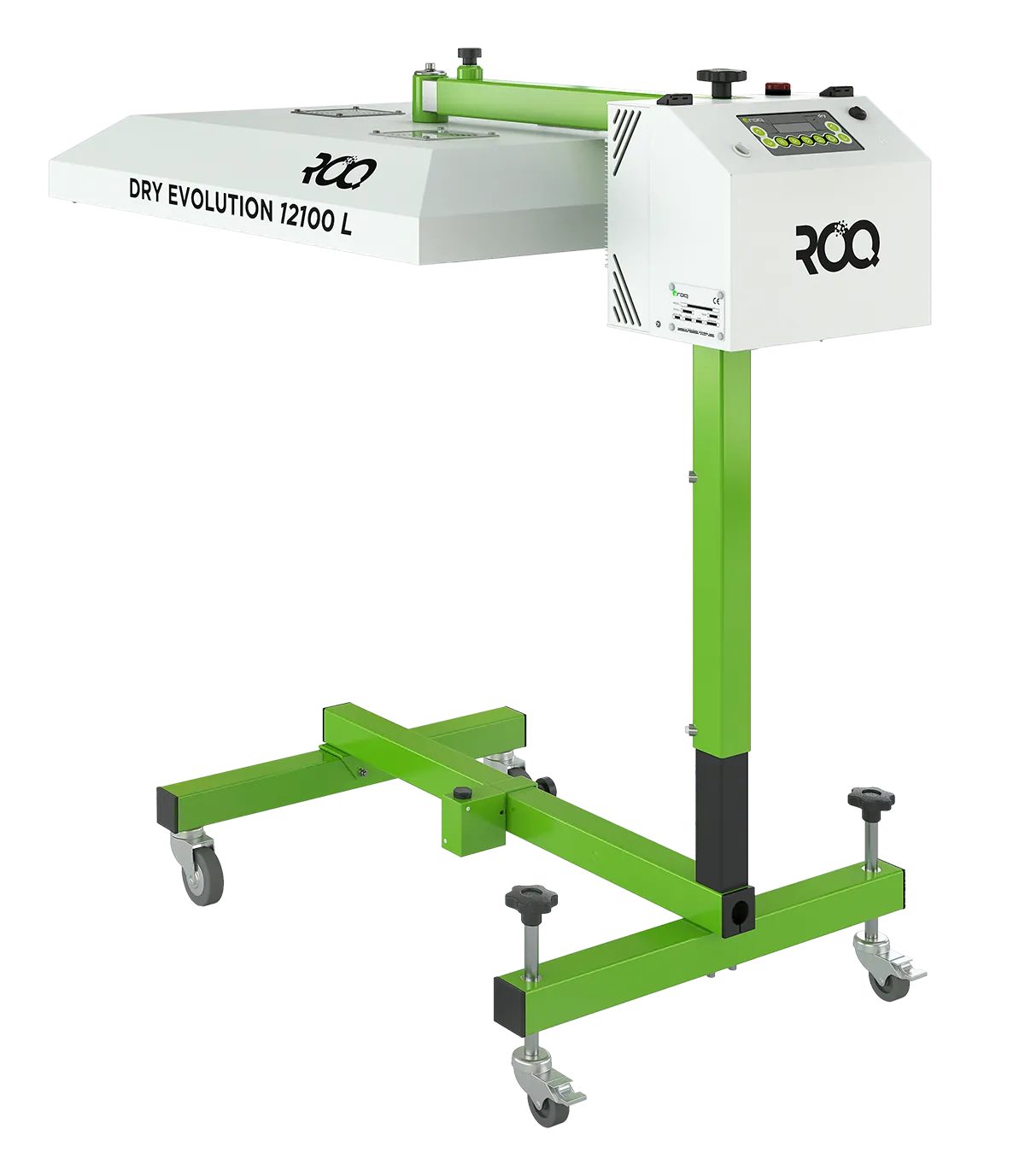
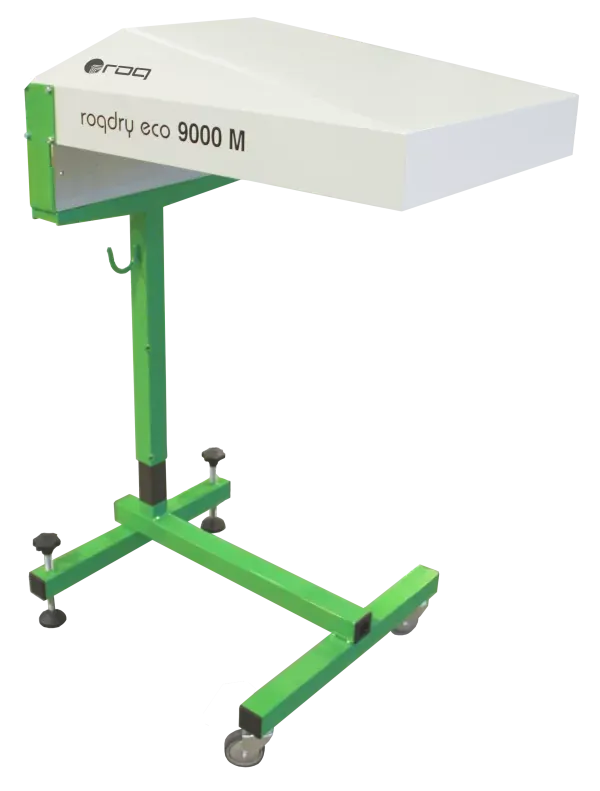
ROQ tackles this problem at its core with their intelligent quartz flash cures, such as the ROQ DRY series. These advanced dryers are equipped with fast quartz lamps that reach their peak temperature within a fraction of a second. Combined with advanced optical sensors in the press, the machine continuously communicates with the flash cure. The lamps only flash on at the exact moment a printed pallet is in the drying position, and they switch off immediately as soon as the pallet starts rotating for the next step.
Furthermore, many ROQ flash cures are divided into ‘Smart Zones’. Suppose you are printing a small chest logo; it is utter nonsense to turn on the entire width of the flash cure. Via the central control panel, the operator can set the system so that only the inner lamps activate. This zone control easily saves thousands of kilowatt-hours per individual dryer over a full production year.
Calculation Example: The Hard Return on Investment (ROI)
To quantify the impact of these innovations, we present a simplified but realistic ROI calculation for a mid-sized printing company.
Scenario A: The Traditional Pneumatic Press
- Drive and peripherals require a 15 kW screw compressor.
- The compressor effectively runs 8 hours a day, 220 working days a year.
- Total compressor energy consumption: 15 kW x 8 hours x 220 days = 26,400 kWh per year.
- At an average energy price of € 0.28 per kWh (including grid fees and taxes), the power costs for compressed air alone amount to: € 7,392 per year.
- Added to this are the constant power draw of infrared flash cures that are poorly switched or continuously on, and the high maintenance costs of the compressed air network (filters, oil, dryer).
Scenario B: The ROQ E Fully Electric Press with Quartz Flash Cures
- No compressor required. The power consumption of the press drive (servo motors) averages 3 kW during active operation.
- Total drive energy consumption: 3 kW x 8 hours x 220 days = 5,280 kWh per year.
- Power costs for press movement: € 1,478 per year.
- The quartz flash cures with sensors and zone control save an estimated 30% to 40% in energy compared to continuously burning IR panels.
Conclusion of the ROI: On mechanical movement and the elimination of the compressor alone, this printing company saves nearly € 6,000 per year directly on the electricity bill. Over a typical depreciation period of 5 years, that represents a massive savings of € 30,000. And we haven’t even factored in the significant savings on maintenance contracts for compressed air, the reduction in flash cure energy, and the lower fixed grid capacity tariffs. The higher initial purchase value of a premium servo-driven ROQ machine is therefore often fully compensated within just a few years by the drop in operational expenditures (OPEX).
Best Practices for Energy-Efficient Textile Printing
Even with the most advanced ROQ equipment in-house, behavior on the shop floor determines the maximum yield. Here are some professional best practices for industrial textile printers:
- Optimize Workflow Around Breaks: Ensure operators do not leave the machine on standby with flash cures activated during lunch breaks or shift changes. Even with smart sensors, the baseline temperature maintenance can draw unnecessary power.
- Climate Control: Because of the efficient, targeted drying of ROQ quartz lamps, less heat escapes into the warehouse. Take advantage of this by strategically regulating the thermostat or air conditioning in your production hall. Extracting hot air directly above the dryers outside prevents your facility from heating up excessively in the summer.
- Preventive and Periodic Maintenance: Ensure servo motors and guides are free of dried ink and dust. Mechanical friction caused by poor lubrication forces the motors to draw more current to maintain or reach their position.
- Utilize the Right Zones: Train your staff to critically review flash cure settings for every job. Routinely turning on all lamps for a small print is a waste of electricity and unnecessarily heats up the aluminum pallets.
Conclusion: A Sustainable Future for the Textile Printing Industry
The transition to sustainable and cost-efficient production is irreversible. Power savings are no longer a marketing buzzword, but a fundamental pillar for the profitability of your screen printing business. ROQ’s innovative drives and intelligent systems prove that technology and ecology can go hand in hand. By investing in solutions like the fully electric ROQ E or the efficient AC servo-driven models combined with smart drying technology, you substantially reduce your ecological footprint while simultaneously strengthening your competitive position thanks to drastically lower variable costs. It is time to say goodbye to expensive compressed air and opt for the silent, precise, and highly economical revolution in screen printing.
Want to learn more about these screen printing solutions?
Explore the technical specifications of ROQ FEED and ROQ PULL or contact the specialists at Dimix.Screen for tailored advice or a live demonstration.
Featured & related machines
Discover the industrial systems and solutions related to this topic:
ROQ YOU
The world-renowned ROQ workhorse automatic carousel for dependable textile screen printing.
ROQ PULL
Automated take-off arm that unloads printed garments from platens directly onto conveyor dryers.
ROQ NEXT
Modern carousel press featuring independent head lift and robust dual-chain drive indexing.