Introduction Many screen printers and textile print shops in the Benelux are still hesitant to fully commit to ecological and sustainable production methods. The general perception is often that making operations more sustainable is purely a cost center—something done out of moral obligation without any direct financial benefit. Business leaders and owners worry about the higher purchase prices of certified inks, the significant capital investments required for new, energy-efficient machinery, and whether the market—their customers—is actually willing to pay that premium.
However, the reality on the shop floor and shifts in the market paint a completely different picture. Today, transitioning to a sustainable business model is not just socially responsible; it is one of the most powerful strategies to ensure long-term profitability. For textile printers in Belgium, the Netherlands, and Luxembourg, producing sustainably leads to a surprisingly rapid Return on Investment (ROI), thanks in part to drastic cost reductions at the operational level and a significantly stronger market position in an increasingly regulated landscape.
1. Debunking the Myth of ‘Expensive Sustainability’
The idea that sustainability eats into profit margins stems from an era when ecological alternatives were still in their infancy. In the past, water-based inks were difficult to work with, dried in the screen, and did not offer the desired opacity, leading to longer production times and more misprints. Additionally, eco-friendly cleaning agents were less effective, resulting in increased prepress and cleaning time.
Today, technology has evolved. The latest generations of eco-friendly inks (such as modern water-based and high-solid acrylic inks) perform better in many areas than traditional plastisol inks. They offer the superior “soft hand” feel demanded by many premium fashion brands, and they are engineered to run effortlessly in high-speed, automated screen printing presses without drying out.
When calculating the ROI of sustainable textile printing, we must look beyond the price per liter of ink or the upfront cost of a machine. The true ROI is formed by a combination of factors: lowering the Total Cost of Ownership (TCO) through energy savings, reducing waste, minimizing rejected garments, and attracting a completely new caliber of clients actively searching for ‘green’ suppliers.
2. Operational Cost Savings: The Internal ROI
The most tangible and immediate Return on Investment from sustainability initiatives is found in operational efficiency. Every liter of water you don’t use, every kilowatt-hour of electricity you save, and every cubic meter of waste you don’t have to dispose of goes straight to your bottom line.
Energy Efficiency
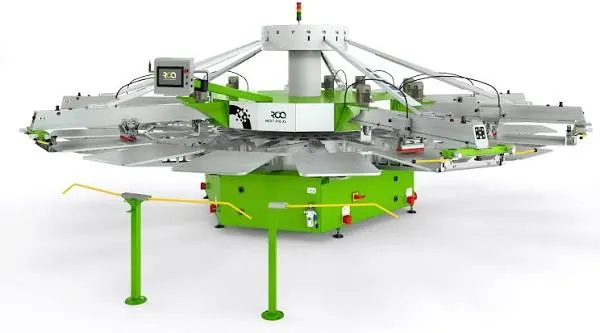
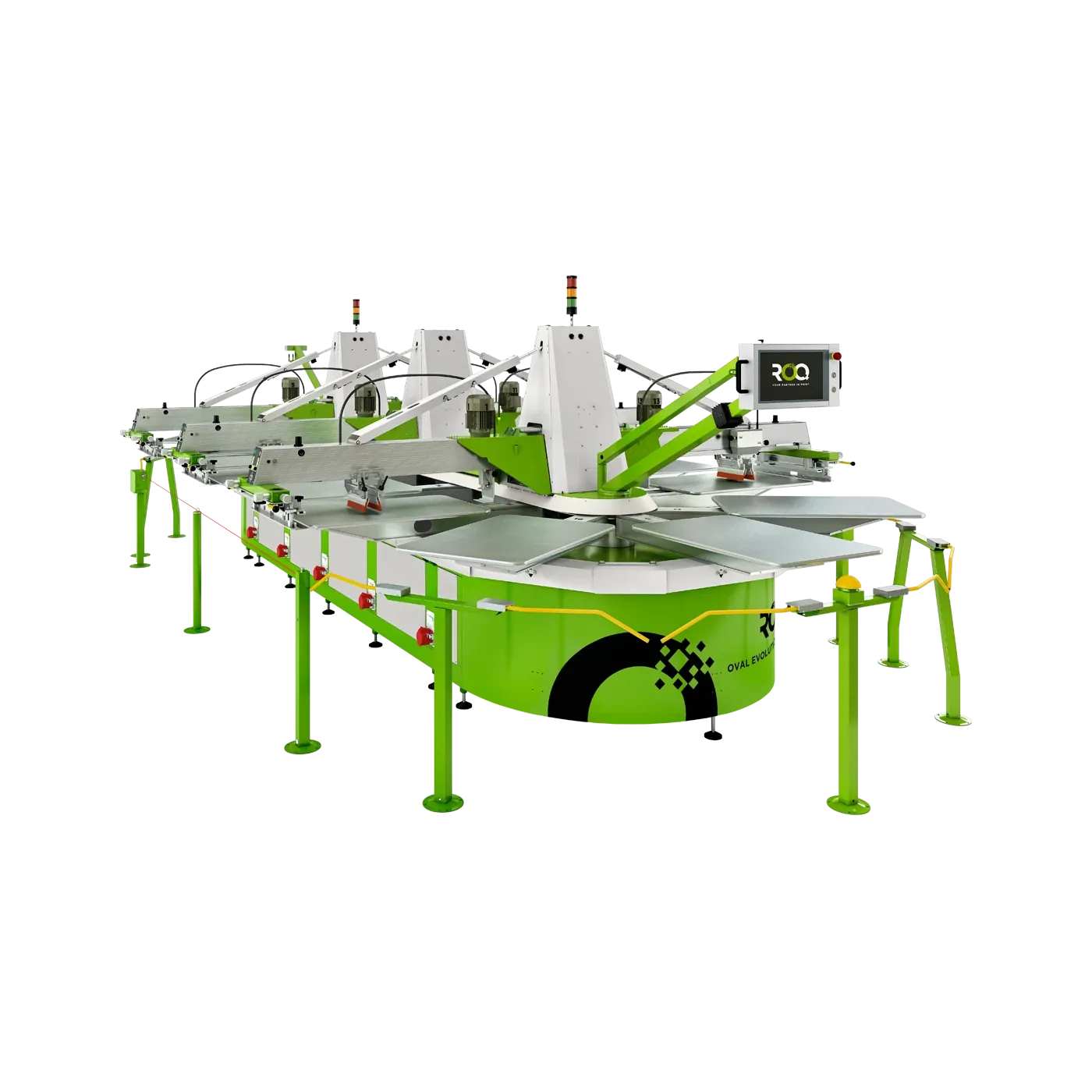
Textile printing is traditionally an energy-intensive process, especially when it comes to drying and curing inks, and powering the presses. Replacing old, pneumatically driven screen printing machines with modern, fully servo-driven presses (such as the latest ROQ models) can have a massive impact. Air compressors are notorious power hogs and cause significant energy loss due to pipe leaks. A servo-driven system uses only a fraction of the electricity while offering far greater precision, which in turn leads to fewer misprints.
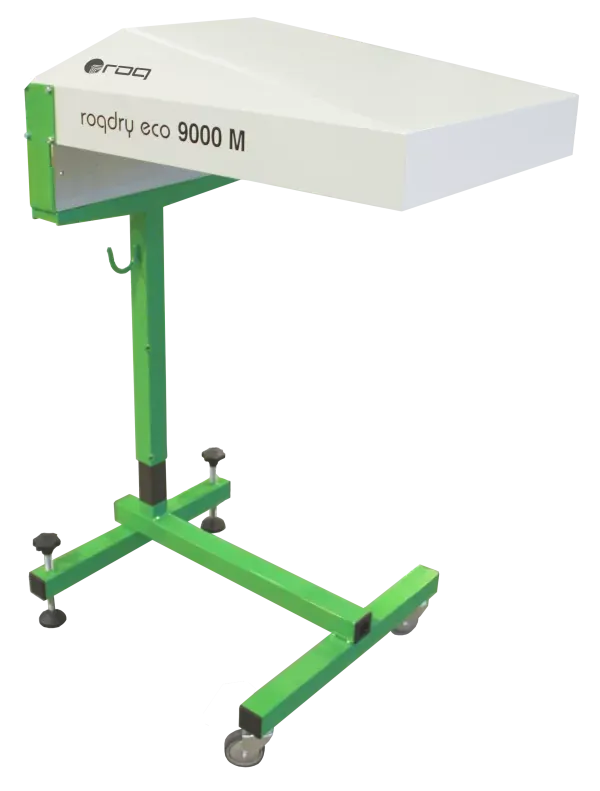
Furthermore, we are seeing the rise of smart flash cures. Where older flash units were often left on continuously—consuming vast amounts of power and making the workshop unbearably hot—modern systems use sensors. These flash cures only activate their quartz lamps in the millisecond a pallet stops underneath them, divided into independent zones matching the design size. The savings on the electricity bill can run into thousands of euros per year.
Computer-To-Screen (CTS) and Prepress Digitalization
One of the biggest leaps a textile print shop can make in terms of sustainability is in the darkroom or prepress department. The traditional screen exposure method requires film positives (plastic), developers (chemicals), and vast amounts of water.
By switching to a Computer-To-Screen (CTS) system, like the ROQ CTS, you completely eliminate the need for plastic films and their associated chemical developer baths. The design is printed directly onto the coated screen using UV-blocking ink or wax, and then exposed by a built-in LED unit.
This not only drastically reduces your print shop’s ecological footprint by cutting plastic and chemical waste, but the financial benefit is enormous. You save on purchasing expensive films, maintaining film printers, buying costly specialty ink for those printers, and paying for hazardous waste disposal. Moreover, prepress throughput speed increases spectacularly, lowering labor costs.
Water Management and Chemistry
Traditional solvents and screen cleaners contain high levels of VOCs (Volatile Organic Compounds), which are harmful to the environment and your employees’ health. Switching to biodegradable chemicals reduces health risks and wastewater treatment costs.
Increasingly, progressive Benelux print shops are also investing in automatic screen washing systems with closed-loop water circulation, where water is filtered and reused. This cuts water consumption by over 80%, providing significant structural savings given the rising rates for tap water and wastewater taxes.
3. The External ROI: Access to Premium Markets and Fashion Brands
Beyond cost savings, sustainability drives a significant increase in revenue. The market for fashion brands and corporate wear in the Benelux is undergoing a fundamental shift. Driven by consumer demands and new European legislation (such as the CSRD - Corporate Sustainability Reporting Directive), large apparel brands and B2B organizations are being forced to guarantee transparency and sustainability throughout their entire supply chain.
This means that when outsourcing their textile printing, they impose strict CSR (Corporate Social Responsibility) requirements. A screen printer operating with outdated, polluting technologies or harmful chemicals simply won’t pass the pre-qualification phase for these major brands.
By positioning yourself as a sustainable partner, you open the door to premium client segments. These clients—think high-end streetwear labels, large event organizers with a ‘green’ image, and multinationals seeking sustainable workwear for their staff—are not looking for the absolute rock-bottom price. They are looking for a partner who can safeguard their brand’s ecological integrity. As a result, you become less dependent on the hyper-competitive bottom end of the market and can maintain healthier margins. The willingness to pay for demonstrable eco-friendly textile printing is significantly higher in these segments.
4. The Value of Certifications (GOTS and Oeko-Tex)
A crucial tool for capitalizing on this external ROI is obtaining certifications such as GOTS (Global Organic Textile Standard) and Oeko-Tex Standard 100. Achieving these certifications requires an investment in time, administration, and adjustments to your production processes. It forces the print shop to meticulously map out exactly which inks, chemicals, and garments are being used.
The ROI of GOTS certification in the Benelux market is often achieved within one to two years. Once a print shop is officially GOTS certified, it joins an exclusive group of facilities legally allowed to release certified organic apparel onto the market labeled as “GOTS.” This creates a unique competitive advantage (USP). Fashion brands sourcing organic cotton must have their garments printed by a GOTS-certified facility; otherwise, the final product loses its GOTS status. Because there are still relatively few fully certified screen printers in the Benelux, this gives you immense pricing power and guarantees a steady stream of orders from quality-conscious brands.
5. ROI Calculations in Practice: Hard Numbers
Let’s translate sustainability into concrete figures using two common investment decisions.
Case 1: The ROQ CTS Exposure Unit
Suppose a mid-sized textile print shop in the Netherlands invests €45,000 in an advanced ROQ Computer-To-Screen system to eliminate the use of environmentally harmful plastic film positives and developing chemicals.
- Traditional system costs: An A3 plastic film positive, including special ink, easily costs €1.00 to €1.50. Add in the chemistry, development time, masking pinholes caused by dust, and human error (misregistration), and a conservative estimate is €2.00 per screen.
- CTS system costs: Virtually no consumables, aside from a minimal amount of UV-block ink, estimated at €0.10 per screen.
- Savings: €1.90 per exposed screen.
If this print shop exposes an average of 60 screens per day, the direct savings on materials equal €114 per day. Over 250 working days a year, that translates to a cost saving of €28,500 annually. This calculation demonstrates that the machine pays for itself in just over 1.5 years (around 19 months) purely on material savings. And this does not even account for the massive labor savings (faster press setup due to perfect registration). What began as a sustainable initiative—reducing plastic and chemistry—turns out to be the smartest financial move for the prepress department.
Case 2: Investing in an Energy-Efficient Drying Tunnel
An older gas-fired or poorly insulated electric drying tunnel loses a massive amount of heat to its surroundings and often runs at full blast even when no shirts are passing through. A modern tunnel with advanced insulation and efficient air circulation requires a substantial initial investment but can reduce energy consumption by up to 30% to 40%. With an annual dryer energy bill of, for instance, €15,000, a more efficient machine immediately saves you €4,500 to €6,000 per year. Over a lifespan of 10 years or more, these savings accumulate to amounts that largely or entirely pay for the machine.
6. Automation as a Catalyst for Ecological Printing
It is often forgotten that automation and sustainability go hand in hand. After all, the core of sustainable production is eliminating waste. In a screen print shop, human errors lead to misprints, meaning the garment—which already consumed liters of water, kilos of cotton, and hours of labor and transport—ends up as waste or a ‘second’.
By investing in automated, highly precise screen printing presses, automatic ink mixing systems, and digital workflow software, the margin of error is minimized. An automated ink mixing system guarantees that exactly the required amount of ink is prepared for a run, rather than an operator mixing “a kilo too much by eye,” which ends up in the trash six months later. Less ink and textile waste means lower disposal costs and a higher yield per order.
7. Best Practices for Textile Printers in the Benelux
Do you want to make the shift to more sustainable production with a demonstrable ROI? Follow these best practices:
- Start with the low-hanging fruit: Digitalize your prepress. The move to Computer-To-Screen makes the most financial sense and offers immediate benefits in reducing plastic and chemicals.
- Opt for GOTS-certified consumables: Even if your facility does not yet hold full GOTS certification, switching to eco-friendly inks and cleaners is a perfect selling point for your customers.
- Analyze your energy consumption: Measure the actual energy draw of your drying tunnel, flash cures, and compressor. Often, replacing the oldest machine is the fastest route to lowering your fixed costs.
- Train your team: Sustainability sometimes requires a different approach on the shop floor. Ensure your operators know how to set up efficiently, handle water-based inks properly, and separate waste.
- Communicate transparently: Let your customers know what steps you are taking. Many Benelux brands are eager to source locally and sustainably; make sure they can find you as their premier eco-responsible partner.
Conclusion
The days when sustainability was viewed purely as a form of charity or an unwanted expense are definitively over. In today’s Benelux textile printing market, ecological production has evolved into a rock-solid revenue model. The Return on Investment is crystal clear: by lowering operational costs (such as energy, water, chemistry, and waste) while simultaneously increasing efficiency and quality, you build a more robust business.
Furthermore, the transition to eco-friendly printing, supported by certifications and smart automation, hands you the keys to the lucrative segment of branded fashion and corporate wear, where quality and CSR standards take center stage. Those who invest now in sustainable textile printing technologies, like CTS systems and energy-efficient equipment, are securing rapid payback times and building a future-proof, highly profitable enterprise.
Want to learn more about these screen printing solutions?
Explore the technical specifications of ROQ CTS and ROQ PRU or contact the specialists at Dimix.Screen for tailored advice or a live demonstration.
Featured & related machines
Discover the industrial systems and solutions related to this topic:
ROQ PRU
Positive Pattern Registration Unit reducing press setup and make-ready times by up to 80%.
ROQ CTS
Direct-to-screen high-resolution UV-LED exposure unit for film-free prepress workflows.
ROQ IMPRESS
Automatic rotary carousel heat press for DTF, vinyl, and screen-printed transfer application.