The global textile industry is rapidly accelerating towards sustainability. Fashion brands, B2B clients, and governments are increasingly demanding transparency regarding the chemicals used, energy consumption, and the ecological footprint of their garments. For screen printing businesses, adopting sustainable practices is no longer just a luxurious marketing tool, but a strategic and operational necessity to remain future-proof. With increasingly strict environmental legislation concerning wastewater, emissions, and chemical usage (such as REACH), printing companies must adapt now to remain competitive and compliant in five to ten years.
But how exactly do you build an ecological print shop without compromising on quality, speed, or profitability? The answer lies in a holistic approach where technology, process optimization, and material selection go hand in hand. In this article, we dive deep into the technical and financial aspects of setting up a future-proof, sustainable screen printing operation.
The Transitional Shift: From Plastisol to Water-Based Inks
The most significant, and often most discussed, step towards an ecological screen printing shop is the transition from traditional plastisol inks to water-based (High Solid) acrylic or polyurethane inks.
Why Plastisol has Reached its Limits Plastisol inks have been the standard for decades due to their ease of use: they do not dry in the screen (they only cure when heated to approximately 160°C) and offer high opacity. However, plastisol contains PVC (polyvinyl chloride) and phthalates (plasticizers). These substances are not only burdensome to the environment during production and waste disposal but can also pose health risks upon exposure. Although “phthalate-free” plastisols exist, the base components remain dependent on fossil fuels and plastics.
The Water-Based Alternative: Quality and Environment Water-based inks (W/B inks) are the ecological standard. Instead of laying a layer of plastic on the fabric, these inks penetrate the fibers of the textile or bind to them with minimal layer thickness. This results in an extremely soft “hand feel” (the print does not feel like a heavy layer) and allows the garment to remain breathable.
Technical Best Practice for Water-Based Printing:
- Climate Control: Because water-based inks air dry, humidity in your print shop is crucial. A humidity level of 50-60% prevents the ink from drying too quickly in the mesh of the screen (commonly referred to as “choking” or “drying in”).
- Mesh and Tension: Use high-quality, well-tensioned meshes (often slightly finer than for plastisol, depending on the ink, think 43T to 90T for coverage colors) with an excellent open area for optimal ink flow.
- Printing Technique: With W/B inks, you must apply the “flood stroke” (filling the screen with ink) carefully to prevent drying out during short production pauses.
Energy Efficiency: Saving Power through Smart Machinery
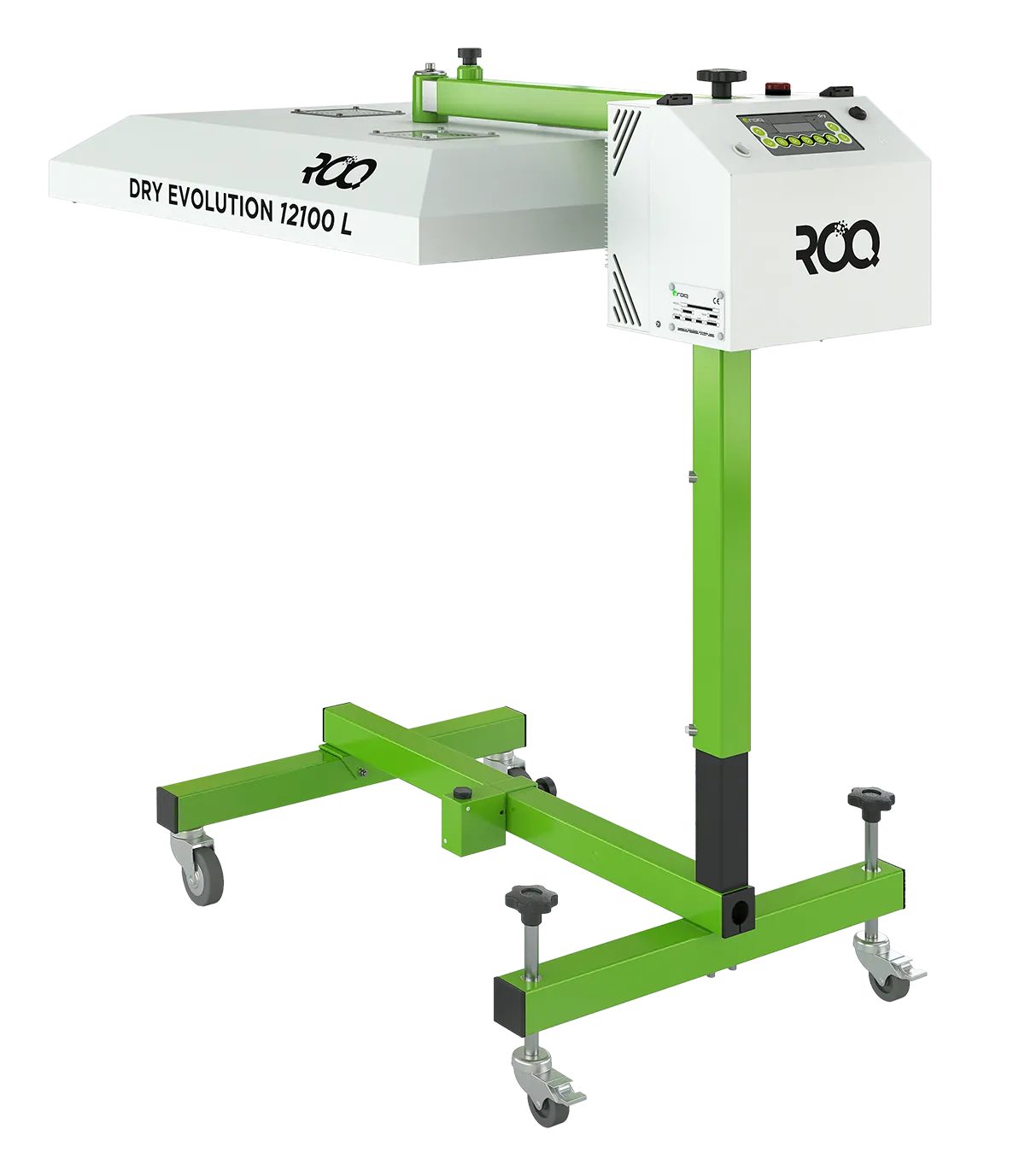
Industrial presses, flash units (intermediate dryers), and drying tunnels have traditionally been massive power consumers. An average drying tunnel with electric heating can consume tens of kilowatts per hour. Optimizing energy efficiency therefore directly yields significant cost savings while reducing your carbon footprint.
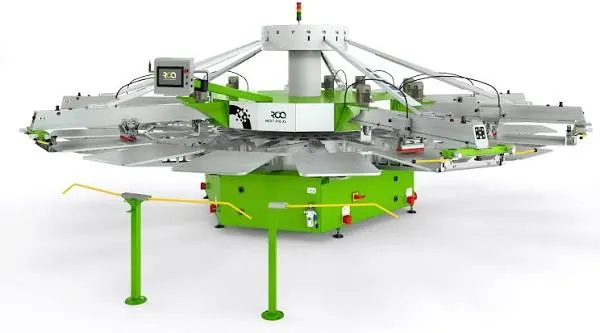
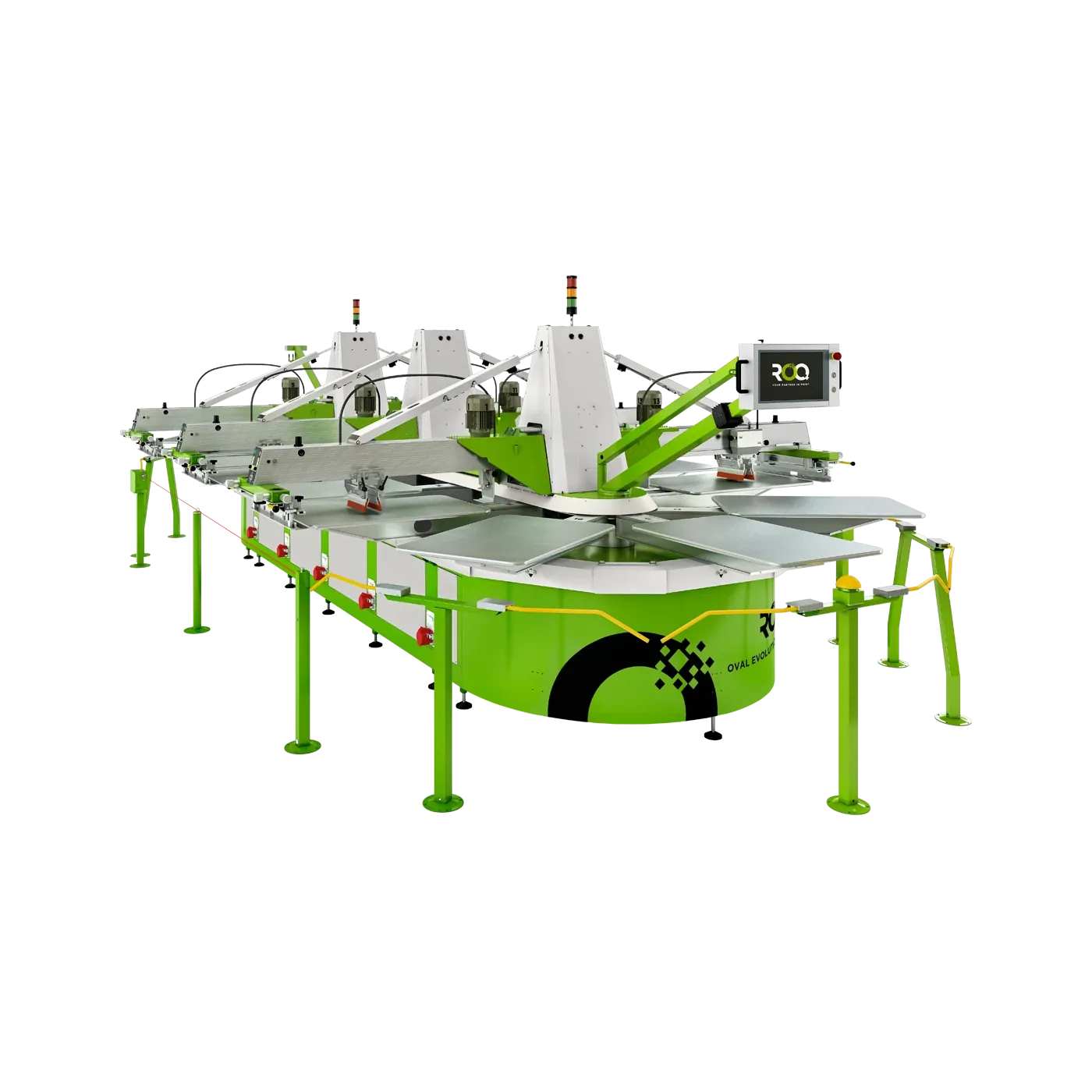
Electric vs. Pneumatic Drive Many older automatic screen printing presses are driven by compressed air compressors. Compressors are notorious for their poor energy efficiency, air leaks, and high maintenance costs. By investing in modern presses with AC servo motors – or even better, fully electric presses like the ROQ E – you eliminate the need for heavy compressors. Servo motors only consume electricity when they are actually moving and offer a much smoother, more precise indexing motion. This reduces wear and tear and increases registration precision, leading to fewer misprints.
Intelligent Flash Curing Flash curing colors requires a tremendous amount of energy. Modern flash cure units utilize quartz lamps combined with optical or thermal sensors. These sensors detect whether a pallet carrying a garment is positioned beneath the dryer. If not, the flash goes into standby mode or turns off completely. This prevents the lamps from producing unnecessary heat (and thus wasting energy) while keeping your production area cooler.
ROI Example: Suppose your old pneumatic press and constant-on flash units consume 50,000 kWh per year (at €0.25 per kWh = €12,500). A modern electric press with intelligent quartz flashes easily saves 40-50% in electricity. That equates to an annual saving of around €5,000 to €6,000, purely on power. Over a 10-year lifespan, the energy savings more than pay back the extra cost of the modern technology.
Prepress Optimization and Chemical Waste Management
The prepress department – where screens are coated, exposed, washed out, and later reclaimed – has historically been a major source of chemical waste, water usage, and plastic consumption.
Filmless Exposure: Computer-to-Screen (CTS) In a traditional workflow, every color channel of a design must be printed onto transparent plastic film (positive) using inkjet or laser printers, resulting in significant ink and plastic use. After single-use, these films end up in the trash. With the transition to Computer-to-Screen (CTS) technology, such as the ROQ CTS, this process is obsolete. The digital file is printed or exposed directly onto the emulsion-coated screen (via UV-LED or DLP technology).
The benefits of CTS:
- No plastic waste: You save hundreds of meters of plastic film each month.
- Faster turnaround times: Setting up the press is lightning-fast (using pin-registration systems), which minimizes downtime.
- Fewer failures: Digital exposure is razor-sharp and suffers no issues from film shrinking, shifting, or attracting dust, resulting in less waste from having to re-expose screens.
ROI Example: A mid-sized print shop printing 2,000 films a month easily spends €800 to €1,000 on films and toner/ink. The investment in a CTS machine pays for itself through material savings, and particularly through hours gained in prepress and shorter set-up times at the press, typically within 12 to 24 months.
Water Purification and Closed Systems Washing and degreasing screens releases emulsion residues, ink pigments, and cleaning chemicals. From an ecological (and legal) standpoint, it is critical not to let this run untreated into the sewer. Invest in stainless steel washout booths with built-in filtration and sedimentation systems. Advanced systems filter the ink and emulsion from the water and pump the purified water back into the system. This reduces water consumption by an impressive 80% to 90% and ensures no harmful microplastics or heavy metals are discharged.
Process Optimization: Reducing the Scrap Rate
Every ruined t-shirt (a “reject” or scrap) has already undergone a long ecological journey: growing organic cotton, spinning, weaving, dyeing, and transporting. If a t-shirt is ruined in your print shop due to a misprint, the ecological footprint of all those preceding steps is wasted. A crucial element of a sustainable print shop is therefore simply quality control and error reduction.
Tips for reducing rejects:
- Automate and Standardize: By saving color profiles, ink recipes, and machine settings in your software, you prevent human error on repeat orders.
- Use Laser Systems for Alignment: Equipping pallets with projection lasers ensures garments are loaded perfectly centered. This minimizes skewed prints.
- Invest in Training: The transition to eco-friendly processes (like water-based inks) requires knowledge. Continuously train your staff, as they are the most critical link in maintaining quality and reducing waste.
Building a Green Business Model
Sustainability is not just a cost-saving or ethical initiative; it is a powerful pillar for your commercial strategy. Once your print shop is operationally ecological, it is time to communicate this to the outside world and leverage it financially.
Certifications as Proof Consumers and B2B clients are increasingly seeing through ‘greenwashing’. To substantiate your claims, you can strive for reputable certifications. Look for ink suppliers and consumables that meet standards such as:
- GOTS (Global Organic Textile Standard): The strictest standard for ecological textile processing.
- OEKO-TEX Standard 100 & ECO PASSPORT: Proves that textiles and inks contain no harmful substances.
- Bluesign: Focuses on a responsible and sustainable textile supply chain.
By operating according to these guidelines yourself (e.g., using GOTS-certified inks), you can position yourself in the premium segment of the market. Fashion brands gladly pay a premium for printers who can guarantee safe, eco-friendly production.
Transparency as a Selling Point Turn your investments in sustainability into a Unique Selling Proposition (USP). Invite clients into your print shop and show them the closed-loop water recycling system. Explain why your CTS system is better for the environment. Through this transparency, you build long-lasting relationships with sustainable clothing brands that cannot find a home anywhere else in the traditional printing market.
Conclusion
Transforming a conventional textile print shop into a future-proof, ecological enterprise does not happen overnight. It requires a willingness to invest and a critical eye on every aspect of production. The transition from plastisol to water-based inks, eliminating plastic films through CTS, drastically lowering energy consumption with electric presses, and closing the water loop in prepress all form the cornerstones of this evolution.
These choices pay for themselves. Lower energy consumption, less waste, reduced ink wastage, and faster set-ups result in lower operational costs. Couple this with a growing market of eco-conscious clients willing to pay a fair price for ecologically produced textiles, and your screen printing business is not only good for the planet but exceptionally healthy for your bottom line. The future of textile printing is undeniably green; the choice is yours whether to lead this revolution.
Want to learn more about these screen printing solutions?
Explore the technical specifications of ROQ CTS and ROQ PRU or contact the specialists at Dimix.Screen for tailored advice or a live demonstration.
Featured & related machines
Discover the industrial systems and solutions related to this topic:
ROQ PRU
Positive Pattern Registration Unit reducing press setup and make-ready times by up to 80%.
ROQ E
100% electric automatic screen printing carousel with whisper-quiet operation and low energy consumption.
ROQ CTS
Direct-to-screen high-resolution UV-LED exposure unit for film-free prepress workflows.