When you decide to purchase a new heat transfer press for your textile printing business, whether you are a startup or an established production facility looking to scale, you inevitably face a crucial choice: do you opt for a manual or a pneumatic transfer press? Both systems have their own specific advantages, technical characteristics, and ideal application areas. The choice you make has a direct impact on your daily production capacity, the quality of your prints, the ergonomics for your operators, and ultimately your Return on Investment (ROI).
Drucktech offers a wide range of high-quality presses in both categories, each equipped with their renowned membrane technology. In this highly comprehensive article, we dive deep into the technical differences, operational pros and cons, financial considerations, and best practices so that you can make an informed and professional choice for your textile printing shop.
The Holy Trinity of Textile Printing: Time, Temperature, and Pressure
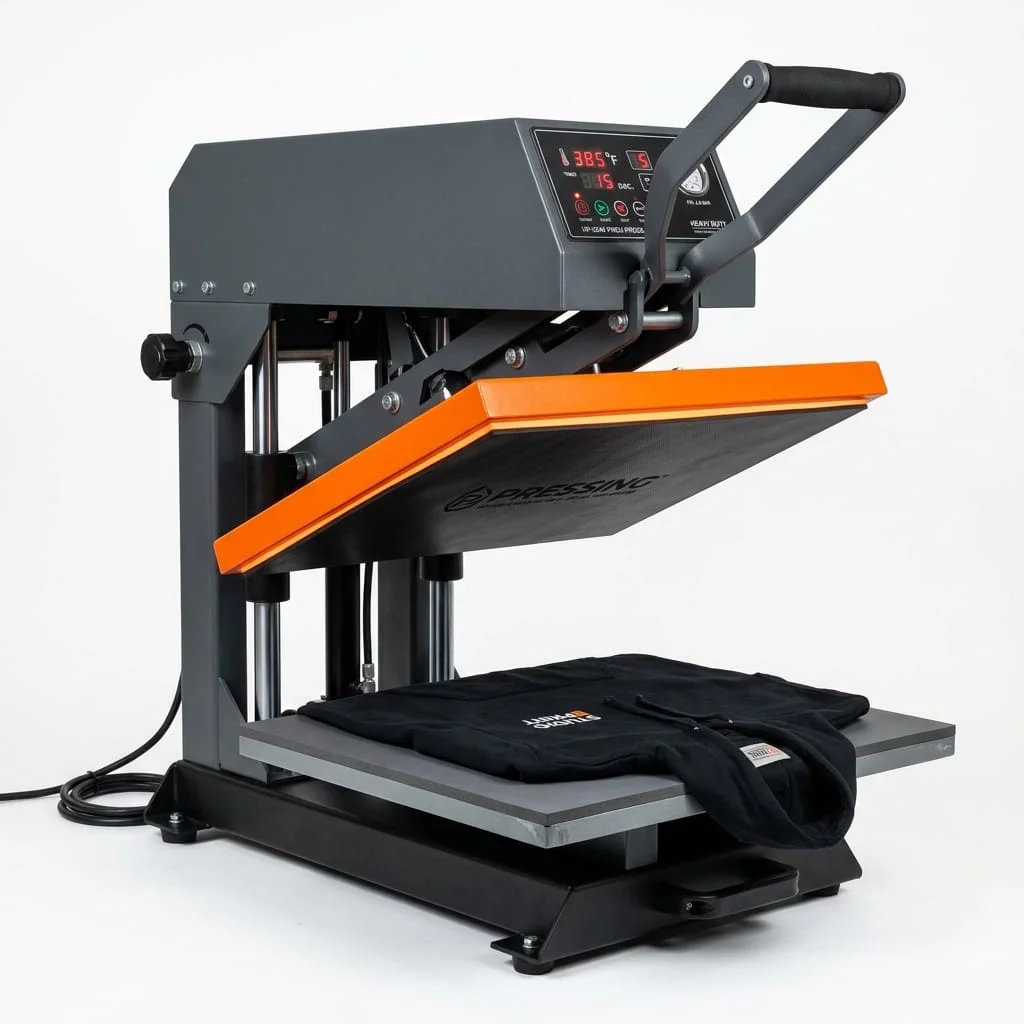
Before analyzing the specific machine types, it is essential to understand what makes a successful transfer. Any form of textile printing—whether it is Direct-to-Film (DTF), sublimation, flex foil, flock, or screen print transfers—relies on three critical variables: Time, Temperature, and Pressure.
While time and temperature are relatively easy to control electronically on modern machines, pressure is often the variable where the greatest differences in quality arise. Inconsistent pressure distribution leads to transfers peeling off after a few washes, color variations, or damaged fabrics. It is exactly in the way this pressure is generated, managed, and applied where manual and pneumatic presses differ the most.
Manual Membrane Heat Presses: Control and Flexibility
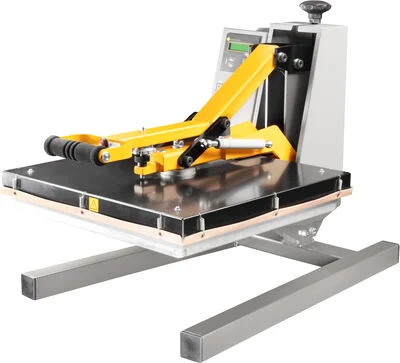
With manual presses, the pressure is built up mechanically by manually closing the press using a lever system. Historically, this required significant physical strength, especially when pressing thicker materials. However, Drucktech has highly optimized this process through the implementation of their revolutionary membrane technology combined with the ‘Etalon’ framework.
Technical Features and Advantages
- Optimized Leverage: Modern manual presses from Drucktech are designed so that closing the press requires significantly less force than traditional brands. The lever mechanism provides a mechanical advantage, making the closure smooth and controlled.
- Auto-Release Functionality: An absolute ‘game-changer’ for manual presses is the auto-release or electromagnetic closure system. While the press is closed manually, it is held in place by an electromagnet. As soon as the set timer expires, the press opens automatically. This prevents the fabric from overheating or burning if the operator is momentarily distracted, which vastly increases reliability.
- Plug-and-Play Installation: Manual presses only require a standard power connection. No complex pneumatic hoses or external compressors are needed. This makes them highly mobile and ideal for use in retail stores, at events, or in areas with limited space.
- Maintenance-Friendly: With fewer moving parts and the absence of pneumatic cylinders and valves, manual presses require minimal maintenance. Regular lubrication of the pivot points is often sufficient for years of trouble-free use.
- Surface Pressure: Despite being manual, the Drucktech models achieve an impressive surface pressure of 0.8 to 1 kg/cm², which is more than enough for standard flex, flock, and most DTF applications.
The Limitations of Manual
Although manual presses are robust and reliable, they do have limitations. When dealing with large print runs (hundreds of pieces per day), operator fatigue inevitably sets in. The repetitive action of opening and closing the press over several hours can lead to RSI (Repetitive Strain Injury) or reduced concentration, which slows down overall efficiency.
Pneumatic and Semi-Automatic Presses: Maximum Power and Efficiency
For serious production environments, or when avoiding repetitive heavy physical strain on employees is a top priority, pneumatic transfer presses are the industry standard. These machines use compressed air—supplied by an external compressor—to drive the heating plate.
Technical Superiority
- Unmatched and Consistent Pressure: Pneumatic presses can generate a much higher surface pressure, which remains 100% constant regardless of the material’s thickness. Where an operator using a manual press physically feels the counter-pressure when pressing thicker garments like hoodies, the pneumatic cylinder compensates for this effortlessly and automatically.
- Full Automation and Ease of Use: Pressing is literally just a push of a button (or a dual-button operation for safety reasons). The machine closes softly, immediately builds up the correct pressure, and opens automatically. Physical exertion is reduced to zero.
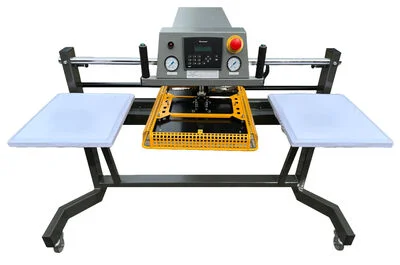
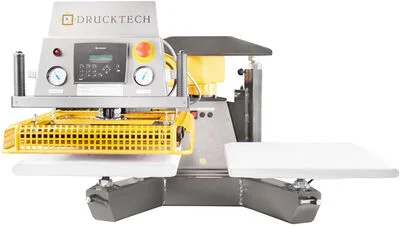
- Dual Workstations: Many pneumatic presses, such as the renowned PHP-45V2 series from Drucktech, are equipped with multiple lower plates. While a shirt is being pressed on one station, the operator can already position the next shirt on the second station. The press head moves horizontally (often automatically) between the stations. This eliminates the “dead time” when the press is closed and can increase production capacity by 80% to 100%.
- Laser Alignment and Precision: Many high-end pneumatic setups are combined with laser systems for the perfect alignment of logos, ensuring the quality and consistency of large batches.
Requirements and Considerations
A pneumatic press requires a reliable external compressor, such as the whisper-quiet MGF compressors or robust Metabo models. A silent compressor is highly recommended if it is located in the same room as the press, to prevent hearing damage or irritation. This does mean that the initial investment is higher, and you must account for extra piping and maintenance (such as regularly draining condensation water from the compressor).
Ergonomics and Working Conditions
In the modern textile printing industry, ergonomics is a top priority. Absenteeism due to physical strain can severely impact a small business.
When an operator stands at a manual press for 8 hours a day, pressing 400 shirts, that person is performing a significant amount of physical labor. As the day progresses, fatigue sets in, the positioning of the textiles becomes sloppier, and the cycle time per shirt increases.
A pneumatic press transforms this heavy physical task into a light assembly task. The operator can focus 100% on the accurate positioning of the transfers and quality control without becoming exhausted. This demonstrably leads to fewer production errors, less waste, and happier, healthier employees.
ROI Calculations: Which is the best financial choice?
Let’s do a simplified Return on Investment (ROI) calculation to illustrate the financial implications.
Suppose you are choosing between a manual press (€ 1,500) and a pneumatic dual-station press with a compressor (€ 5,500). The price difference is € 4,000.
Scenario: You have an order of 1,000 shirts.
- Manual press: The operator processes 50 shirts per hour (prep, positioning, pressing, cooling/peeling). Total time: 20 hours.
- Pneumatic dual-station press: The operator processes 100 shirts per hour (preparing on station A while station B is pressing). Total time: 10 hours.
Savings: 10 hours of labor. If we assume a modest hourly wage/cost of € 35 per hour, you save € 350 on this single order.
If you average this kind of volume improvement weekly, you will have recouped the € 4,000 price difference in less than three months. After that, the pneumatic press is pure profit generation. For businesses that primarily do single items or small print-on-demand orders where setup time is the biggest factor, this efficiency gap is much smaller, making the manual press more economically appealing.
Best Practices for Textile Printers
Regardless of the machine you choose, there are a few professional tips to ensure longevity and quality:
- Calibration: Check at least twice a year whether the displayed temperature matches the actual plate temperature using a calibrated infrared thermometer or contact probe.
- Silicone Pads: Replace the lower silicone pad on time. Over the years and after thousands of presses, it can harden or become uneven, resulting in cold spots or areas without pressure.
- Teflon Protection: Always use high-quality Teflon sheets or covers to protect both the heating plate and the textile from ink residue and scorching.
- Compressor Maintenance: For pneumatic systems: drain the moisture trap of the compressor weekly. Water inside the pneumatic cylinders can cause rust and expensive repairs.
Conclusion and Buying Advice
Choosing the right heat press is not a matter of ‘right’ or ‘wrong’, but of ‘does it fit my business model?’.
Choose manual if:
- You mainly process small to medium runs (up to 50-100 pieces per day).
- You are a start-up on a tight budget.
- You need mobility (events, markets, small retail spaces).
- You mainly press materials that do not require extremely high, industrial pressure.
Choose pneumatic (preferably with a dual station) if:
- You structurally process large volumes or experience seasonal peaks.
- You prioritize the well-being and ergonomics of your employees.
- You want to maximize the production output per hour worked.
- You work with complex transfers or stiff, thick materials that require consistent, heavy pressing force.
- You view your textile printing shop as a professional, scalable production line.
Compare Our Most Popular Drucktech Heat Presses
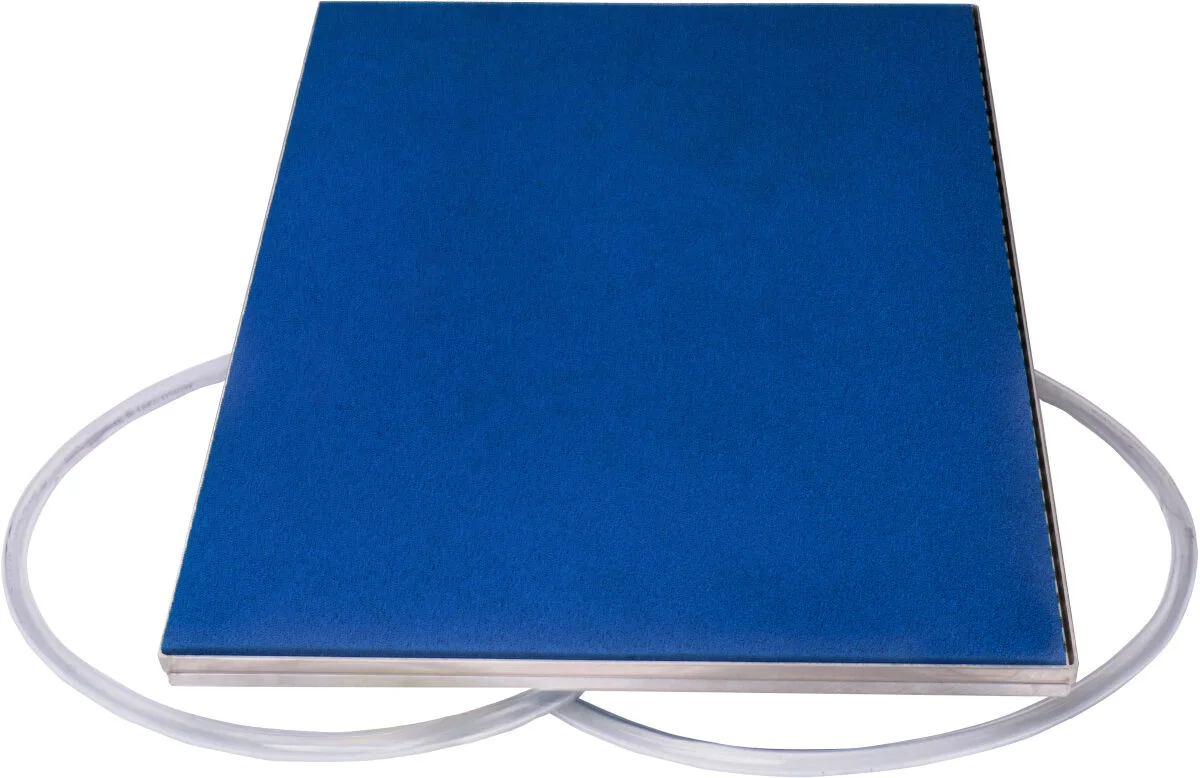
- Drucktech HP-45N (Manual Heat Press): Heavy-duty manual transfer press, compatible with the MM-1 Membrane Plate.
- Drucktech PHP-45 2N (Dual-Station Pneumatic Press): Double your hourly output with dual workstations and pneumatic pressure.
- Drucktech PHP-45 V2 Maxima: Flagship dual-station press with integrated active membrane plate.
- Explore all Drucktech Heat Presses or contact our specialists.
If you are still in doubt after reading this guide, or if you want to experience the presses yourself, do not hesitate to contact the Dimix experts. We can provide you with tailored advice, give demonstrations in our showroom, and help you integrate the perfect press into your workflow!
Featured & related machines
Discover the industrial systems and solutions related to this topic:
Drucktech HP-45N
Robust manual heat press for traditional flat transfer applications.
Drucktech SH-12NA
Manual traditional heat press for fast production with automatic opening.
Drucktech SH-12N
Manual traditional heat press for fast and versatile cap and flat textile printing.