Every textile printer, from the enthusiastic starter in a garage to the large-scale industrial producer, knows the frustration. You’ve printed or ordered a beautiful full-color logo, and you want to transfer it onto a premium polo shirt, a sturdy work jacket, or a comfortable zip-up hoodie. You place the garment under the heat press, close the press with the recommended pressure, and wait for the timer to go off. But then, when removing the carrier (the ‘peel’), you discover the doomsday scenario: the transfer hasn’t adhered properly around the seam. The added thickness of the buttons, the zipper, or the thick collar has prevented the heat plate from touching the transfer with equal pressure everywhere. The result? A transfer that lacks coverage, or worse, that peels off after a single wash. This leads to an unsatisfied customer, wasted materials, and valuable time gone up in smoke.
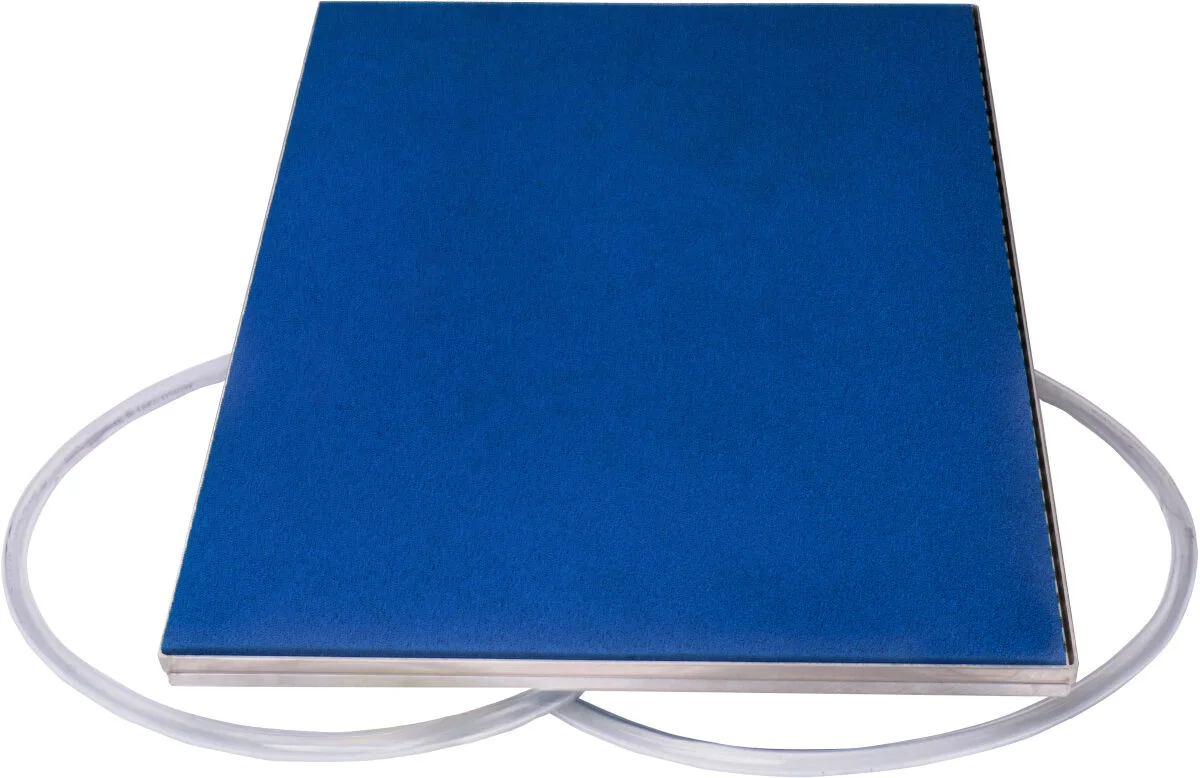
Drucktech, a pioneer in the world of heat presses, has developed and patented a brilliant and revolutionary solution for this universal and common problem: the membrane plate. In this extensive article, we dive deep into the technology behind this plate, discuss the undeniable advantages for your production process, and calculate how this innovation pays for itself in no time.
What exactly is a membrane plate?
To understand the membrane plate, we must first look at the status quo. The vast majority of heat presses on the market are equipped with a hard silicone mat or rubber pad on the bottom plate. This mat offers some resilience, but is essentially rigid. If you place a garment with a thickening (such as a zipper) on this flat, rigid surface and then press down an equally flat and rigid heat plate, the thickening creates a ‘bridge’. Around the zipper, the pressure will be extremely high, but right next to the zipper, the pressure drops away. As a result, in those lower areas, there is insufficient contact between the adhesive layer of the transfer, the textile, and the heat source.
Drucktech’s membrane plate completely breaks with this traditional concept. Instead of a solid piece of silicone, Drucktech uses a flexible membrane that acts as a kind of cushion. Depending on the specific press model, this robust membrane is filled with air or fluid. As soon as the heat plate comes down and exerts pressure on the textile, something magical happens: the membrane dynamically and flexibly shapes itself around the contours of the garment.
When a zipper, a V-neck seam, a thick collar, or a row of buttons is pressed into the membrane, the material yields in the areas where the thickening is. The air or fluid within the membrane shifts to the surrounding, thinner parts of the textile (where the pressure would normally drop off). The result is a hydraulic/pneumatic principle that ensures the counter-pressure over the entire surface — including right next to that thick zipper — is 100% even and constant.
The undeniable advantages in practice
The theoretical explanation sounds great, but what does this mean for you as a textile printer in daily practice on the shop floor? The benefits are multifaceted and immediately noticeable.
1. Absolute and perfect pressure distribution
As explained earlier, obstacles sink into the base plate. The pressure on the transfer itself, the area that really matters, remains equal everywhere. This guarantees that the hotmelt (the adhesive layer of the transfer) can optimally melt into the fibers of the textile, regardless of the surrounding bumps. The washability and lifespan of your print increase significantly as a result. No more arguments about peeling letters after a few washes!
2. Say goodbye to Teflon pillows and raising pads
Every printer has a drawer full of Teflon pillows, mouse pads, and custom-cut pieces of rubber to bypass problems. Precious minutes are lost exactly positioning a raising pad under the area to be printed, in an attempt to leave the zipper or collar outside the pressure zone. With a Drucktech press featuring a membrane plate, this is a thing of the past. You place the garment directly on the press, position the transfer, and close the press. This eliminates a frustrating and time-consuming step in your workflow, dramatically increasing your throughput speed.
3. Drastic reduction of misprints (wastage)
Every failed print costs you not only the transfer (which often costs several euros), but also the blank garment. A premium softshell jacket or a heavy hoodie can easily cost between €20 and €50 wholesale. A few misprints a week quickly add up to thousands of euros in wastage on an annual basis. Because the heat and pressure are always constant with a membrane plate, peeling corners or poorly covering transfers due to unevenness are a thing of the past. You can confidently work on the most challenging garments, knowing it will go right the first time.
Calculating the Return on Investment (ROI)
It is often thought that high-end presses with such patented technologies are exclusively reserved for multinationals with huge budgets. It’s true that a Drucktech press requires a higher initial investment than a cheap, unbranded press from the Far East. However, we shouldn’t look at the purchase price, but at the Total Cost of Ownership and the ROI.
Let’s do a sample calculation. Suppose you run a small print shop and print 500 items a week. Due to the hassle with seams and zippers on a traditional press, you have an error margin of 2% (10 garments a week). On average, a garment with a transfer costs you €15 in purchase value. That’s €150 in wastage per week. That is a whopping €7,800 per year, purely in wasted material. In addition, setting up and positioning raising pads costs you an average of 30 extra seconds per garment. On 500 items, that’s over 4 hours a week in lost production time. With an hourly rate of €40, that costs you another €8,320 annually.
By switching to a Drucktech membrane plate, you reduce that 2% error margin to virtually 0% and eliminate the 30 seconds of setup time per garment. A simple calculation shows that the savings on wastage and labor often fully recoup the investment in a new press within half a year. After that period, the press yields net profit in the form of saved time and materials.
Best practices and tips for optimal use
Although the membrane plate compensates for many errors, there are still some ‘best practices’ you should follow as a professional:
- Temperature Calibration: Due to its cushioning effect, the membrane can sometimes cause the textile to absorb slightly more heat than with a hard plate. Always check the adhesive layer after printing; if the texture of the garment is slightly visible in the transfer, you know the temperature and pressure have fused optimally.
- Position is Everything: Preferably place the zipper or the extremely thick seam at the edge of the plate if the print allows it. While the membrane fully absorbs the thickness, positioning towards the edges helps to ensure an even more homogeneous heat release in the center.
- Regular Maintenance: The membrane is highly durable, but it remains a flexible component. Make sure you do not scrape the plate with sharp objects (such as scissors, utility knives, or staples). An occasional puncture in an air-filled membrane can ruin its effectiveness, although they are fortunately easy to replace if necessary.
Availability in the Drucktech range
The beauty of Drucktech’s philosophy is that they do not keep this crucial technology exclusive to their most expensive, industrial flagships. The membrane plate has become a standard feature on many of their models.
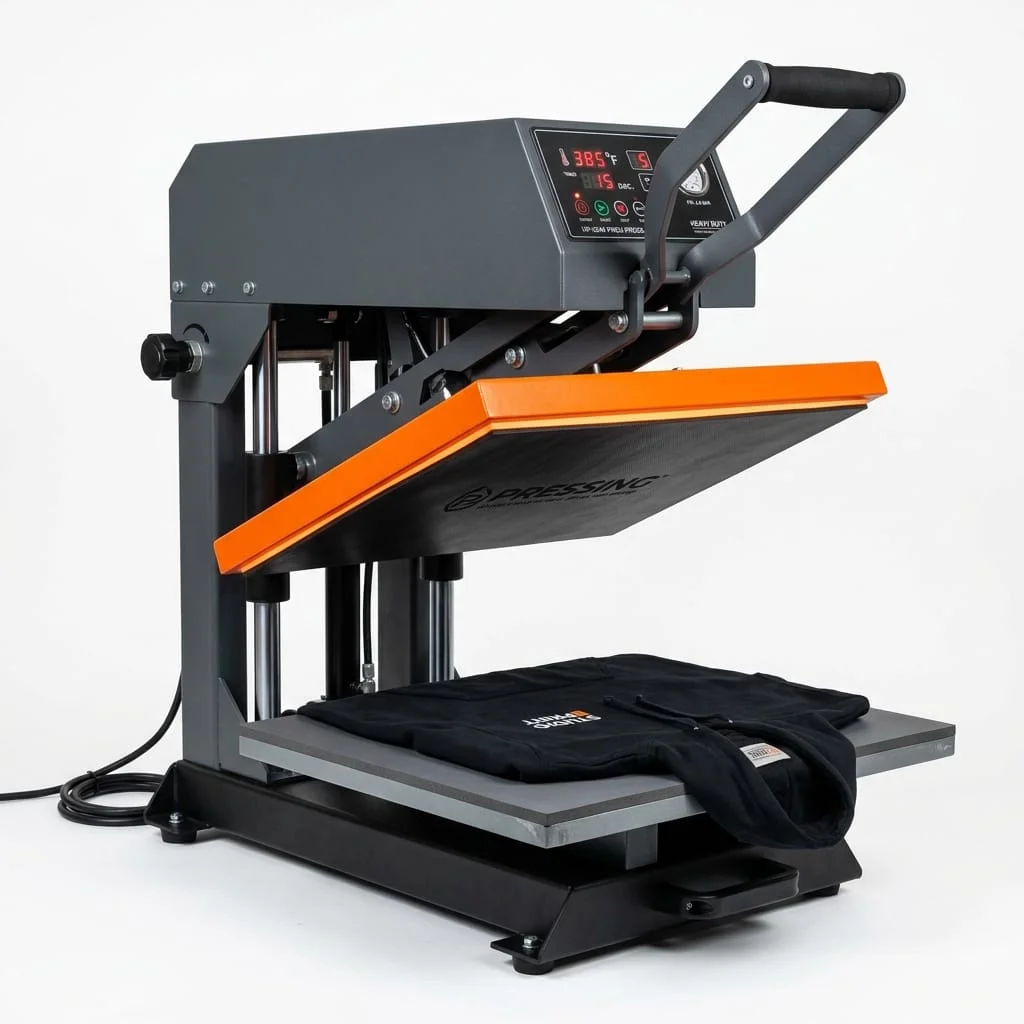
For the starting professional, there is the Drucktech SSH-1NA and SSH-2A, for example. These are manual presses, but thanks to the ingenious toggle lever construction, they require minimal force to close, while you still benefit from the membrane plate in the base. Perfect for smaller volumes or if you want to scale up to a higher quality end product.
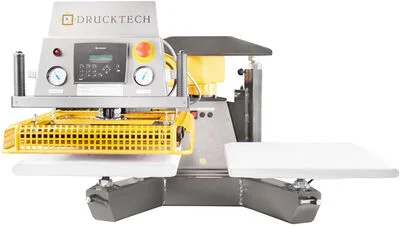
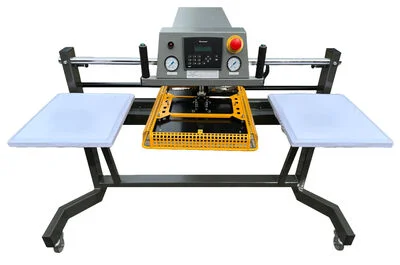
For production companies, there is the renowned Etalon series, such as the PHP-45-V2 Maxima or double-plate presses. These pneumatic presses take all the heavy lifting off your hands. With a simple press of a button or foot pedal, the press closes with amazingly constant and adjustable pressure. You prepare a jacket on one side while the other side is being pressed. The membrane plate guarantees flawless results even at high speeds, item after item.
Conclusion
In today’s textile industry, quality is the distinguishing factor. Customers expect their corporate clothing, sports kits, and merchandise to not only look good but also survive the wash, regardless of whether the print happens to be near a zipper. The Drucktech membrane plate gives the textile printer back control. No more makeshift solutions with pillows, no more stress over expensive softshells failing, but consistent, fast, and reliable production.
Would you like to see with your own eyes how this technology works and test it yourself on your own ‘difficult’ textile pieces? Then contact the Dimix.Screen team. We will gladly provide you with expert advice and cordially invite you for an extensive demonstration in our showroom! Experience the difference and take your textile printing to the next level.
Featured & related machines
Discover the industrial systems and solutions related to this topic:
Drucktech SSH-1NA
High-end manual cap heat press with membrane plate and auto-release.
Drucktech PHP-45V2A Optima
Automated pneumatic membrane heat press for ultimate pressure control and productivity.
Drucktech PHP-45-V2A Maxima
Automated pneumatic double workstation press with membrane plate for materials up to 6 cm.