The world of textile printing and transfer printing is constantly evolving. Novice textile printers almost always start with a manual heat press. These machines are relatively affordable, easy to use, and reliable for smaller jobs or hobbyist use. However, as the business grows, orders become larger, and volumes increase, many entrepreneurs hit the inevitable physical and logistical limits of manual pressing. It is physically demanding, unnecessarily time-consuming, and the chance of inconsistencies in print quality increases. This is the moment when an investment in a pneumatic heat press becomes not only desirable but even necessary for the further professionalization of your textile printing company.
1. What makes a pneumatic press fundamentally different?
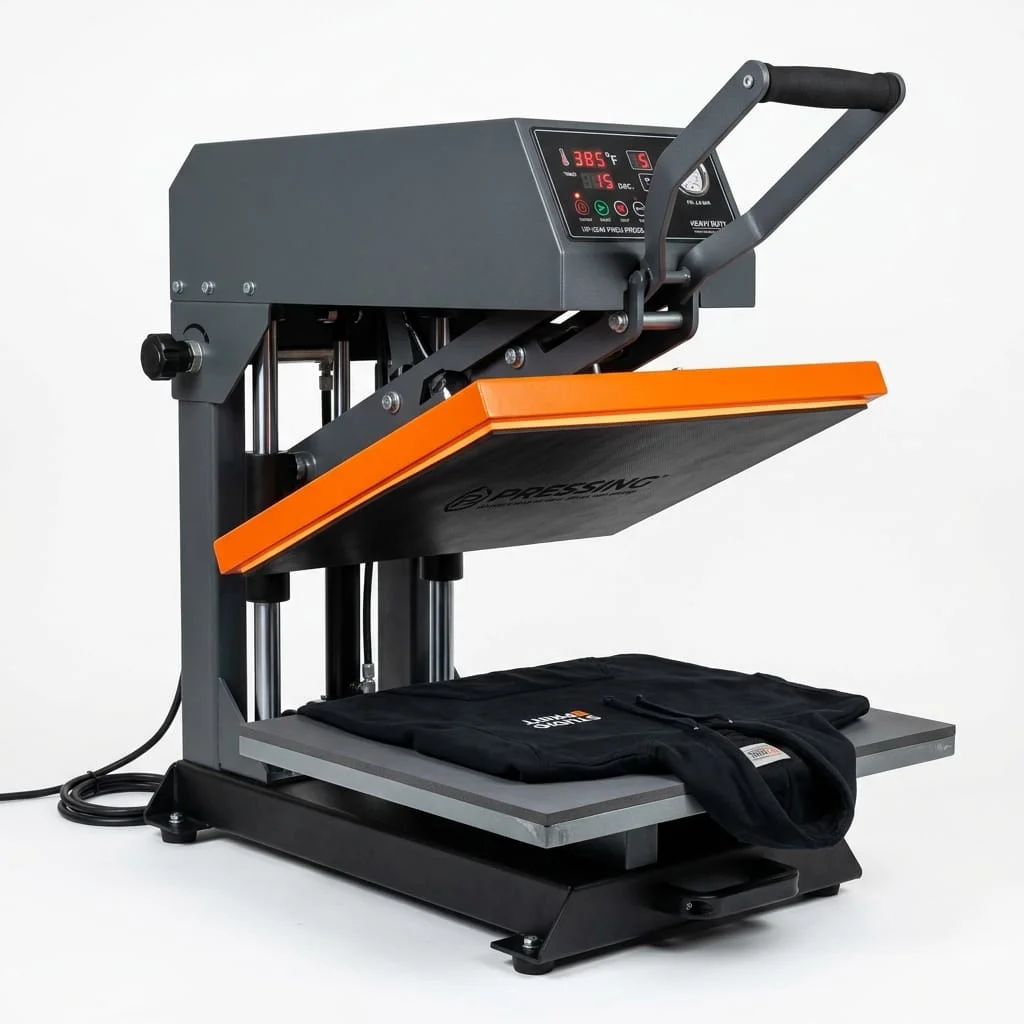
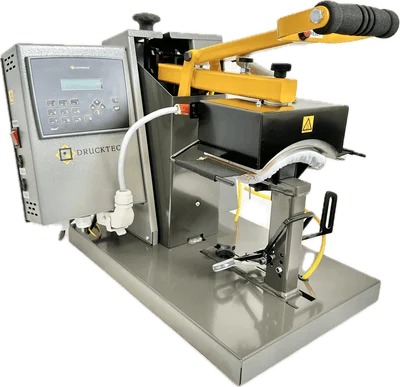
To understand why this upgrade is so crucial, we need to look at the technology behind it. A manual press works by using muscle power combined with a lever mechanism to push down and lock the heat platen. A pneumatic heat press, on the other hand, uses compressed air, supplied by an external or built-in compressor, to drive the pressing cylinder.
This compressed air delivers an enormous and highly controlled force. Instead of physically pulling a lever, the operator simply presses buttons, after which the pneumatic cylinder takes over the heavy lifting. This not only ensures comfort but also introduces a level of accuracy that is simply unmatched by hand. Where you set the pressure on a manual press by feeling a rotary knob, on a pneumatic press you set the exact air pressure (usually in Bar or PSI), visible on a display or pressure gauge.
2. Physical comfort, safety, and ergonomics
Manually closing and opening a transfer press requires considerable force, especially when printing thicker materials such as heavy hoodies, softshell jackets, or workwear. If your operators have to repeat this process hundreds of times a day, it inevitably leads to fatigue. In the worst case, this can even result in Repetitive Strain Injury (RSI) or other long-term physical complaints to shoulders, wrists, or back.
A pneumatic press operates on compressed air. With a simple, light press on two safety buttons (a mandatory safety mechanism that prevents hands from getting under the heat platen), the press closes automatically, and it opens by itself when the set time has elapsed. This makes the work significantly lighter, safer, and more enjoyable. An operator who feels less exhausted at the end of the workday is more productive, makes fewer mistakes, and has less chance of sick leave. Investing in ergonomics is therefore directly an investment in your staff and in the continuity of your business.
3. Constant and unmatched quality
With a manual press, the actual pressure applied partly depends on the operator and the manual adjustment. Moreover, this adjustment must be manually tweaked every time there is a switch between garments of different thicknesses (for example, from a thin T-shirt to a thick sweater). Human errors are always lurking here. Too light a pressure can result in a transfer peeling off after the first wash, while too high a pressure can damage the textile fibers or leave unwanted press marks in the fabric.
A pneumatic press offers an exactly adjustable, absolutely constant pressure. The air pressure is regulated and applied to the garment with the same precision every time. This means that the first shirt of the day is pressed with the exact same pressure as the thousandth shirt, regardless of who is operating the machine. The result is a significantly more reliable, uniform end product with no nasty surprises for your customers. In a market where quality and washability are the main distinguishing factors, this consistency is worth its weight in gold.
4. Dual workstation for double efficiency
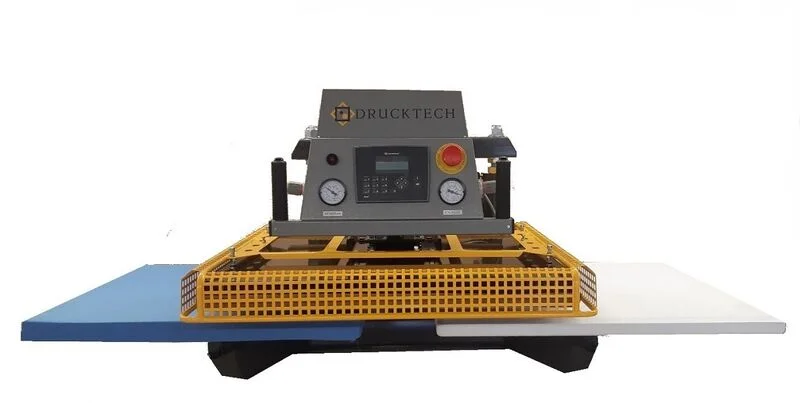
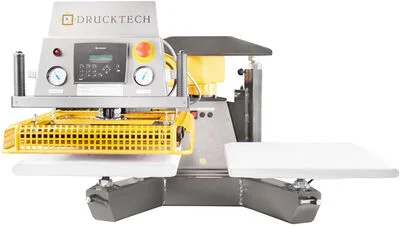
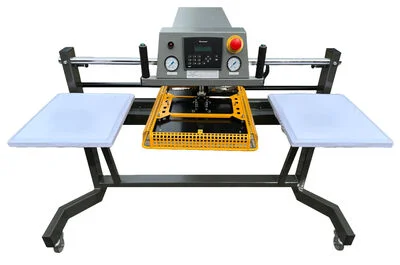
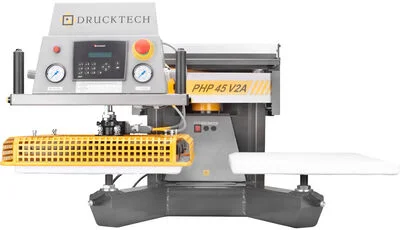
One of the biggest advantages of many professional pneumatic presses, such as the well-known Drucktech PHP-45-V2 Maxima or comparable models, is the addition of a dual workstation (also called a membrane press or shuttle press).
With a standard single-station press, a large part of the production cycle consists of waiting time. The press is closed, and your operator simply has to wait 15 to 20 seconds for the timer to finish. That doesn't sound long, but on an order of 500 pieces, this dead time adds up enormously.
The huge advantage of a dual workstation is that your operator practically never has to stand still anymore. The workflow changes drastically:
- While station 1 is actually pressing (the heating cycle), the operator is already pulling the next shirt tight on station 2.
- The operator carefully places and positions the transfer.
- As soon as station 1 automatically opens, the heat head smoothly moves (in many advanced models this happens with a foot pedal or even fully automatically) to station 2, after which the press cycle immediately starts again.
- The operator can now directly remove the finished shirt from station 1, peel it if necessary (hot peel or cold peel), and prepare the next shirt.
5. In-depth Return On Investment (ROI) Calculation
It is understandable that entrepreneurs hesitate about the purchase. A pneumatic transfer press is a significantly larger investment than an entry-level manual model. In addition, the machine also requires the purchase and installation of a (preferably silent) compressor and associated air lines. However, if you look at the savings in man-hours and the greatly increased output, the Return On Investment (ROI) is often surprisingly short.
Let's do a realistic calculation. Suppose you save an average of 15 seconds per garment due to the efficiency gain of a dual workstation and the automatic closing/opening. When you print an order of 400 garments, you save 400 x 15 seconds = 6000 seconds, or more than 1.5 hours of pure production time per job.
If your labor costs (including social charges and overhead) are, for example, €35 per hour, you save over €50 on that single order alone. If you extrapolate this to an annual production of, say, 20,000 garments, we are talking about a saving of more than 83 hours of work and almost €3,000 in direct labor costs. This amount often exceeds the price difference of the press compared to a manual model in the first year alone. Companies that press for hours every day sometimes recoup the total investment within six to nine months.
6. Best practices and tips for optimal use
When you make the transition to working pneumatically, there are a few things to keep in mind to get the most out of your equipment:
- Choosing the right compressor: Invest in a 'whisper-quiet' (low noise) compressor. Since it will be in or near your workspace all day, you want to keep the noise nuisance for you and your employees to an absolute minimum. Also ensure a sufficiently large pressure vessel (e.g., 50 liters) so that the motor does not have to kick in continuously.
- Air humidity and filters: Compressed air always contains a certain amount of condensation (water). To prevent this moisture from entering the cylinders or valves of your expensive press, it is crucial to install good moisture separators and oil filters (air preparation units) on the compressed air line. Also, drain the compressor regularly.
- Use teflon sheets or covers: Just like with manual presses, it is important to protect your heat platen. Use high-quality teflon sheets or pull a teflon cover tightly over the heat platen. This prevents ink or glue residue from baking in and extends the life of the equipment.
- Opt for a laser alignment system: To keep up with the high speed of the press, accurate positioning is essential. A cross laser or point laser mounted directly above the workstation helps operators place transfers perfectly straight at chest or back level in a fraction of a second.
Conclusion: Are you ready for the next step?
The transition from a manual press to a dual-station pneumatic heat press is one of the most impactful upgrades a textile printing business can make. Not only does it drastically improve the working conditions and health of your employees, but it also delivers consistently high quality and enables you to complete larger jobs in a much shorter turnaround time. The initial higher investment quickly pays for itself in saved labor costs and increased production capacity.
Has the demand for your personalized textiles, workwear, or sportswear increased recently? Do you feel that you are constantly short of time, or do your operators experience physical discomfort after long shifts? Then this is the right time to do the math for your own company. We at Dimix.Screen are happy to advise you on the right model, the necessary compressor, and the optimal layout of your workspace for maximum yield!
Want to learn more about these screen printing solutions?
Explore the technical specifications of Drucktech PHP-45 V2 Maxima and Drucktech PHP-45 2N or contact the specialists at Dimix.Screen for tailored advice or a live demonstration.
Featured & related machines
Discover the industrial systems and solutions related to this topic:
Drucktech PHP-45-V2 Maxima
Pneumatic double workstation heat press with membrane platen for materials up to 6 cm.
Drucktech SP-58A
Large 50x80 cm manual membrane heat press with auto-release for uniform pressure.
Drucktech SP-512A
Extra-large 50x120 cm manual membrane heat press for banners, flags, and sportswear.