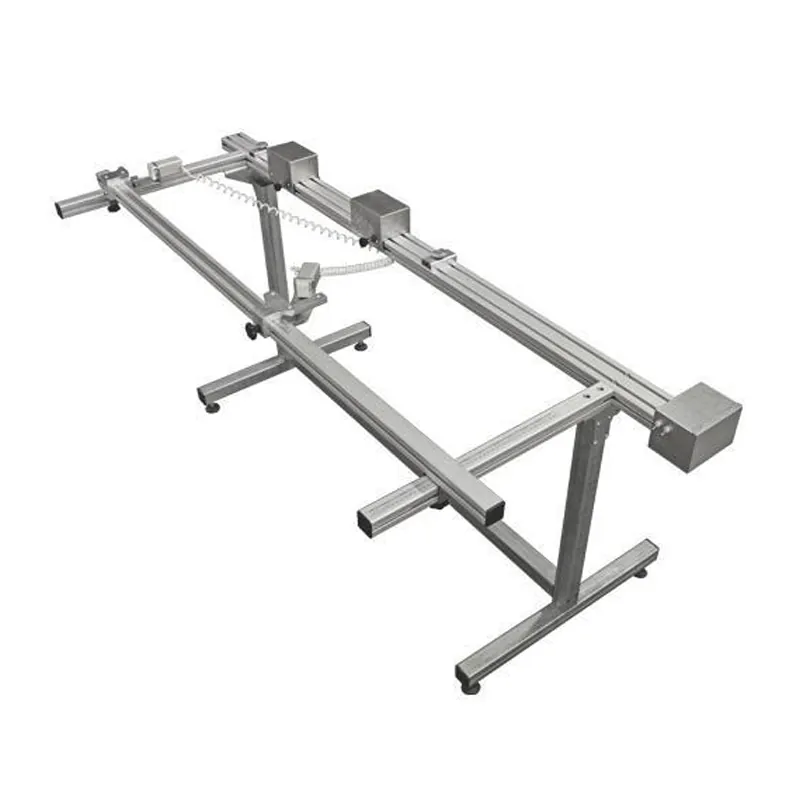
As a screen printer, you know better than anyone that a running press makes money, and an idle press costs money. When setting up a multi-color job (for instance, a CMYK halftone print or a complex 8-color graphic design) on an automatic screen printing carousel, each individual color must be exactly aligned with the other screens to ensure a perfectly registered final result. The traditional process of manually shifting, checking, striking off, and adjusting on the press easily consumes 30 to 45 minutes per setup. The ROQ PRU (Positive Registration Unit) drastically changes this by shifting the alignment process entirely to the prepress room. This massively increases your uptime and transforms the efficiency of your textile printing shop.
In this comprehensive article, we dive deep into the technical workings of the ROQ PRU, discuss best practices for prepress, and demonstrate through a detailed ROI calculation why this system is an indispensable investment for any professional screen printer.
The Hidden Costs of Long Press Setup Times
In traditional registration, the operator mounts the screens one by one into the print heads of the carousel. Next, a test print (strike-off) is made on a test shirt or pellon. Then, the operator must manually adjust the micro-registration knobs for each print head, partially clear the ink, make another test print, and repeat this iterative process until all colors perfectly overlap.
During this entire period—which for a 6-color print can easily take 45 minutes—a machine capable of generating thousands of dollars a day sits completely idle. Ink is wasted, test shirts are consumed, and often two or more operators are tied up doing fine adjustments.
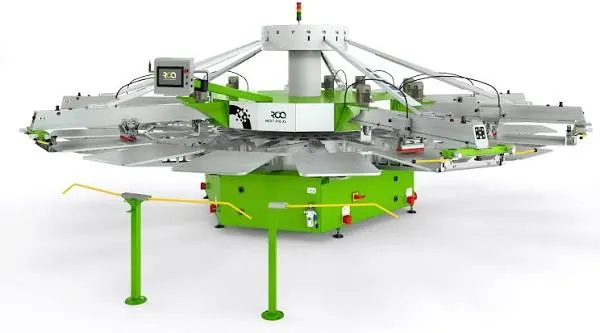
Aside from the direct downtime costs, this also creates a bottleneck in your production planning. Taking on smaller orders (like 50 pieces of multi-color prints) simply becomes unprofitable because the setup time takes longer than the actual production run.
How the ROQ PRU Works: A Technical Perspective
The ROQ PRU solves the problem of long setup times by utilizing an extremely precise system with micrometer registration pins and an LED positioning board. The system functions completely independent of the automatic press, meaning preparation can take place while the press is still running the previous order.
The Prepress Process
- Film Positioning: The prepress technician places the film positives (or CTS - Computer-to-Screen output) on the illuminated, glass LED board of the PRU. The board is equipped with a grid and reference lines that exactly match the positioning on the pallets of your ROQ press.
- Screen Alignment: The unexposed (or already exposed in the case of CTS) screen is placed on the PRU. The frame locks into robust, mechanical registration pins (U-blocks) on the PRU, which are an exact replica of the holders in the machine’s print heads.
- Optical Precision: Using the built-in LED lighting, the technician can look through the mesh to align the film exactly to the screen. In advanced setups, cameras or microscopes can be used for even higher precision (especially for high-resolution CMYK work).
- Fixation: Once the film is perfectly positioned, it is fixed in place and the screen can be exposed. The register is now physically anchored in the mechanical position of the screen relative to the film.
From Prepress to Press: The Pin-Lock Mounting System
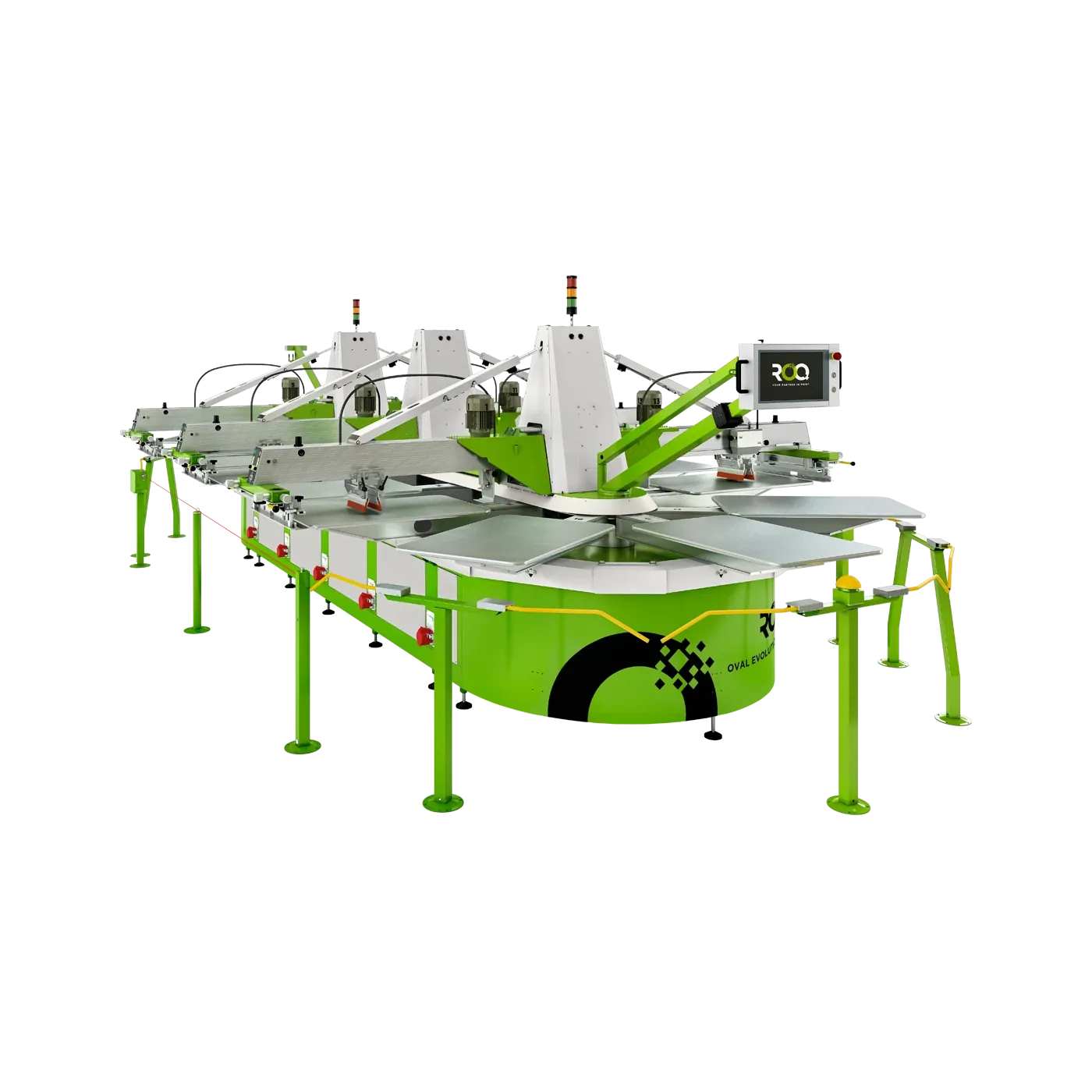
The true power of the ROQ PRU becomes evident on the production floor. The print heads of all ROQ carousel presses (such as the ROQ YOU, ROQ ECO, and ROQ OVAL) come standard with a compatible pin-lock mounting system.
When an order is ready, the operator brings the exposed and washed-out screens to the machine. The operator slides the screen into the print head and pushes it firmly against the fixed registration pins. Then the clamps (pneumatic or mechanical) are closed.
Thanks to this 1-to-1 transfer from the PRU to the press, the designs drop into a “99% perfect register” instantly. The operator only needs to adjust a fraction of a millimeter using the micro-registration knobs on the print head to compensate for any minor mesh distortion (which can occur during exposure). Field tests consistently show that the setup time per job drops from 45 minutes to less than 5 minutes as a result.
Step-by-Step Best Practices for Optimal Results
While the hardware is designed for flawless operation, achieving optimal results requires discipline in your workflow. Here are some best practices for textile printers implementing the ROQ PRU:
- Standardize Your Screens: Ensure all your screens have the same profile thickness and are not warped. High-quality aluminum frames are crucial.
- Consistent Mesh Tension: One of the few variables that can disrupt off-press registration is fluctuating mesh tension (Newtons). Ensure all your screens are measured monthly and kept at an equal tension (e.g., 25-30 N/cm).
- Train Your Prepress Department: The responsibility for registration shifts from the press operator to the prepress department. Ensure they understand the accuracy required. A mistake on the PRU translates directly to downtime on the press.
- Maintain the V-Block System: Keep the pins and U-blocks of both the PRU and your ROQ press clean. Dried ink or emulsion on the contact points can disrupt the fit and reduce accuracy.
In-Depth ROI (Return on Investment) Calculation
Let’s quantify the impact of the ROQ PRU on your bottom line. We will assume a mid-sized textile printing shop with one automatic ROQ press running eight hours a day.
- Press Production Costs: Suppose the operational costs (including labor, power, depreciation, rent) for the press are $150 per hour.
- Number of setups per day: Average of 4 multi-color jobs per day.
- Traditional Setup Time: 40 minutes per setup (4 x 40 = 160 minutes / 2.6 hours of downtime per day).
- Setup Time with PRU: 5 minutes per setup (4 x 5 = 20 minutes downtime per day).
Time savings per day: 140 minutes (2 hours and 20 minutes). Financial savings per day: $350 in downtime costs. Financial savings per month (20 working days): $7,000.
But the real profit is not in savings, but in the extra capacity. A ROQ press can easily print 1,200 to 1,500 additional shirts in those saved 2 hours and 20 minutes. If your profit margin per printed shirt is $1.50, this represents an additional profit potential of over $1,800 per day.
Given the relatively low purchase cost of the ROQ PRU (compared to the press itself), the payback period (ROI) in this calculation is only a few weeks to months.
A Paradigm Shift for Short Runs and Rush Orders
In the modern apparel industry, print runs are getting smaller. Brands want to produce “on-demand” to prevent excess inventory. This means your print shop must be able to process more job changeovers in a day to generate the same revenue.
Without a pre-registration system, taking an order of 50 pieces with 6 colors is almost a loss-making endeavor. With the ROQ PRU, you can complete the setup in 5 minutes, print the 50 pieces in 10 minutes, and move on to the next customer within fifteen minutes. This makes your business highly flexible, agile, and extremely competitive in a demanding market. You can take on rush orders without disrupting your entire weekly schedule because the preparation is done offline.
Conclusion: An Indispensable Link in Modern Screen Printing
Switching to a pre-registration system is perhaps the most impactful process improvement a screen printing shop can implement after purchasing an automatic carousel press. The ROQ PRU (Positive Registration Unit) is not just an optional accessory; it is the bridge between your prepress department and your production floor.
By reducing press setup time by an impressive 80%, you eliminate the biggest bottleneck in your workflow. It reduces operator frustration, cuts down on waste (fewer test shirts and ink), and maximizes the profitability of your equipment. If you are serious about scaling your production, lowering your costs, and improving your print quality, integrating the ROQ PRU is a step you simply cannot skip.
Want to learn more about these screen printing solutions?
Explore the technical specifications of Drucktech PHP-45 V2 Maxima and Drucktech PHP-45 2N or contact the specialists at Dimix.Screen for tailored advice or a live demonstration.
Featured & related machines
Discover the industrial systems and solutions related to this topic:
ROQ ECO
The flagship automatic carousel with chainless direct servo drive and independently lifting print heads.
ROQ E
100% electric automatic screen printing carousel with whisper-quiet operation and low energy consumption.
ROQ YOU
The world-renowned ROQ workhorse automatic carousel for dependable textile screen printing.