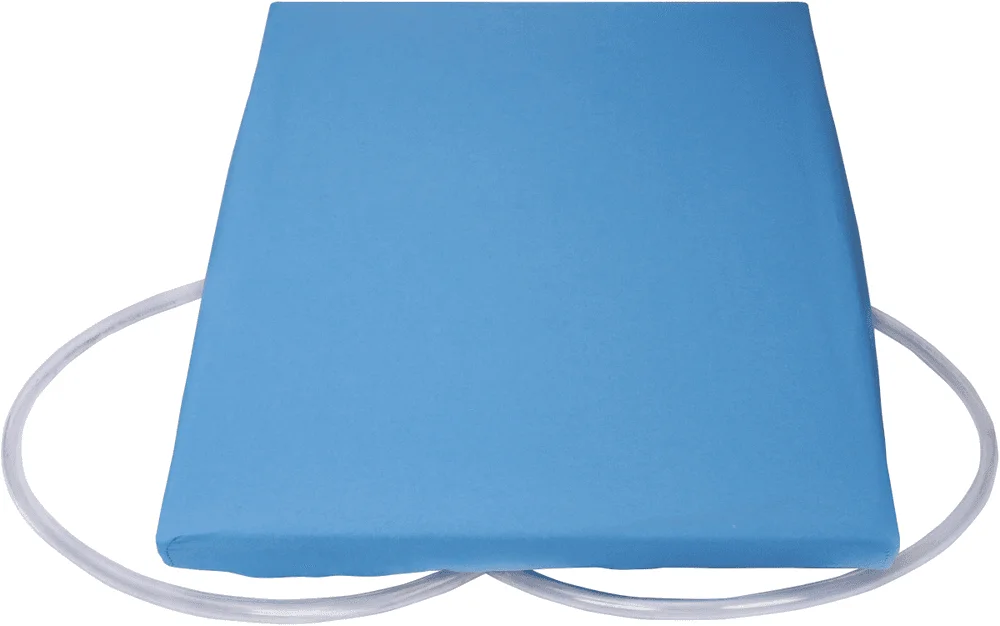
Drucktech has permanently changed the world of textile printing and heat transfer technology through the introduction of membrane heat presses. For textile printers, screen printers, and print professionals, the heat press is the backbone of daily production. While traditional presses and heat presses have struggled with significant limitations for decades—especially when it comes to evenly distributing pressure across uneven surfaces—the membrane plate solves this fundamental problem in a highly ingenious way.
In this comprehensive article, we dive deep into the technology behind the membrane plate. We explore the physics of this revolutionary press, compare it to conventional systems, and provide practical tips and ROI analyses for entrepreneurs in the textile industry who are considering making the switch.
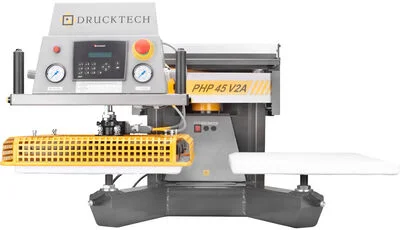
Looking for a Membrane Heat Press (Membran Press)? View the Drucktech MM-1 & M-1 Membrane Platen, the Drucktech PHP-45 V2 Maxima, or browse all Drucktech Heat Presses.
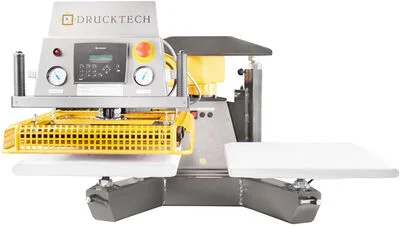
What Exactly is a Membrane Plate?
In the context of textile printing, the “lower platen” or “base plate” is the surface on which the garment to be printed is placed. In a conventional press, this plate is hard and inflexible, usually made of aluminum covered with a thin layer of silicone rubber.
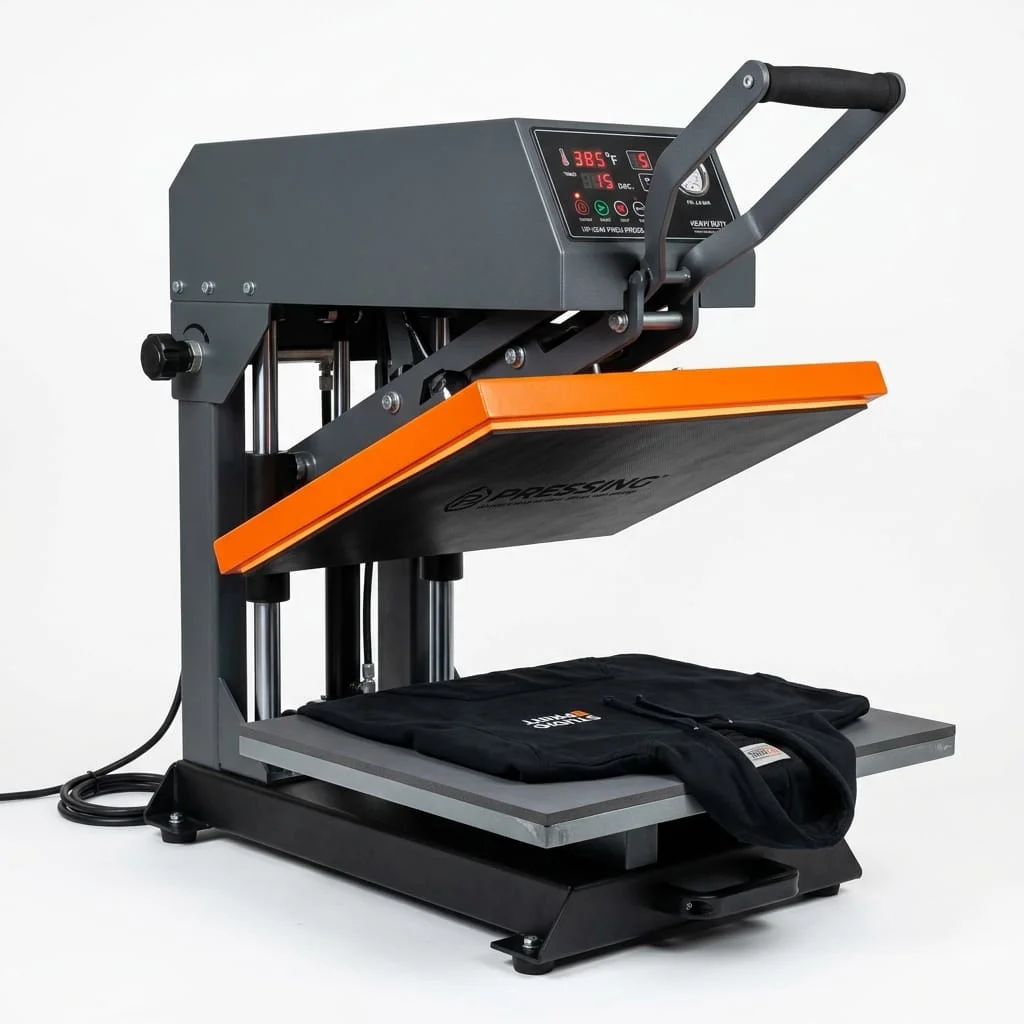
A membrane plate, such as those developed by market leader Drucktech, replaces this static setup with a dynamic, air- or fluid-filled system. The base plate is equipped with a specially designed, extremely durable rubber membrane layer. Beneath this membrane lies an air chamber. As soon as the heat press is closed and locked, this chamber is rapidly filled with compressed air. The membrane inflates as a result, pressing itself with immense yet perfectly even force against the textile and the heating platen (the upper plate).
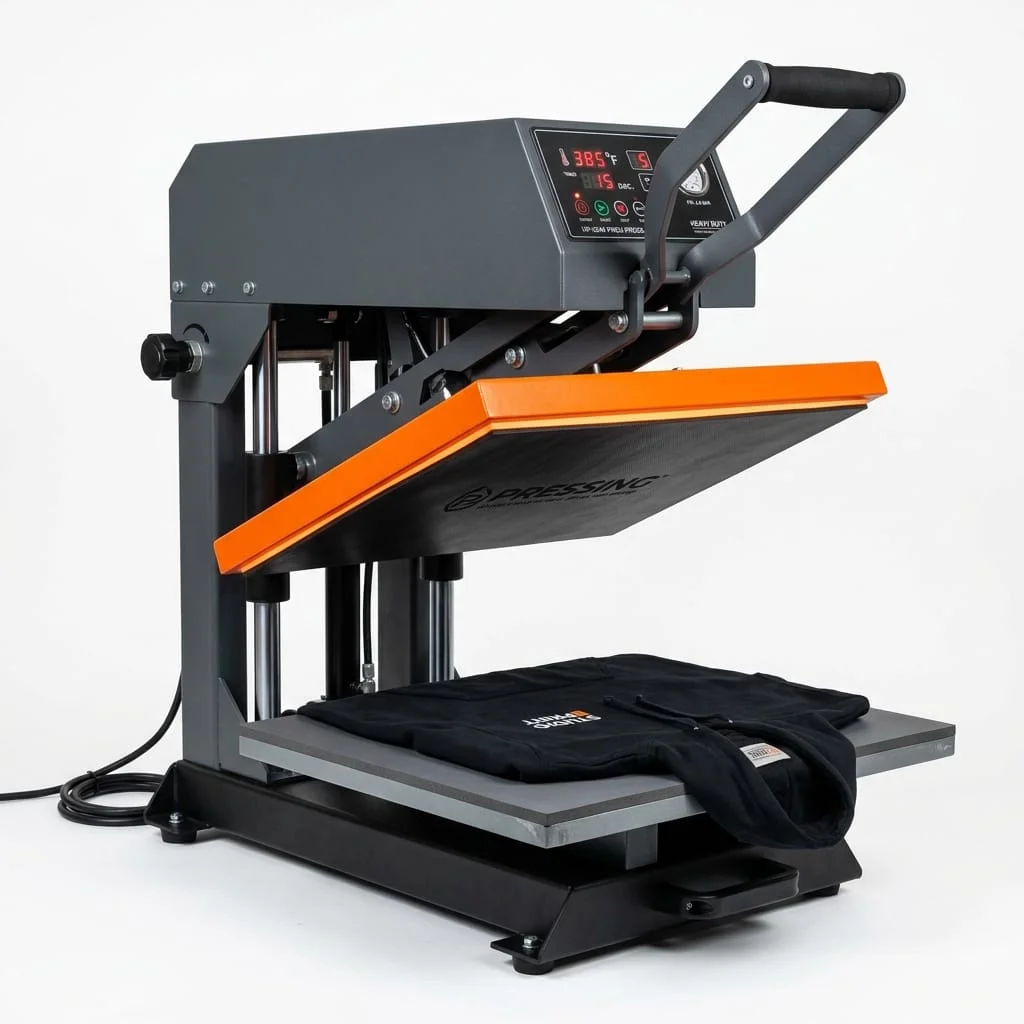
Traditional Heat Presses vs. Membrane Presses: The Fundamental Problem
To fully appreciate the innovation of the membrane plate, we must understand where conventional heat presses fall short.
The Problem of the “Highest Points”
In traditional heat presses, two flat platens (the heat platen and the base platen) close parallel to each other with the textile in between. According to the laws of physics, the pressure inevitably concentrates on the highest or thickest point located between these platens.
Imagine you are printing a polo shirt with buttons, a hoodie with a thick kangaroo pocket, a jacket with zippers, or even garments with heavy, thick seams like workwear. The moment you close a conventional press, the button, zipper, or seam takes the full closing pressure. The rest of the surface—where your valuable transfer is located—is essentially hovering or receiving insufficient pressure. This leads to an incomplete transfer, washability issues, or even peeling prints after the customer washes the garment.
Printers often try to solve this by using teflon pillows (pillow pads) or mouse pads that they elevate and place under the design. While this sometimes works, it is a time-consuming, error-prone workaround that drastically reduces efficiency.
The Membrane Solution: Fluid Pressure Distribution
In a membrane heat press, the built-up compressed air behaves like a fluid. Instead of trying to crush the obstacles (buttons, zippers, seams), the air-filled membrane effortlessly folds and forms around these obstacles. The compressed air pushes the material and the transfer against the heated upper platen with exactly the same force everywhere. Whether the material is 1 mm or 5 mm thick in a certain spot, the air pressure inside the chamber is uniform, meaning the resulting counter-pressure on the textile is also uniform.
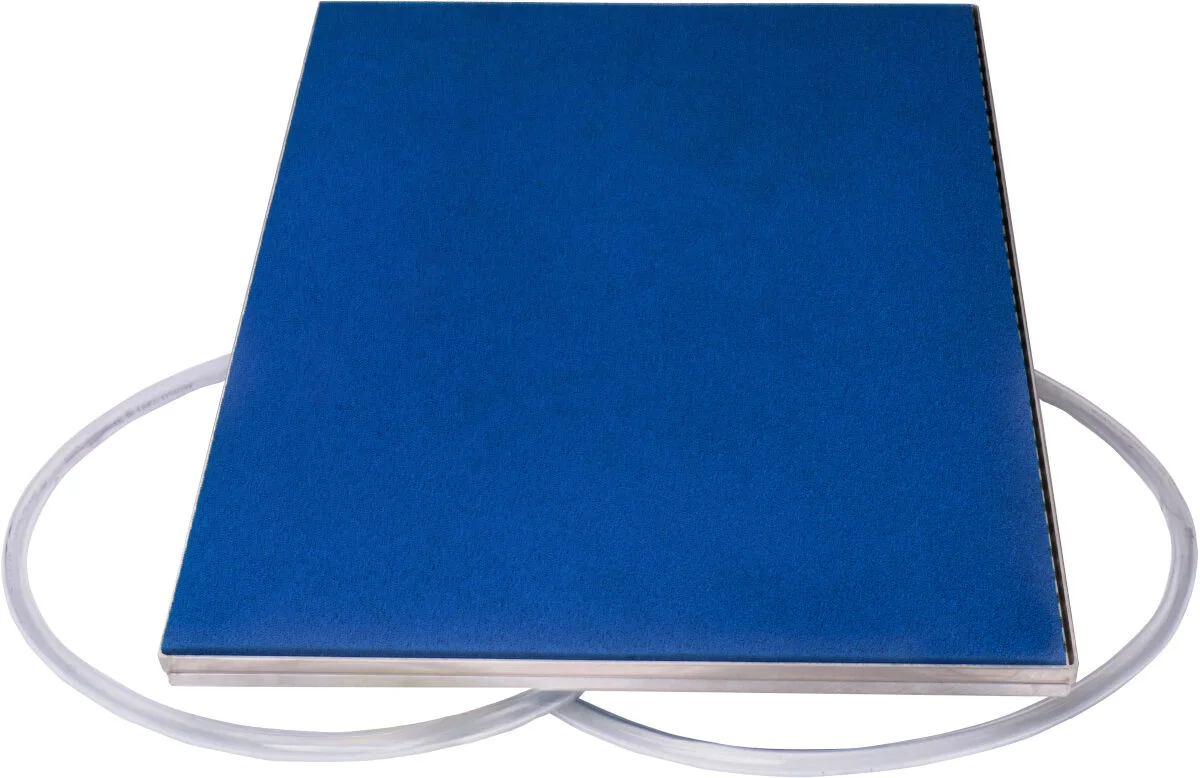
The Technical Workings in Detail
The core of the membrane plate is connected to an air compressor or a compressed air network within your print shop. When the operator pulls the upper platen down to start the pressing process, a sensor activates the air valve.
- Closing: The heat platen is locked at a fixed distance above the base platen. At this moment, there is no high pressure yet, allowing the operator to close the press without any physical exertion.
- Inflation: Within a fraction of a second after closing, the valve opens, and compressed air flows under the membrane.
- Compression: The membrane bulges upwards, pushing the textile and the transfer firmly against the heat platen.
- Stabilization: A built-in pressure regulator keeps the pressure exactly at the set value (e.g., 0.5 kg/cm²) for the entire pressing time, regardless of the material’s thickness.
- Deflation: As soon as the timer expires, an exhaust valve lets the air escape. The pressure drops instantly, allowing the press to simply and safely spring open or be opened manually without ‘kickback’.
Detailed Benefits for the Professional Textile Printer
Implementing a membrane press like Drucktech’s offers numerous advantages that transform production on the shop floor.
1. High and Exact Pressure
A membrane machine can deliver a significant and, above all, constant pressure across the entire platen. Regular flatbed presses often cannot achieve the same high, readable pressures without heavy pneumatics. Membrane presses effortlessly reach 0.5 to 0.7 kg/cm², and up to 1.5 kg/cm² for cap presses. This high pressure is essential for modern transfer systems, such as DTF (Direct to Film) and thicker screen print transfers, where the adhesive layer must be pressed deep into the textile fibers for maximum adhesion and washability.
2. Equal Pressure, Regardless of the Surface
As discussed earlier, the pressure is guaranteed to be equal at every point of the platen because the plate forms to the object. This means you can confidently print V-neck shirts, polos with button plackets, overalls with zippers, and bags with thick straps in one smooth motion. You no longer need to use pillows or awkwardly drape the textile off the press.
3. Unrivaled Ease of Use and Ergonomics
Physical strain (such as RSI complaints) in the shoulders and arms is a notorious problem among printers who have to clamp down traditional manual presses all day. Because the actual pressing pressure in a membrane press is generated by the compressed air rather than the operator’s leverage, the press can be closed and opened with virtually no effort. This drastically increases working comfort and ensures that your employees work just as quickly and accurately at the end of their shift as they did at the beginning.
4. 100% Reproducibility
In professional textile printing, consistency is everything. If a customer orders 500 shirts, shirt 500 must have exactly the same quality as shirt 1. With conventional hand presses, the pressure often depends on the ‘feel’ of the operator and the thickness of the specific shirt. With the membrane press, the parameters of the transfer process—pressure, temperature, and time—are digitally set and thus exactly reproducible. No more guesswork: the machine does the work.
5. Minimal Equipment Wear and Tear
Because the operator closes the press without physical force (the heavy pressing work happens pneumatically after the valve is closed), the mechanical load on the frame, hinges, and springs is minimal. Wear and tear on mechanical parts is greatly reduced, resulting in a much longer lifespan for your investment.
Best Practices for Working with a Membrane Plate
To get the most out of your investment, there are several best practices every textile printer should follow:
- Regular Compressor Maintenance: Ensure your compressed air is clean and dry. Use a water separator on your compressor to prevent moisture from entering the membrane system, which can corrode internal components.
- Protect the Membrane Layer: Although the rubber is extremely robust, you should avoid sharp objects like open safety pins. Always maintain a clean workspace.
- Check Your Heat Distribution: Use temperature strips or a calibrated infrared thermometer weekly to guarantee that the heat platen is still emitting an even temperature, which perfectly complements the even pressure of your membrane plate.
- Optimize Your Workflow: Now that you no longer have to struggle with elevation pillows or awkwardly positioning zippers off the platen, you can speed up your production line. Train your staff to load textiles quickly and flat onto the membrane; the system does the rest.
Return on Investment (ROI) Calculation and Business Considerations
A membrane press, like those from Drucktech’s renowned ‘Etalon’ product group, is an investment that costs more than a budget heat press from the Far East. However, the business case is rock solid. Let’s look at the factors for the ROI:
- Reduction of Misprints (Spoilage): If you have 5 failures on an order of 100 expensive jackets or hoodies due to poor pressure near a seam, it costs you not only the blank jackets but also the transfers and labor time. A membrane press virtually eliminates this risk. If a jacket costs €30 wholesale, saving 5 failures already saves you €150 per order.
- Time Savings: Constantly swapping and placing teflon pillows takes an average of 15 to 30 seconds per garment. On an order of 200 items, you easily save 1.5 hours of pure labor time.
- Higher Production Speed: By reducing operator fatigue, output remains high even at the end of the day.
- Broader Customer Acceptance: Because the print is pressed uniformly into the fabric, washability improves. This results in satisfied, returning customers and fewer complaints (RMAs).
When you add these factors together, the premium price of a membrane heat press often pays for itself within the first 6 to 12 months for a print shop with an average production volume.
Conclusion: The Heat Press of the 21st Century
Textile printing has evolved significantly in recent years with the advent of new transfer techniques like DTF, toner transfers, and improved screen print transfers. These high-quality transfers demand precision. It is no longer justifiable to leave the application—the crucial final step in your production process—to inferior equipment that cannot guarantee even pressure.
The invention of the membrane plate has brought about a paradigm shift. Products from Drucktech’s “Etalon” product group combine this technology with indestructible build quality and advanced digital controls. They can rightfully be called the heat presses of the 21st century.
Discover Drucktech Membrane Heat Presses at Dimix Screen
Want to integrate membrane plate technology directly into your textile production workflow? Explore our most popular models and accessories:
- Drucktech MM-1 & M-1 Membrane Lower Platens: Passive and active inflatable membrane plates that absorb buttons, zippers, and thick seams up to 15 mm.
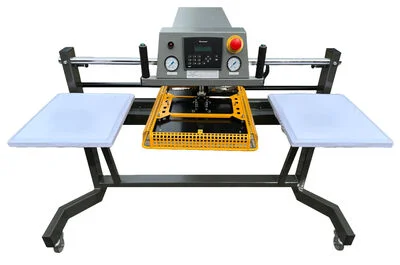
- Drucktech PHP-45 V2 Maxima: High-output pneumatic dual-station transfer press with integrated active membrane plate.
- Drucktech PHP-45 2N: Versatile dual-station pneumatic heat press for industrial DTF and screen print transfers.
- View all Drucktech Heat Presses & Accessories or request a live demonstration at our showrooms in Genk (BE) and Breda (NL).
For textile printing companies striving for the highest quality, maximum efficiency, happy employees, and flawless end products, upgrading to a membrane heat press is not just an upgrade; it is an absolute necessity to remain competitive in the modern market. Ensure you aren’t left behind and experience the perfect pressure of a membrane plate yourself!
Featured & related machines
Discover the industrial systems and solutions related to this topic:
Drucktech MM-1
Professional mug heat press for vivid and durable sublimation on mugs.
ROQ FOLD & PACK / Folding & Packaging Machines
Fully automated garment folding, bagging, sealing, and labeling lines (ROQ FOLD, ROQ PACK, ROQ OUT & ROQ LABEL) for screen printers and fulfillment centers.
Drucktech SP-45NA
Manual membrane heat press with 40x50 cm platen and auto-release for textiles up to 1.5 cm.