Choosing the right heat transfer press is one of the most crucial decisions for any textile printing company. A high-quality press is the beating heart of your production. A good press not only guarantees a durable, wash-resistant print but also ensures that your production process runs in a streamlined, efficient, and ergonomically sound manner. With the rise of new techniques such as Direct-to-Film (DTF) and the enduring popularity of screen print transfers and flex vinyl, the heat press has become more important than ever.
Today, there is an overwhelming array of presses on the market, ranging from cheap entry-level models to highly advanced, fully automatic pneumatic systems with dual workstations. But which press is the best fit for your specific situation, production volume, and budget? In this comprehensive guide, we dive deep into the technical aspects, compare different technologies, and provide professional tips and Return on Investment (ROI) calculations to help you make the perfect choice.
1. The Core Technology: Manual, Semi-Automatic, or Pneumatic?
The most important choice you have to make, and the one with the biggest impact on both your budget and your daily operations, is the drive mechanism of the press. We distinguish three main categories.
Manual Heat Presses
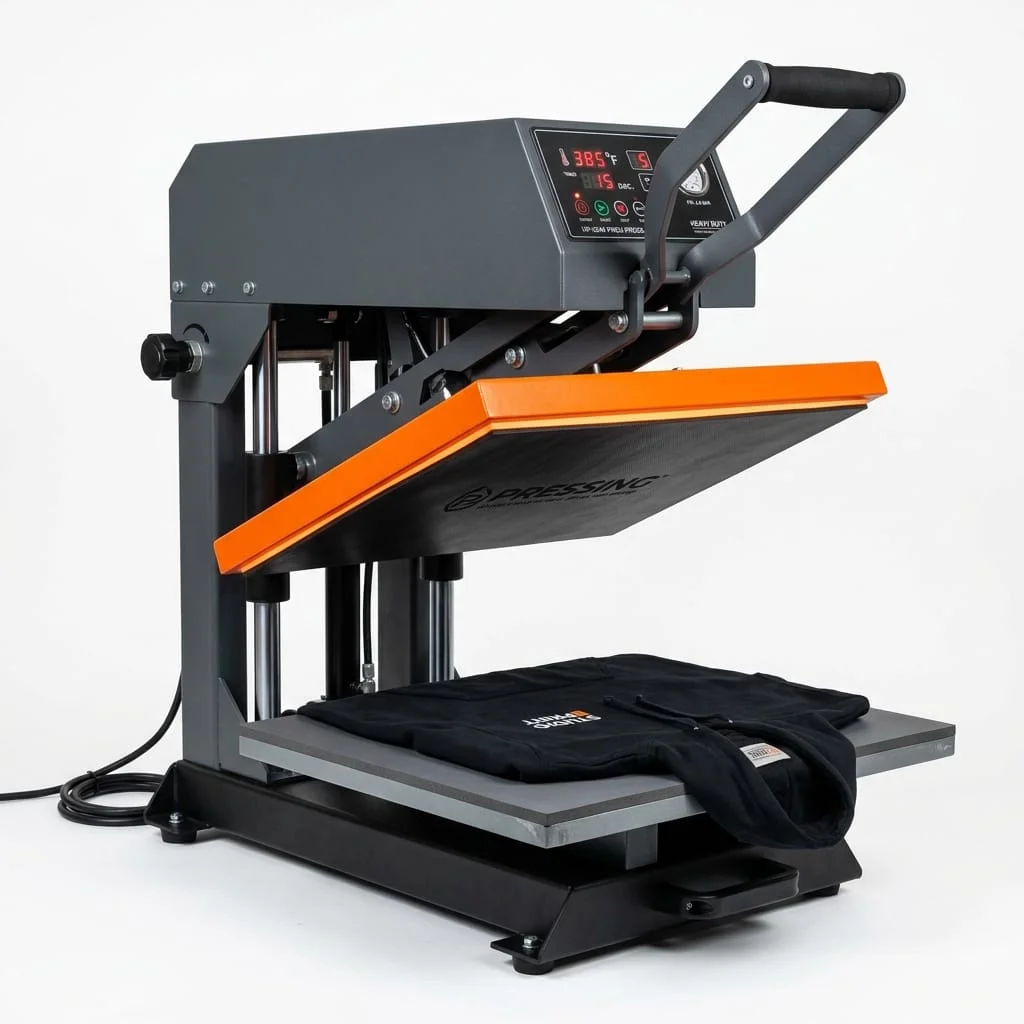
Manual heat presses require physical force from the operator to close the press and open it again. They are available as "clam-shell" or "swing-away" models.
- Pros: These are often the most affordable presses. They typically take up less space (especially clam-shell models) and have fewer moving parts that can break. They are ideal for smaller runs, start-up businesses, or as a reliable backup press. Models like the Drucktech SSH-1A offer excellent heat distribution and pressure for an accessible price.
- Cons: Continuous opening and closing require a lot of strength. With a production of hundreds of shirts a day, this inevitably leads to operator fatigue, which can lower efficiency and cause long-term physical complaints. Moreover, the pressure setting often relies on the "feel" of the operator or a simple dial, which can lead to inconsistent results.
Semi-Automatic (Auto-Open) Heat Presses
These presses are closed manually but open automatically thanks to an electromagnet or gas strut as soon as the set time has elapsed.
- Pros: They prevent transfers from burning or "over-curing" if the operator is momentarily distracted. It also saves half the physical effort compared to a fully manual press.
- Cons: You still have to close the press by hand, so for the heaviest work (like thick hoodies), significant force is still required.
Pneumatic Heat Presses
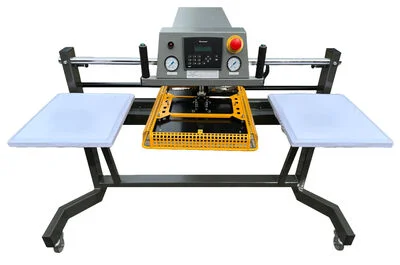
Pneumatic heat presses operate on air pressure and are powered by an external compressor. With the push of a button (or a foot pedal), the press closes with immense, perfectly calibrated force, and opens automatically.
- Pros: For high-volume productions, this is absolutely indispensable. It reduces the physical strain on the operator to practically zero. But most importantly: the pressure is always 100% constant, exactly as set on the digital gauge, regardless of who operates the press. This guarantees consistent quality.
- Cons: They are more expensive to purchase and require an air compressor (which can introduce extra noise and maintenance, unless you use a whisper-quiet compressor).
2. Workstations: Single, Dual, or Carousel?
After choosing the drive mechanism, the number of workstations (the lower platens where you place the garment) is the next big decision.
Single Workstation
A press with a single station is fine for standard work, one-off jobs, or when space is a limiting factor. However, while the press is closed, you are waiting. With a pressing time of 15 seconds, you stand idle for several minutes every hour.
Dual Workstation
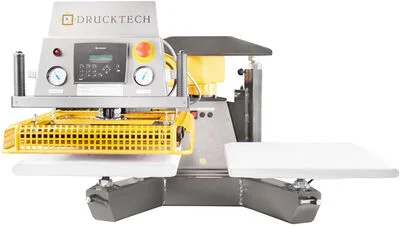
Do you have many orders with large quantities? Then a press with a dual workstation (like the Drucktech PHP-45-V2 Optima) adds immense value and is often the key to high ROI. While one shirt is being pressed on platen A, you peel the film off the previous shirt and position the next shirt with the transfer on platen B. As soon as the press opens, the heat platen slides (or swings) directly over to station B. This eliminates wait times and can truly double your production speed.
Return on Investment (ROI) Example
Let's do a simple calculation. Suppose you need to press 500 shirts. With a single press, the cycle (positioning, pressing, peeling, setting aside) takes about 45 seconds per shirt. Total: 6.25 hours. With a dual press, you can reduce the cycle to 25 seconds per shirt (because you do the positioning while the machine is pressing). Total: 3.47 hours. You save almost 3 hours on a single order. At an hourly rate of €50, you save €150. If you do this weekly, you will have recouped the €3000 extra cost for a dual press within six months, purely in saved labor time.
3. The Heat Platen: Consistent Temperature as the Holy Grail
A transfer stands or falls with the temperature. DTF (Direct to Film) transfers, plastisol screen print transfers, and sublimation all have specific, strict temperature requirements. If your press is set to 160°C, but the edges of the heat platen are only 145°C (cold spots), the logos on the edges will peel off after the first wash.
Cheap presses often feature thin heat platens with a heating element that zigzags with large gaps. Professional presses use heavy, cast aluminum platens (sometimes up to 2 to 3 centimeters thick) with tightly spaced heating elements. These thick platens have a high thermal mass; they retain heat even when you place cold, damp shirts under them all day long.
Pro Tip: Regularly test your press with a reliable digital pyrometer (surface thermometer) to verify that the temperature in the corners matches the temperature in the center.
4. Membrane Platen Technology: The Life-Changing Innovation
One of the biggest frustrations for any textile printer is printing over or near bulky areas such as seams, buttons, zippers, polo collars, and V-necks. With a standard flat lower platen, you instantly lose pressure around these obstacles. The result? Poor adhesion of the transfer and dissatisfied customers. Often this is solved by fiddling with teflon pillows or elevating rubber pads, which takes a lot of time.
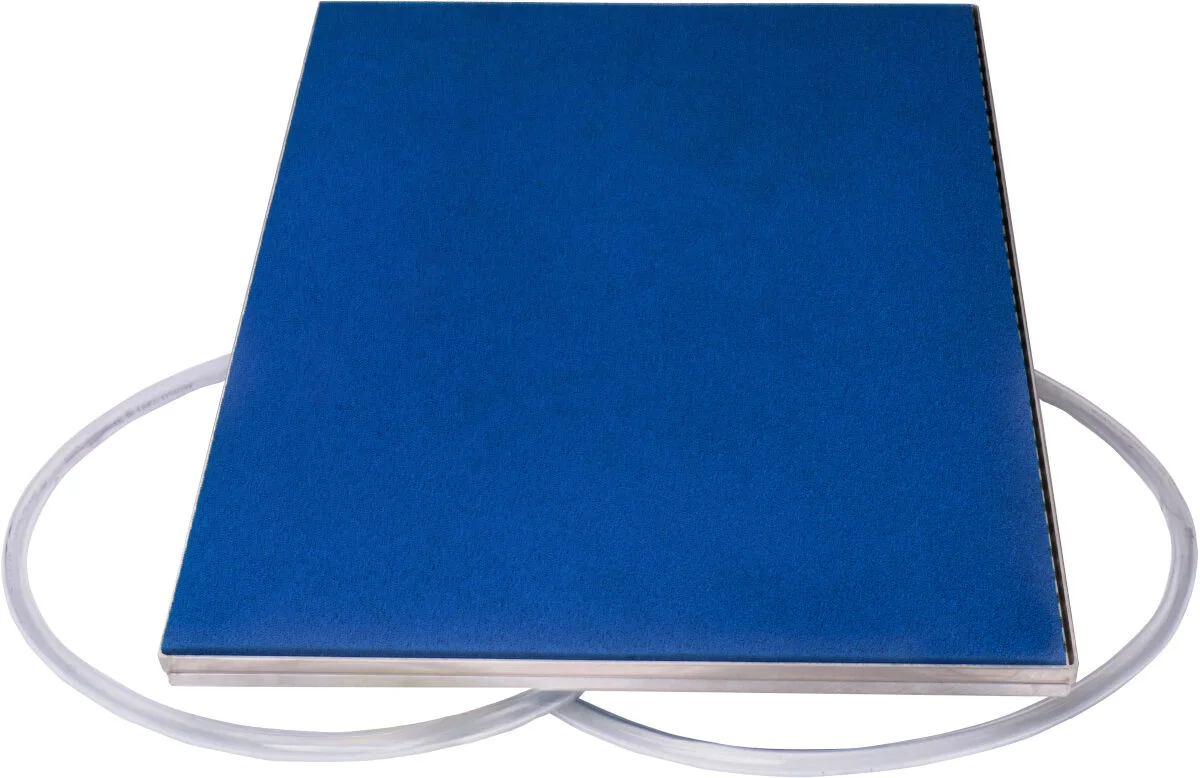
The membrane platen technology (as utilized by Drucktech) solves this fundamental problem. The lower platen is essentially an inflatable (air or liquid-filled) cushion. When the press closes, the membrane platen molds perfectly around zippers and thick seams. The pressure on the thin transfer remains exactly equal over the entire surface. This saves an enormous amount of preparation time and reduces the number of failed prints to zero.
5. Ergonomics and Safety in Production
Besides efficiency, the health of the operator is of paramount importance. A good heat press is designed with ergonomics in mind. For swing-away presses, this means they swing away smoothly without jerking. For pneumatic presses, it means operation via a foot pedal so the operator has both hands free to accurately position and smooth out the transfer.
Additionally, safety features are crucial, especially with pneumatic presses that close with immense force. Modern dual-station presses are equipped with laser safety sensors or two-hand button controls. This ensures the press cannot close if the operator's hands are still underneath the heat platen.
6. Advanced Features and Modular Options
When purchasing a heat press, it is also wise to look at future-proofing. Can the press grow with your business?
- Interchangeable lower platens: Can you easily swap out the standard 40x50cm platen for a smaller one for children's clothing (e.g., 15x15cm), a sleeve platen, or a special platen for umbrellas or caps? A "Quick-Release" or "Quick-Change" system provides a massive time saving here.
- Laser positioning: Some presses can be equipped with crosshair lasers that indicate precisely where the logo should be positioned. This is indispensable for quickly and exactly aligning left-chest logos on large batches of corporate workwear.
- Programmable touchscreens: The ability to save presets. You simply tap 'DTF Cotton' or 'Sublimation Polyester' on the screen, and the press automatically sets the right time, temperature, and pneumatic pressure.
Conclusion
Choosing the right heat press is not the place to cut corners if you aim to deliver professional quality and grow your business. It is an investment in the future of your print shop.
For small, highly personalized runs or as a start-up, a robust, high-quality manual press is an excellent choice. But as soon as you start mass production, volumes increase, or you notice that staff become physically fatigued, making the switch to a pneumatic press – ideally with a dual workstation and membrane platens – is the most logical and profitable step. These machines transform your workflow from a labor-intensive process into a streamlined, highly profitable production line.
Take the time to map out your production needs, calculate your current wait times, and choose the press that meets your requirements not just today, but five years down the line.
Want to learn more about these screen printing solutions?
Explore the technical specifications of Drucktech PHP-45 V2 Maxima and Drucktech PHP-45 2N or contact the specialists at Dimix.Screen for tailored advice or a live demonstration.
Featured & related machines
Discover the industrial systems and solutions related to this topic:
Drucktech PHP-45-V2 Optima
Compact pneumatic dual workstation heat press with membrane plate for garments up to 4 cm.
Drucktech PHP45-2NR
Heavy-duty floor standing pneumatic heat press with dual workstations for heavy production.
Drucktech PHP45-2N
Mobile pneumatic heat press with generous dual workstation clearance for textiles up to 3 cm.