
The textile printing industry is in the midst of a profound transformation. While plastisol was the undisputed king of the screen printing floor for decades, we are now witnessing a massive shift towards more ecologically responsible alternatives. Water-based inks have become the industry standard for high-quality, sustainable textile printing. However, “water-based” is no longer an automatic synonym for environmentally friendly. To ensure that these inks are genuinely safe for the planet, the printer, and the end-user, strict, independent international certifications such as GOTS (Global Organic Textile Standard) and OEKO-TEX ECO PASSPORT are of absolute crucial importance.
These certifications provide fashion brands and print shops with the necessary assurance that the entire supply chain complies with stringent ecological, chemical, and social criteria. In this comprehensive article, we dive deep into the technical properties, operational best practices, financial implications (ROI), and commercial advantages of switching to certified water-based ink systems.
Delving Deeper: What do GOTS and ECO PASSPORT really mean?
When your print shop invests in new ink systems, it is essential to understand what the labels on the buckets actually mean. They are not just marketing terms; they are quality marks awarded after rigorous audits.
GOTS (Global Organic Textile Standard) is the world’s leading standard for the processing of textiles made from organic fibers. A GOTS certification (specifically for chemical inputs like ink) means that the ink has been meticulously assessed for toxicity and biodegradability. GOTS prohibits the use of heavy metals, formaldehyde, aromatic solvents, and genetically modified organisms (GMOs). Furthermore, GOTS looks beyond the chemistry; it also evaluates the ecological footprint of the ink manufacturer and demands strict adherence to social criteria and safe working conditions.
OEKO-TEX ECO PASSPORT, on the other hand, is a robust, independent certification system designed specifically for textile chemicals, colourants, and auxiliaries. The process involves a multi-stage verification. First, the ingredients are compared against the Manufacturing Restricted Substance List (MRSL) and the Restricted Substance List (RSL) of OEKO-TEX and ZDHC (Zero Discharge of Hazardous Chemicals). Next, an analytical laboratory test is conducted to verify that the ink is indeed free of banned or harmful substances, such as allergens, endocrine disruptors, and carcinogenic amines. This is invaluable, especially for the production of baby clothing, sportswear, and textiles intended for direct and prolonged skin contact.
Together, GOTS and ECO PASSPORT form an ironclad duo that guarantees you and your customers that the produced garments meet the strictest global safety and sustainability requirements.
Plastisol vs. Water-Based Ink: A Technical Deep Dive
To fully appreciate the benefits of certified water-based inks, we must compare them to the traditional standard: plastisol.
Plastisol is essentially a liquid plastic. It primarily consists of PVC (polyvinyl chloride) resin and plasticizers (often phthalates, although many modern plastisols are now phthalate-free). Because it contains no solvents, it does not dry out on the screen, making it extremely user-friendly for the printer. The ecological drawback, however, is significant. Plastisol is not biodegradable and contributes to the microplastic problem when garments are washed.
Water-based inks, as the name implies, use water as the main carrier (the solvent) for the pigments and binders (often acrylic or polyurethane-based). When the ink is exposed to heat in the conveyor dryer, the water evaporates, and the binders form a network (cross-linking) around the pigments, firmly anchoring them to the textile fiber. Modern High Solid Acrylic (HSA) water-based inks offer excellent opacity, even on dark fabrics, without compromising on durability.
| Property | Plastisol Ink | HSA Water-Based Ink (GOTS) |
|---|---|---|
| Base Ingredients | PVC and phthalates (plasticizers) | Water, acrylic/PU binders, bio-pigments |
| Physical Integration | Sits on top of the fiber as a coating | Penetrates and binds with the textile fiber |
| Handfeel | Thick, rubbery plastic layer, non-breathable | Extremely soft, highly breathable |
| Drying & Curing | Melts (cures) at ~160°C, no evaporation | Evaporation of water + cross-linking at ~150-170°C |
| Equipment Cleaning | Chemical solvents required | Easily cleaned with water and mild, eco-friendly soap |
| Environmental Risk | High (VOC emissions during curing, microplastics) | Very low (fully biodegradable, zero VOCs) |
Printability, Quality, and the ‘Soft Handfeel’
One of the most significant advantages of water-based inks is their physical interaction with the fabric. Because the water pulls the ink into the fibers, the final print results in an extremely soft wash print, known in the industry as the ‘soft handfeel’. This means you can barely feel the print when you rub your hand over the garment.
This is a crucial selling point for premium apparel brands, fashion designers, and the sportswear industry. Consumers demand clothing that is comfortable and breathable. Plastisol prints on large surface areas can feel like a shield that traps sweat; water-based prints allow the fabric to breathe.
Furthermore, the durability is impressive. Because the pigments are physically bonded to the fibers via the binder, water-based prints will not crack, peel, or flake over time—a common issue with thick plastisol prints as they age. Provided they are cured correctly, the prints will retain their color vibrancy and wash fastness for decades.
Operational Impact in the Print Shop: Best Practices
Transitioning to water-based inks requires a workflow adjustment and discipline on the print floor. Unlike plastisol, water-based ink does dry out on the screen when exposed to air. This is called “in-screen drying” and is the primary operational challenge.
Here are the best practices for screen printers working with water-based systems:
- Humidity (Climate Control): Optimal humidity in the print shop (ideally between 50% and 60%) is crucial. Dry air causes rapid evaporation and clogging of the screens. The use of humidifiers (foggers) around the press can significantly reduce this.
- Screen Emulsion and Preparation: Water breaks down standard emulsions. You must invest in water-resistant (often diazo-based or dual-cure) emulsions or post-treat your screens with a hardener. This dramatically extends the life of your stencils during large print runs.
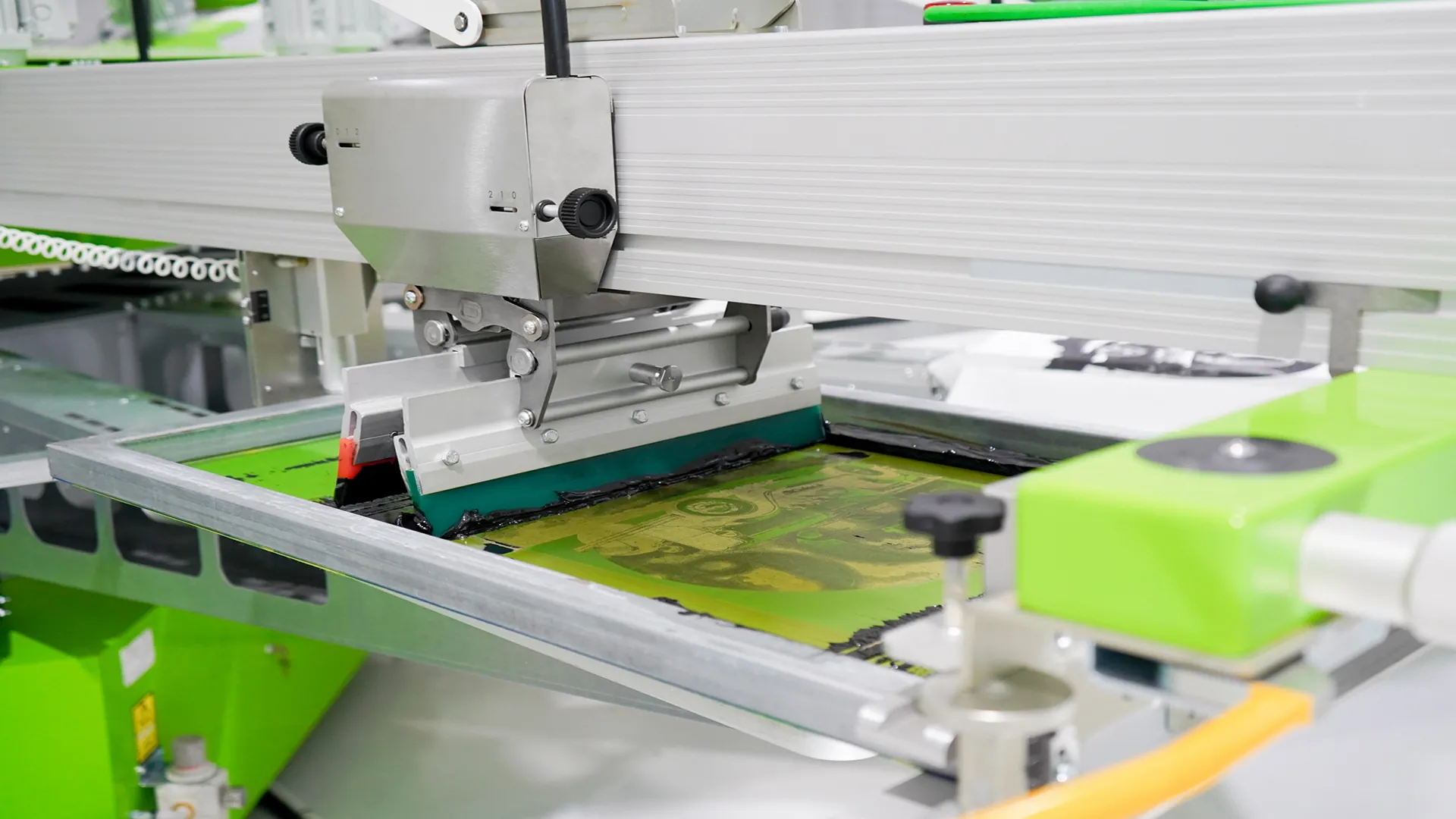
- Equipment and Pressure: Advanced automatic presses, such as ROQ machines, provide consistent squeegee and flood bar pressure. With water-based ink, it is essential to keep the screen constantly ‘flooded’ (filled with ink) between print strokes, so the ink in the open mesh does not dry out.
- Curing: Because water must be evaporated before the actual curing (cross-linking) can occur, a proper conveyor dryer is necessary. It requires a dryer with forced air circulation to remove the moist microclimate above the shirts and sufficient dwell time, usually around 2 to 3 minutes at 160°C.

ROI Calculations: Why Sustainability is a Smart Investment
At a superficial glance, the price per liter of certified water-based ink often appears higher than that of standard plastisol. However, it is essential to look at the Total Cost of Ownership (TCO) and the Return on Investment (ROI).
Firstly, consumption is lower. Because water-based inks leave a thinner ink deposit and are often printed through finer meshes (higher thread counts), you can print significantly more shirts with one liter of ink compared to plastisol. This often immediately offsets the higher price per liter.
Additionally, you save significantly on cleaning costs. While plastisol requires aggressive and expensive chemical solvents to clean the screens—which brings extra costs and health risks—water-based inks can, in many cases, be cleaned with water and a simple, biodegradable soap. This drastically reduces your chemical disposal costs and improves the air quality in the print shop.
Finally, the most significant ROI lies in the margins. Garments printed with eco-friendly, GOTS, and ECO PASSPORT certified inks, on organic cotton or recycled textiles, are premium products. Consumers and B2B clients are willing to pay a higher unit price for this. Therefore, you can increase your profit margins.
Marketing Advantage and B2B Opportunities
Sustainability is no longer a niche; it is a hard requirement in tenders from governments, corporates, and large retail brands. By positioning yourself as a print shop that works exclusively with or specializes in GOTS and ECO PASSPORT certified inks, you position yourself as a market leader.
This gives your sales and marketing teams a powerful narrative. You can guarantee B2B clients that their brand (and their ESG reporting) is safe, and that they will not be associated with toxic production processes or microplastic pollution. It enables you to secure contracts that simply remain closed to printers clinging to conventional methods.
Conclusion
The transition to water-based, certified inks requires an investment in time, training, and sometimes equipment. But the benefits are overwhelming. From unparalleled print quality and ‘soft handfeel’ to significant environmental, health, safety, and profitability advantages. With the GOTS and ECO PASSPORT certifications in hand, you are not just ready for the future of textile printing; you are leading the way. At Dimix Screen, we are happy to advise you on the right ink lines, chemistry, and the optimal setup of your print shop for this sustainable revolution.
Want to learn more about these screen printing solutions?
Explore the technical specifications of ROQ FEED and ROQ PULL or contact the specialists at Dimix.Screen for tailored advice or a live demonstration.
Featured & related machines
Discover the industrial systems and solutions related to this topic:
ROQ PULL
Automated take-off arm that unloads printed garments from platens directly onto conveyor dryers.
ROQ FEED
Automated garment feeding arm ensuring consistent placement and continuous press productivity.
ROQ Sahara
High-efficiency industrial conveyor drying tunnel operating on gas, electricity, or dual MIX energy.