In the increasingly competitive world of textile decoration, it is no longer enough to just print a standard full-color image on a T-shirt. Consumers, especially those wearing premium fashion brands, streetwear labels, and band merchandise, are looking for garments that offer an experience. They want to feel textures, see gloss, and experience designs that literally pop off the fabric.
Pure DTG (Direct-to-Garment) printers have undeniably revolutionized the market by enabling fast, photorealistic prints in short runs. However, they are fundamentally limited to flat ink deposits. They cannot apply metallic gold foil, they lack the ability to create soft, velvety flock surfaces, and they cannot build thick, tactile 3D reliefs. This is where hybrid screen printing, and in particular ROQ’s solutions, shows its true creative power. By combining the precision and unlimited color spectrum of digital print heads with the mechanical and chemical capabilities of conventional screen printing stations, you create exclusive products with very high added value.
The Creative Shortcomings of Standalone DTG and DTF
While DTG (Direct-to-Garment) and DTF (Direct-to-Film) excel at printing photorealistic details and easily transferring colorful designs to various fabrics, respectively, both lack the ability to add physical dimensions to a print. In the premium market, the feel (the “hand” or texture) of a print is just as important as its visual impact.
When a clothing brand offers its products in retail at prices of €50, €80, or even over €100 per shirt, the consumer expects premium elements. A standard, flat CMYK print rarely justifies these prices. Hybrid screen printing elegantly solves this problem. By using a hybrid machine, the traditional screen printing carousel acts as the engine for special effects (adhesives, thick inks, white underbases), while the digital module (such as the ROQ Hybrid) is used for photorealistic, variable elements. All of this happens inline, in the same production run, without having to remove the garment from the pallet, ensuring perfect registration.
Deep Dive 1: ROQ FOIL and Metallic Inline Effects
One of the most sought-after special effects in streetwear and high-fashion is the addition of metallic foils. Gold, silver, holographic, or colored metallics immediately give a design a luxurious appearance.
The Technical Process of Inline Foil
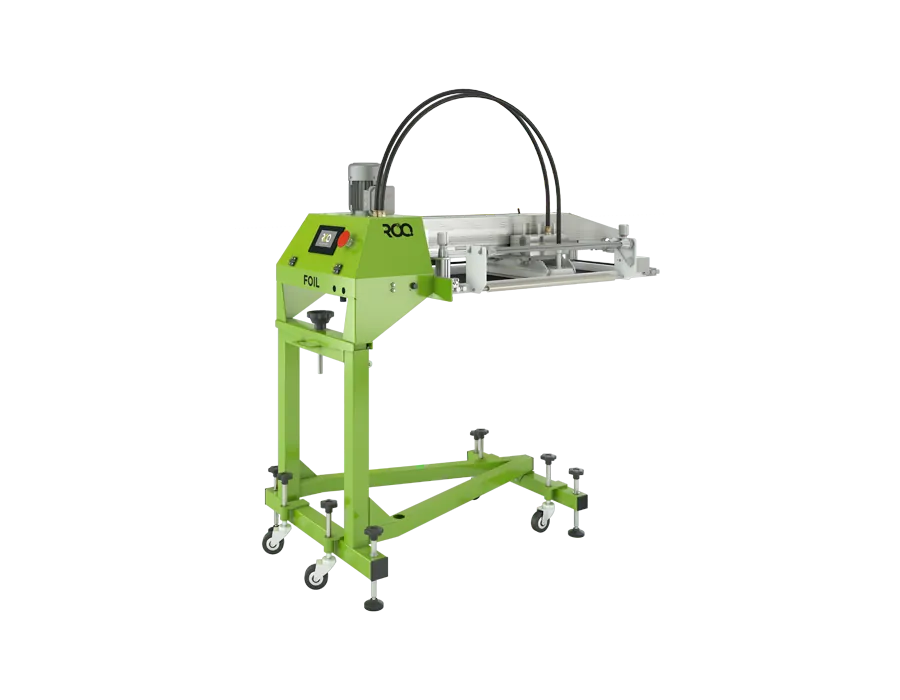
Using the ROQ FOIL module, integrated into a screen printing carousel, this traditionally time-consuming process is fully automated.
- Printing Adhesive: First, a standard screen printing station prints a special water-based or plastisol-based foil adhesive onto the fabric, exactly in the shape where the foil needs to adhere.
- Drying (Flash): The adhesive is flashed briefly so it reaches the correct tackiness.
- Applying Foil: The ROQ FOIL module rolls the metallic foil over the design and presses it firmly into the adhesive using a heated element under high pressure (often around 160°C - 170°C).
- Removing Foil: The carrier (the foil’s backing) is automatically peeled away, leaving the foil exclusively on the areas where the adhesive was printed.
- Digital Overprinting: Once the foil is in place, the pallet can index to the digital print station. Here, CMYK details can be printed directly over or perfectly aligned around the foil. For example, imagine a shiny gold shield with photorealistic roses digitally printed over it.
Best Practices for Foil
- Mesh Selection: Use a relatively coarse mesh (e.g., 43T to 55T) for the adhesive layer. You need a generous adhesive deposit so the foil can bond well to the fabric fibers and withstand washing.
- Heat and Pressure: Ensure the foil module’s heat station maintains a constant temperature. Variations in heat can lead to incomplete foil transfer.
Deep Dive 2: ROQ FLOCK for Velvety Tactile Structures
Flock adds not only visual depth but also an unparalleled physical feel. It creates a soft, suede-like or velvety texture that literally sits on top of the shirt.
Electrostatic Flock Mechanics
The ROQ FLOCK module is a technical masterpiece that utilizes electrostatic charging.
- Applying Adhesive: Similar to foil, an opaque layer of special flock adhesive is first printed via screen printing.
- Electrostatic Flocking: The ROQ FLOCK unit contains millions of microscopic nylon or rayon fibers. By creating a high-voltage field (electrostatic charge), these fibers are shot vertically into the wet adhesive like tiny darts. As a result, the fibers stand upright rather than lying flat, providing the characteristic velvety texture.
- Drying and Curing: The garment goes through the tunnel dryer, causing the adhesive to polymerize and permanently lock the fibers in place.
- Hybrid Combinations: In a hybrid setup, it is possible to print digitally over flock! By using a white flock as a base, you can digitally print any desired color or photographic detail onto it. Imagine printing a photo of a bear, where the bear’s fur consists of 3D flock fibers. This is an absolute “game-changer” in textile design.
Best Practices for Flock
- Adhesive Thickness: The adhesive layer must be thick enough to encapsulate at least 10-15% of the flock fiber. Use a thick stencil (capillary film) and a coarse mesh (e.g., 32T).
- Fiber Length: Depending on the desired effect, choose short (e.g., 0.5mm) or longer (1mm+) fibers. Longer fibers require a thicker adhesive layer.
Deep Dive 3: 3D Printing and High Density (HD) Effects
High Density (HD) printing creates a sharp, raised profile that feels like rubber or silicone. This is extremely popular for logos on sportswear, caps, and premium streetwear.
The Technique of Building Layers
To achieve a 3D effect, you build up layers of ink:
- Thick Film Stencils: Preparation starts in prepress. Normal screen printing emulsion is too thin. You need capillary films ranging from 200 to sometimes 700 microns thick. This creates a very deep “pool” in your screen for the ink to fall into.
- Ink Selection: HD inks have a high viscosity and often contain blowing agents that expand slightly during the drying process to create extra volume, although pure silicone or HD plastisol inks are preferred for sharp, square edges.
- Print-Flash-Print: The ink is printed via the ROQ’s screen printing stations, flashed (dried), and printed again to build up the height.
- Digital Precision: Once the physical 3D block is ready, the pallet moves under the digital print head. With extreme precision, the digital printer can now apply a complex color gradient, a pattern, or photographic detail to the top of the 3D block. The contrast between the matte or glossy raised surface and the razor-sharp CMYK print is guaranteed to grab attention.
ROI Calculations: Why Special Effects Make Financial Sense
Integrating modules like ROQ FOIL and ROQ FLOCK or printing HD effects naturally requires an initial investment, extra handling in prepress, and slightly longer process times per shirt. However, the Return on Investment (ROI) is compelling.
Let’s look at the “Cost of Goods Sold” (COGS) and potential retail value:
-
Standard DTG Print:
- Blank shirt cost: €3.00
- Ink and production costs: €1.50
- Total COGS: €4.50
- Expected Retail Price: €25.00
- Profit per shirt: €20.50
-
Hybrid Print with Flock or Foil & Digital:
- Premium blank shirt cost: €4.00
- Ink, adhesive, foil/flock material: €2.50
- Production time (depreciation): €1.00
- Total COGS: €7.50
- Expected Retail Price (Premium segment): €45.00 - €60.00
- Profit per shirt: €37.50 - €52.50
By investing just €3.00 extra in your production (and a higher quality shirt), you can significantly increase the retail price of the garment. Because you create a unique product that competitors with standard DTG or basic screen printing cannot replicate, you escape the “race to the bottom” price competition. Your margins increase exponentially relative to the additional production costs.
Best Practices for Prepress and Production in Hybrid Environments
The key to success in hybrid production is control. Because you are working with both mechanical screen printing stations and digital print heads, all variables must be tightly managed.
Screen Preparation and EOM
The thickness of your emulsion (EOM - Emulsion Over Mesh) is crucial, especially when printing adhesives for foil and flock. A consistent EOM of 15% to 20% above the mesh thickness ensures that the ink/adhesive sits as a tight “gasket” on the fabric rather than sinking into it. Always use an automated emulsion coater for the best results.
Registration
Registration between the analog screen printing stations and the digital print head is the holy grail. ROQ systems use the PRU (Positive Registration Unit) system, which ensures screens are positioned exactly. Make sure your digital artwork has the exact same anchor points and dimensions as your screen printing films or CTS (Computer-to-Screen) output. Equally important is the choice of pallet adhesive. The shirt must absolutely not move a single millimeter during the transition from the screen printing carousel, the flash dryer, to the digital print head. Use high-quality water-based pallet adhesive that is heat resistant, and reapply it regularly during long production runs.
Conclusion
Hybrid printing is not just an intermediate step; it is the ultimate destination for textile printers looking for maximum versatility, efficiency, and creative freedom. Where pure digital systems remain stuck on a flat two-dimensional plane, the combination with the mechanical power of ROQ screen printing stations opens the door to a three-dimensional world of creativity.
Whether you want to add the luxurious shine of inline metallic foil, the velvety, tactile experience of flock, or the architectural relief of High Density inks; these techniques, seamlessly bridged with photorealistic digital prints, offer you a competitive advantage that no other machine on the market can match. By investing in these capabilities, you position your print shop not as a simple supplier, but as a premium creative partner for brands. The investment in special effects translates directly into higher profit margins and a distinctive position in a saturated textile market.
Want to learn more about these screen printing solutions?
Explore the technical specifications of Drucktech PHP-45 V2 Maxima and Drucktech PHP-45 2N or contact the specialists at Dimix.Screen for tailored advice or a live demonstration.
Featured & related machines
Discover the industrial systems and solutions related to this topic:
ROQ HYBRID
Industrial digital hybrid printing unit with Ricoh Gen5 printheads and active ink recirculation for seamless integration on ROQ screen printing presses.
ROQ FOIL
Automated inline foil application module for metallic and holographic fashion prints.
ROQ FLOCK
Electrostatic flocking module for premium velvet-like 3D textile effects inline.