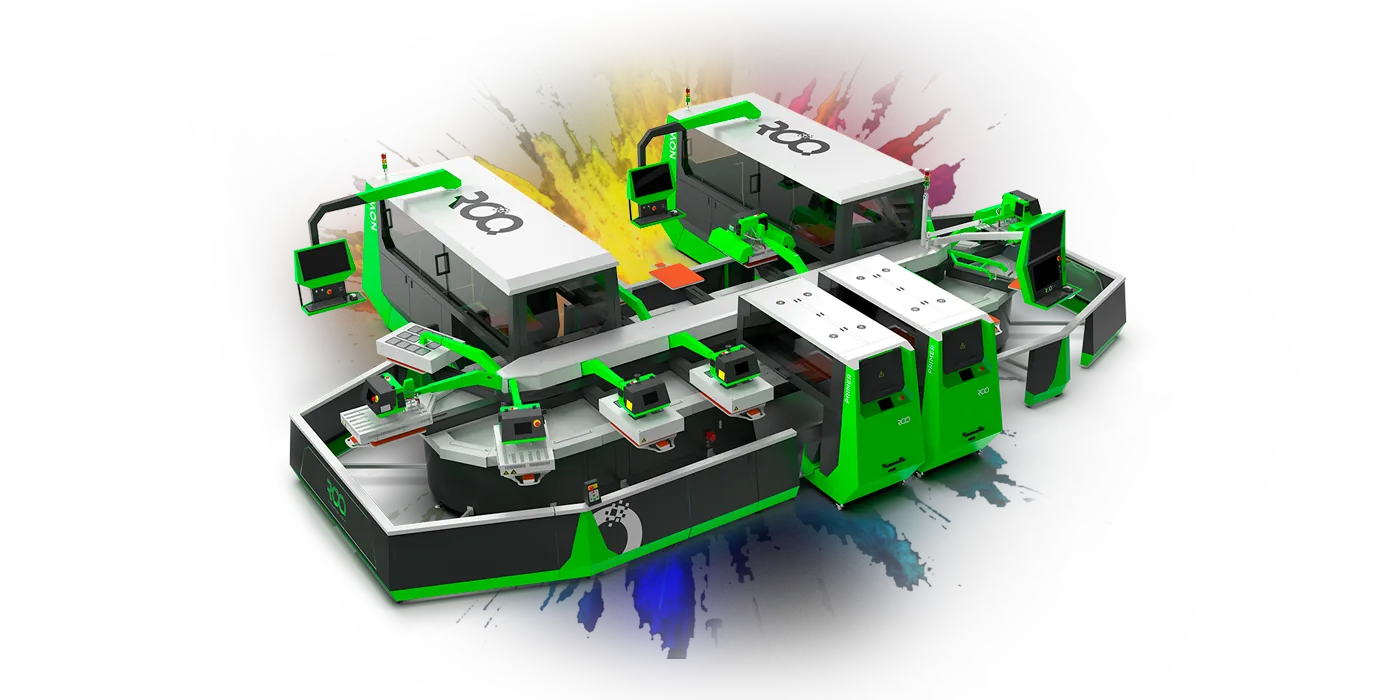
Within the professional textile printing industry, a significant and complex debate has raged for years: do you choose the low unit costs, immense speed, and unparalleled reliability of traditional screen printing, or do you opt for the ultimate flexibility, absence of setup costs, and breathtaking photorealistic detail of Direct-to-Garment (DTG) digital printing? Both technologies have dominated the market for decades, each with its specific advantages and disadvantages. But what if you no longer had to choose? With the spectacular rise of hybrid printing systems, such as the groundbreaking ROQ HYBRID, a completely new era in textile printing begins. This article dives deep into the technology, operational benefits, and Return on Investment (ROI) of the synergy between screen printing and digital printing.
Looking for technical specifications? View the print speeds (up to 450 pcs/h), Ricoh Gen5 printhead specs, and configurations on the ROQ HYBRID product page.
What Exactly is a Hybrid Printing System?
At its core, a hybrid printing system is an advanced textile printing press (usually an oval or carousel screen printing machine) equipped with at least one digital printing station (a DTG module) right in the middle of the classic screen printing stations’ cycle. This seamless integration means that a garment remains on one and the same pallet while undergoing both the benefits of analog screen printing and the precision of a digital print head.
In the most common configuration, a screen printing station is used to print a highly opaque white underbase. This is a process where screen printing has historically been extremely strong: fast, cheap, and with perfect coverage. After a short ‘flash cure’ or drying step, full-color digital printing is applied over this screen printed underbase. Subsequently, special effects can be added in the remaining screen printing stations, such as foil, flock, high-density (3D) ink, or metallic colors, before the garment enters the drying tunnel.
The Technological Evolution: The Best of Both Worlds
Today’s consumer demands increasingly complex designs: photorealistic images, subtle color gradients, smoke and fire effects, and designs with a seemingly unlimited number of colors. Traditionally, these types of designs require advanced simulated process color separations, which not only demands highly specialized prepress knowledge but also results in exposing and setting up ten or more screens.
Hybrid screen printing combines the two worlds into a single, flawless workflow. The digital print heads (such as industrial Ricoh or Fujifilm heads) apply CMYK or even extended gamut colors (including red and green for a wider color spectrum) with photorealistic details and resolutions up to 1200 DPI. At the same time, with the screen printing elements, you retain the speed and robustness of plastisol, water-based, or discharge inks for the base and finishing. You are able to produce complex, full-color graphic designs in a fraction of the time a purely analog setup would require.
The Workflow of a Hybrid System in Practice
To truly appreciate the efficiency of hybrid systems, we must look at the workflow step by step:
- Prepress and RIP Software: Unlike traditional color separations for every shade, in the machine’s RIP software you only separate the design into a ‘mask’ for the white underbase (and any primer or special effects), and a digital print file for the rest.
- Screen Printing the Underbase: The garment rotates to the first station where a white ink layer is printed using a standard screen. This happens with high speed and precision.
- Flashing and Pressing: The ink is dried with a flash cure unit and optionally smoothed by an iron roller or heat press to create a perfectly flat surface – the perfect canvas for digital ink.
- Digital Printing: The garment arrives under the digital print bridge. Here, millions of microscopic drops of ink (often between 2 and 7 picoliters in size) are sprayed onto the fabric at lightning speed to build the colorful image.
- Additional Effects (Optional): After printing, the carousel can rotate to further screen printing stations to apply, for example, a transparent gloss varnish, puff ink, or a foil adhesive.
- Curing: Finally, the textile goes through the drying tunnel to permanently fix both the screen printing ink and the digital pigment ink.
Decimation of Prepress Costs and Setup Times
One of the most compelling arguments for transitioning to hybrid printing is the drastic reduction in prepress costs and machine downtime. In traditional screen printing, a ten-color design requires ten separate screens, ten films or CTS (Computer-to-Screen) exposures, and significant time to set up (register) each screen on the press.
In a hybrid workflow, for the exact same complex design, you typically only need one or two screens (e.g., for the white underbase and possibly a primer). The entire multi-color image is printed digitally.
Example Calculation (Setup Time):
- Traditional (10 colors): Setting up 10 screens at 5 minutes per screen = 50 minutes of setup time per job. During this time, the press generates no revenue.
- Hybrid: Setting up 1 screen (white base) = 5 minutes setup time. The remaining colors are sent from the computer to the print head with the push of a button.
This lowers your prepress costs by up to 80% and significantly increases your machine uptime. This suddenly makes small to medium-sized print runs highly profitable.
Quality, Color Gamut, and Soft Handfeel
While early DTG prints on dark textiles sometimes suffered from a stiff, heavy print due to the thick layer of digital white ink (which is also very expensive), the hybrid process fundamentally solves this.
Because the digital print heads spray their ink directly onto the screen printed underbase, an extremely sharp print is created. The screen printing ink acts as a barrier; the expensive, fluid digital pigment ink does not penetrate too deeply into the fabric and does not bleed. This results in bright, vibrant colors with an unprecedentedly wide spectrum (color gamut) and a display that mimics photographs with razor-sharp precision.
Moreover, the ‘handfeel’ (how the print feels to the touch) is superior. A well-printed hybrid image feels extremely soft, supple, and flexible, offering a premium quality experience for brands in streetwear, high-fashion, and high-end merchandising. The prints do not crack and, if properly cured, have excellent resistance to dozens of washes without significant color loss.
Return on Investment (ROI) Calculations and Profitability
The biggest challenge for any textile printer is finding the sweet spot between print run size, ink costs, and setup costs.
- Pure DTG: Has zero setup costs per design, but the ink (especially white ink) is expensive per liter, and the production speed is relatively low (e.g., 30 to 60 pieces per hour).
- Traditional Screen Printing: Has high setup costs (screens, labor, machine downtime), but the screen printing ink is dirt cheap and production speed is immense (500 to 1000+ pieces per hour).
- Hybrid System: Spectactularly reduces digital ink costs by replacing expensive ‘digital white’ with cheap screen printing ink (or paste). It eliminates the high screen printing setup costs for complex colors. The production speed of a hybrid press is significantly higher than pure DTG (often 300 to 450 pieces per hour, depending on the print size).
Hybrid printing systems are supremely profitable for medium-sized print runs — the zone between 50 and 1000 pieces with complex, colorful graphics. This is exactly the order size that is growing enormously today due to e-commerce, print-on-demand services, and clothing brands working with seasonal or temporary “drops”. You directly bridge the gap where pure DTG is too slow and ink-technically too expensive, and where traditional screen printing simply requires too much prepress time relative to the number of pieces.
Best Practices for Successful Hybrid Textile Printing
To get the most out of your hybrid investment, several aspects require specific attention from the print operator:
- The Quality of the Underbase: The digital print will only be as good as the underbase. Use high-quality emulsion and correct mesh counts, often between 60T and 90T (150 to 230 US). A perfectly ironed, opaque, flash-dried underbase is essential for detail retention.
- Climate Control: Digital print heads are sensitive to fluctuations in temperature and humidity. Maintain a conditioned production environment around the digital bridge (typically between 20-25°C and relative humidity of 45-60%).
- Preventive Maintenance: Daily and weekly maintenance of the print heads (capping stations, wipers, and purging) is absolutely crucial to prevent nozzle clogging. Hybrid systems require a different mindset than robust mechanical screen printing presses.
- File Optimization: Work with high-resolution files (minimum 300 DPI) and train your DTP department to design specific “choke” masks (slightly shrinking the white underbase so no white protrudes under the colors).
Sustainability and Environmental Impact
An easily underestimated benefit of the hybrid revolution is its positive impact on sustainability. Because you need far fewer screens per order, you drastically reduce water and chemical consumption (such as emulsion removers and degreasers) in your reclaim room. Furthermore, the inks used in digital modules are almost always water-based, eco-friendly pigment inks that comply with strict certifications like Oeko-Tex Standard 100 and GOTS.
Fewer test prints and rejects, because digital printing is highly consistent, contribute to reducing textile waste. The ability to produce closer to consumer demand (just-in-time) also reduces the need to build up large inventories that might go unsold.
Conclusion: The Future is Hybrid
The debate between screen printing and digital printing is no longer a battle, but a collaboration. The textile printing industry is evolving rapidly, driven by consumer expectations for faster delivery times, ecological responsibility, and limitless design freedom. Hybrid printing systems, like those confidently marketed by pioneers such as ROQ, offer a highly elegant solution to these challenges.
By drastically reducing prepress costs, minimizing setup times, and adding the unlimited possibilities of digital color to the indestructible reliability of screen printing, hybrid printing positions itself as the ultimate production engine for the modern textile printing business. For clothing brands, streetwear labels, sportswear manufacturers, and higher-end promotional textiles, this is not just a new technique; it is the blueprint for the future of efficient and profitable textile printing.
Explore ROQ Screen Printing & Hybrid-Ready Solutions
Ready to bridge the gap between screen printing, special effects, and digital DTG in your print shop? Discover our industrial ROQ systems:
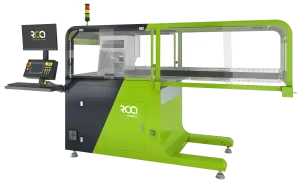
- ROQ HYBRID: The industrial digital print bridge with Ricoh Gen5 printheads and 24/7 active ink recirculation for 1200 DPI hybrid textile printing.
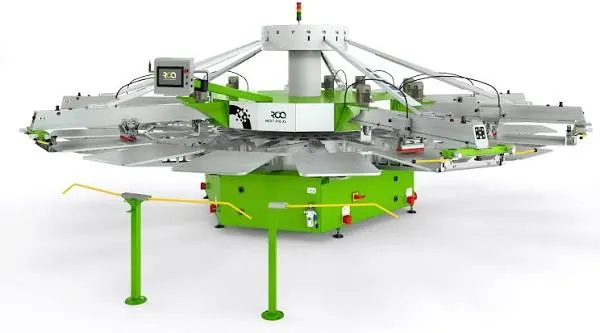
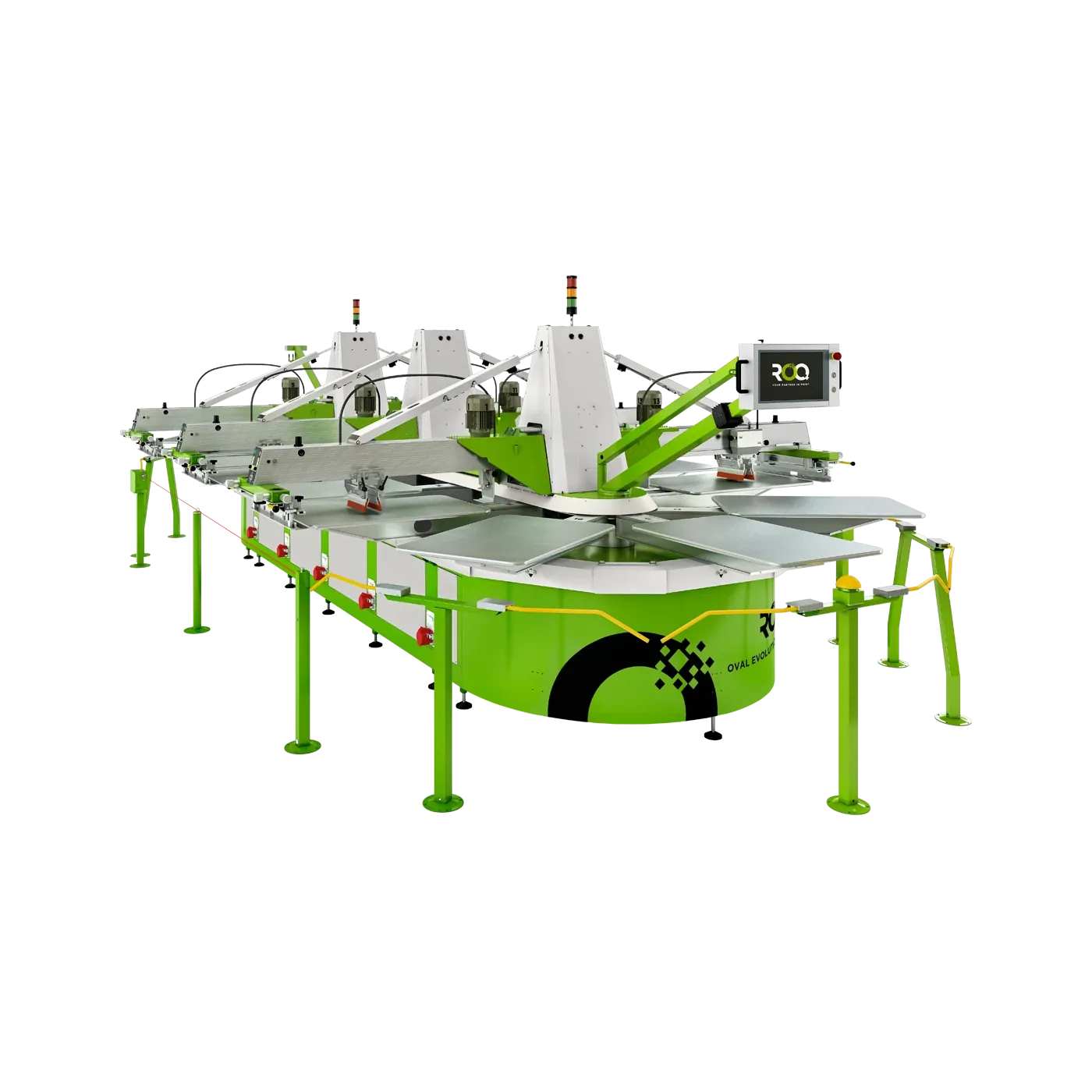
- ROQ OVAL EVOLUTION & ROQ OVAL PRO: Modular oval screen printing presses with open stations designed for digital hybrid units, flock, and foil.
- ROQ NEXT & ROQ ECO: High-speed automatic carousel presses ready for hybrid integration.
- ROQ FLOCK & ROQ FOIL: Add inline 3D flock and metallic foil effects directly into your hybrid production workflow.
- View all ROQ Screen Printing Machines or request a tailored ROI calculation.
Featured & related machines
Discover the industrial systems and solutions related to this topic:
ROQ FLOCK
Electrostatic flocking module for premium velvet-like 3D textile effects inline.
ROQ ECO
The flagship automatic carousel with chainless direct servo drive and independently lifting print heads.
ROQ E
100% electric automatic screen printing carousel with whisper-quiet operation and low energy consumption.