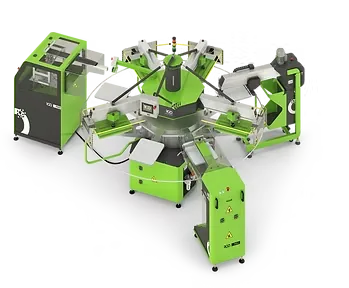
Why Automatic Pretreatment with the ROQ Primer is Indispensable in Modern Textile Printing
The world of textile printing and garment decoration has undergone a profound transformation over the past decade. Where traditional screen printing was once the undisputed king of mass production, we now see an increasingly strong shift toward more flexible, efficient solutions that meet the skyrocketing demand for personalization and rapid turnaround times. The rise of Direct-to-Garment (DTG) printing and, more recently, hybrid printing systems—which combine the unmatched speed and cost-efficiency of screen printing with the unlimited color richness and high resolution of digital printing—has set new standards for what is possible on textiles.
Within these innovative, fast-paced print environments, there is one crucial, often overlooked element that directly dictates the success or failure of your final product: the pretreatment, also known as primer. Although printheads, advanced digital inks, and the immense presses themselves frequently steal the spotlight and command the most attention, the primer forms the absolute foundation of any successful digital or hybrid print on fabric. In this comprehensive guide, we will dive deep into the technical aspects of primers, explore exactly why manual processes are no longer viable for modern businesses, and examine how the advanced inline ROQ Primer system can revolutionize your textile printing facility.
The Chemical and Physical Necessity of a Primer
To truly grasp why a primer is absolutely indispensable, we must examine the chemical and physical interactions that occur between textile fibers and water-based digital pigment inks. During the digital printing process using water-based CMYK inks, the printheads jet millions of microscopic ink droplets onto the fabric at lightning speed. Textiles, particularly cotton, are naturally highly porous, textured, and incredibly absorbent. If liquid, water-based ink were to be applied directly to untreated cotton (or even onto a wet screen-printed white underbase in a hybrid setup), it would immediately sink deeply into the weave or spread uncontrollably via the capillary action of the interwoven yarns.
The resulting outcome? A highly undesirable phenomenon known in the industry as ‘dot gain’ and ‘ink bleed’. The colors appear faded, muted, and muddy because the pigment does not stay on the surface. Fine details, crisp text, and sharp lines are completely lost, and the overall print looks washed out even before the garment has ever seen a washing machine.
The primer is a specially formulated chemical solution (often based on a salt solution combined with specific polymer binders) that is applied to the fabric just before printing. The moment the water-based ink comes into contact with the primer layer, an instantaneous chemical reaction is triggered: the salt in the primer causes the water in the ink to rapidly separate from the pigment particles. The pigment coagulates (solidifies) instantly upon contact and is essentially ‘frozen’ on the surface of the fabric. Because of this reaction, the ink droplets remain perfectly round, they do not sink into the absorbent fibers, and they produce the brilliant, photorealistic, and vivid colors that today’s discerning clients demand. Furthermore, the primer acts as a critical adhesion bridge that durably binds the pigment to the fibers, which is an essential factor for long-term washability.
The Drawbacks and Pitfalls of Manual Pretreatment
In the early days of DTG printing, it was standard practice to manually pretreat garments using a handheld power sprayer or a standalone pre-treatment spray cabin, after which the garments were manually dried under a commercial heat press before being loaded onto the printer. For small, startup-level businesses operating out of a garage, this was a workable solution. However, for professional industrial production facilities aiming for high volumes, this process has become completely unsustainable for several critical reasons:
- Inconsistency and Human Error: Manual spraying inevitably leads to human error. An operator might inadvertently spray too much primer on the top half of the shirt and too little on the bottom half. This results in uneven color opacity, color variations across the entirety of the print, and wildly variable washability from one garment to the next.
- Quality Issues and Garment Damage: Applying an excessive amount of primer can lead to crystallization on the fabric, resulting in a stiff, cardboard-like feel (a terrible ‘handfeel’) and, in the worst-case scenarios, severe yellowing or the dreaded ‘box effect’ where a visible, discolored square is left behind after heat pressing. Conversely, too little primer leads to dull, lifeless prints.
- Severe Production Bottleneck: The multi-step process of manually pretreating, pressing to dry, and then physically transporting garments to the printing machine consumes an enormous amount of time and manpower. It completely strips the speed and scalability out of your otherwise fast digital workflow.
- Health and Safety Concerns: Manually atomizing chemical solutions in the workspace creates airborne aerosols that, without excellent and expensive exhaust ventilation systems, can be hazardous for operators to breathe and can settle on the sensitive, highly expensive printheads of nearby digital machines, causing clogs.
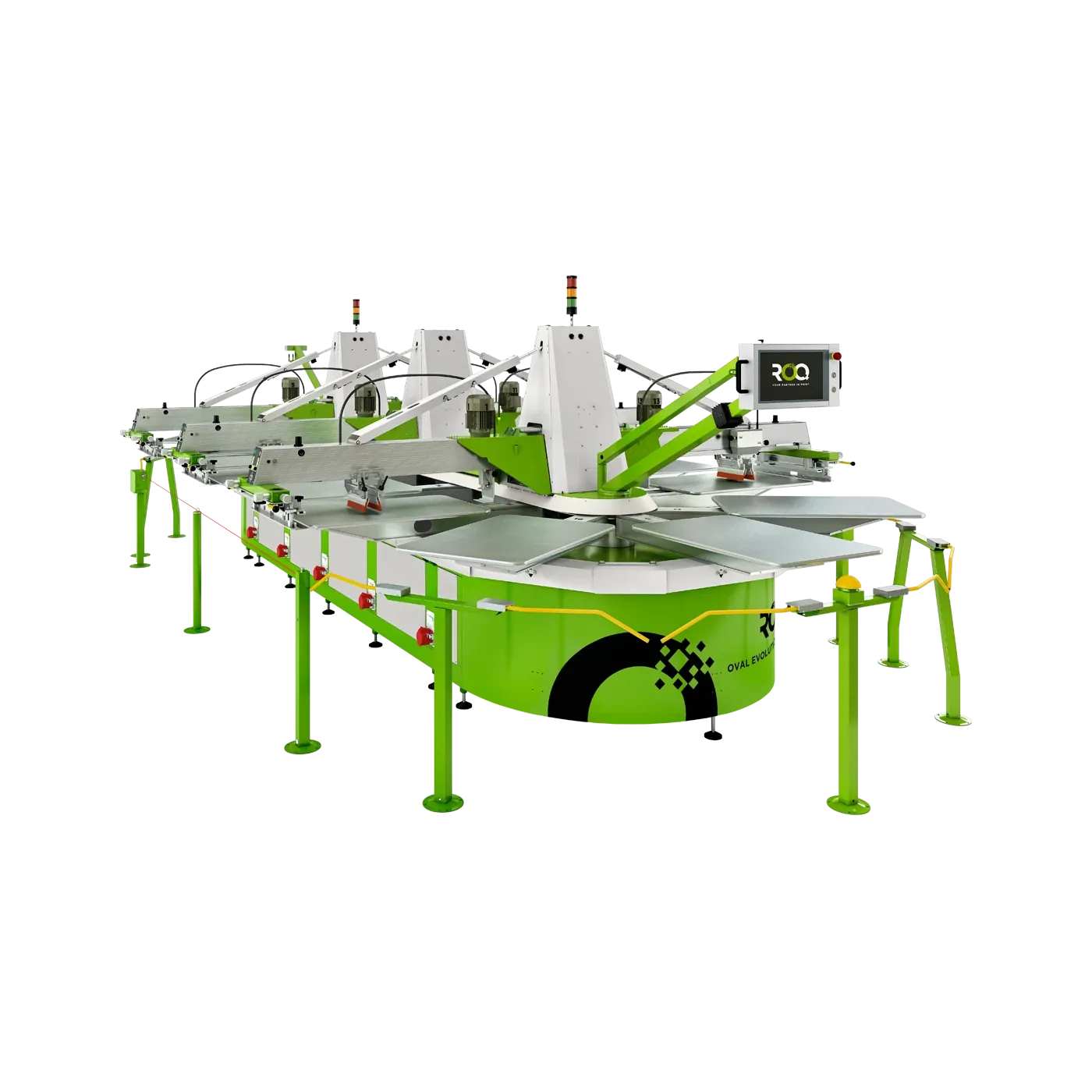
The Revolution: The ROQ Inline Primer Module
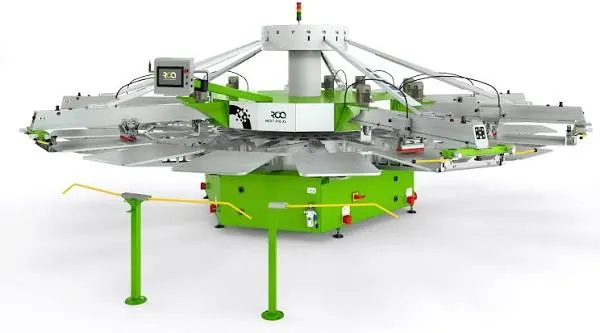
To meet the rigorous demands of high-volume industrial textile printers, ROQ has engineered a revolutionary solution: the integrated, fully automatic ROQ Primer module. Rather than relying on a disconnected, standalone process, the primer application is now executed completely ‘inline’, directly integrated onto the carousel or oval press (such as the ROQ ECO, ROQ OVAL, or seamlessly combined with the ROQ Hybrid systems).
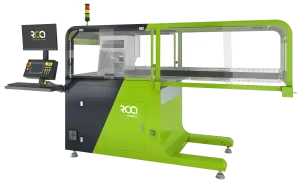
The inline ROQ Primer system eliminates all the pain points associated with manual pretreatment in a single stroke by automatically applying the exact, precisely dosed amount of primer at one of the very first print stations. How does this process work? As soon as the operator loads the blank shirt onto the pallet, it rotates into the primer station. The module is equipped with high-end, precision-calibrated spray nozzles that are digitally controlled via the machine’s robust PLC (Programmable Logic Controller).
The operator is relieved of all manual spraying duties. The exact volume of primer—down to micro-liter precision—can be programmed directly through the central touchscreen console and saved directly into the job parameters. This means that if a specific print job for a heavyweight cotton hoodie requires a precise 22 grams of primer per square meter, every single garment in that run will receive exactly that volume. The consistency rate is effectively 100%. This removes the guesswork, maximizes output quality, and fully automates a highly labor-intensive process, freeing up your staff.
Return on Investment (ROI) and Significant Cost Savings
An investment in heavy-duty industrial equipment like the ROQ Primer module must, of course, make strong financial sense. When we calculate the actual ROI of automatic inline pretreatment versus manual methods, it becomes clear that the investment pays for itself in a remarkably short timeframe.
First, there is the massive saving on primer fluid costs. Manual spraying almost always results in significant over-spray (spraying chemical off the edges of the garment or applying needlessly thick layers), meaning highly expensive chemical fluids literally vanish into thin air. The ROQ Primer strictly limits the spray to the programmed print area and applies it only at the specified thickness, drastically reducing chemical waste.
Second, and perhaps most impactfully, is the incredible reduction in rejects and misprints. Faulty pretreatment is unequivocally the number one cause of ruined garments in the commercial hybrid and DTG sectors. Every single misprinted shirt costs the business not only the price of the blank garment itself but also the wasted digital ink, the wasted primer, and the irrecoverable machine time. By eliminating human error from the equation, your reject rate drops dramatically, approaching zero.
Finally, the increased production speed allows for a substantially higher daily output. There is no longer a bottleneck starving the printing press; the machine runs continuously at optimal speeds. The labor hours saved can be redirected toward critical tasks like quality control, packing, shipping, or running additional shifts, all of which directly contribute to padding the profit margins of your printing business.
Material-Specific Challenges: Cotton, Polyester, and Blends
A crucial and powerful advantage of the digitally controlled ROQ Primer is its unparalleled flexibility to adapt to an incredibly wide variety of textiles. Not every fabric material reacts the same way to chemical pretreatment and water-based ink.
- 100% Cotton (Ring-spun or Carded): Natural cotton possesses excellent absorbent properties. A standard, robust amount of primer is generally required here to effectively hold the ink on the surface. With the ROQ module, you can dial in the perfect setting to achieve a vibrant, highly opaque result without sacrificing the fabric’s natural breathability and softness.
- Polyester and Performance Wear: Polyester absorbs very little moisture and is highly prone to dye-migration (the bleeding of the fabric’s original dye into the printed ink when subjected to heat). Printing on 100% dark polyester requires a specific, often lighter, polyester-optimized primer and meticulous temperature control during the curing phase. The exact dosing capabilities of the ROQ Primer prevent the chemical from pooling on the synthetic fibers and leaving unsightly glossy stains behind.
- Tri-blends and Poly-Cotton: For blended fabrics, a delicate middle ground must be found. Because the ROQ Primer settings can be saved as specific ‘recipes’ within the software’s memory for different jobs and garment types, an operator switching from a batch of heavy cotton tees to lightweight poly-cotton blends can load the perfect primer delivery parameters with the simple push of a button.
Long-Term Quality: Unbeatable Washability and the Perfect Handfeel
In the highly competitive market of retail-quality apparel, how a garment feels to the touch and how it performs in the washing machine over time are just as important as how stunning it looks on day one. The ‘handfeel’—the tactile sensation of the print as it sits on the fabric—is heavily influenced by the pretreatment process.
A very common complaint stemming from improperly applied primer is a stiff, sticky, or sandpaper-like print area. Consumers immediately associate this texture with cheap, low-quality garments. Because the ROQ Primer delivers the fluid in an exceptionally fine, even mist, it subtly integrates with the uppermost microscopic layer of the fibers without completely drowning them. When combined with premium water-based inks and a finely tuned screen-printed white underbase, this results in an ultra-soft handfeel that is barely distinguishable from the unprinted fabric itself.
Furthermore, durability is paramount. Major retail brands demand that their printed garments withstand the harshest industrial wash tests (such as rigorous AATCC standards). Without a consistent, high-quality, and evenly applied primer layer, the digital ink will inevitably begin to crack, flake, or fade after just 5 to 10 wash cycles. The perfectly even inline primer layer provided by ROQ, especially when immediately followed by the correct flash-curing step, guarantees unsurpassed wash fastness, ensuring that colors and intricate details remain perfectly intact even after 50+ rigorous wash cycles at 40°C.
Process Optimization: The Ultimate Checklist for the ROQ Primer
To extract the maximum value and performance from your investment in hybrid printing and the ROQ ecosystem, consistent maintenance and strict adherence to industry best practices are required. We highly recommend that operators and production managers implement the following process optimization checklist:
- Rigorous Daily Cleaning: Thoroughly clean and purge the spray nozzles at the end of every single production shift. Primer solutions can easily crystallize or dry out in the microscopic openings, which can cause uneven misting, streaking, or complete clogs during the next operating shift.
- Weekly Calibration and Inspection: At least once a week, inspect the spray pattern of the primer unit by running a test on a disposable sheet or test pallet. This ensures that the mist distribution remains perfectly symmetrical across the entire printing bed.
- Use Only Certified Fluids: Exclusively utilize original, OEM primers certified by ROQ and your specific ink manufacturer (e.g., formulations fully compatible with Ricoh or Fujifilm industrial printheads). Cheap, third-party, or non-compatible chemical alternatives can trigger unexpected chemical reactions, destroy wash fastness, or cause severe long-term damage to the expensive hardware.
- Optimal Flash Curing: Ensure immediate and adequate drying right after the primer is applied. It is absolutely crucial that the water content in the primer solution is fully evaporated so that only the active chemical binding agents remain before the digital ink (or the screen-printed white underbase) hits the garment. A properly tuned ROQ Flash Cure unit positioned immediately after the primer station is essential for this step. Routinely verify with an infrared temperature gun that the precise curing temperature is being reached consistently.
Conclusion
For professional print shops making the strategic transition to hybrid printing or seeking to dramatically scale and optimize their existing digital processes, manually pretreating textiles is unequivocally a thing of the past. The inline ROQ Primer system is not merely a luxurious add-on; it is an absolute, technological necessity for modern production. It eliminates the unpredictable human variables that compromise print quality, aggressively lowers operational overhead by reducing waste and rejected garments, and guarantees an unmatched, continuous production speed.
By fully digitalizing the dosing of chemical pretreatment and integrating it seamlessly into the incredibly robust workflow of a ROQ carousel press, you equip your business with the ultimate tools needed to produce at the highest possible retail standards. Investing in the perfect primer application system means investing directly in the long-term consistency, quality, and profitability of your textile printing operation. With ROQ, you are fully prepared to lead the future of garment decoration.
Want to learn more about these screen printing solutions?
Explore the technical specifications of ROQ CTS and ROQ PRU or contact the specialists at Dimix.Screen for tailored advice or a live demonstration.
Featured & related machines
Discover the industrial systems and solutions related to this topic:
ROQ HYBRID
Industrial digital hybrid printing unit with Ricoh Gen5 printheads and active ink recirculation for seamless integration on ROQ screen printing presses.
ROQ ECO
The flagship automatic carousel with chainless direct servo drive and independently lifting print heads.
ROQ E
100% electric automatic screen printing carousel with whisper-quiet operation and low energy consumption.