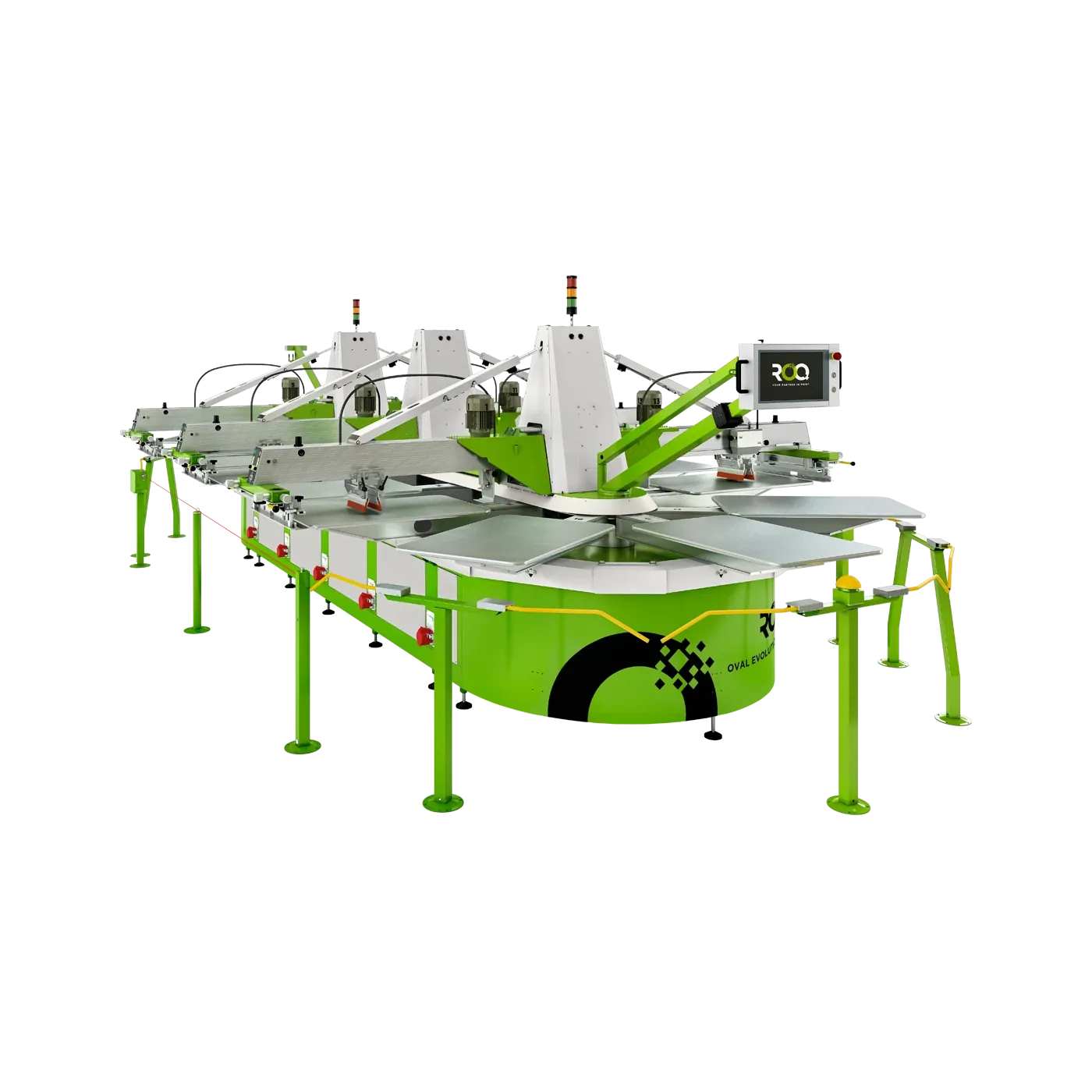
When industrially printing apparel with fine details, halftones, or multi-color images, registration accuracy is simply the most critical quality factor. If a screen frame or a garment pallet shifts by even a fraction of a millimeter during the rotation of the automatic press, disruptive white edges, overlapping colors, and severely blurred details instantly appear. This results in rejected garments (misprints), a frustrated production team, and an immediate loss of profit.
In the highly competitive and fast-paced world of modern textile printing, margins are literally everything. Customers demand perfection, photorealistic prints, sharp lines, and consistent quality from the very first to the last shirt in an order. Without the right high-quality equipment and tight processes, this consistency is nothing more than an illusion. In this comprehensive article, we dive deep into the world of mechanical tolerances, prepress variables, and the enormous impact micrometer precision has on your print shop’s profitability.
What Exactly is Registration Accuracy or “The Register”?
Registration accuracy, often simply referred to as ‘the register’ on the shop floor, refers to the absolute spatial alignment of different colors within a multi-color design. Because each color in a textile print design is separated and exposed onto a different screen frame, these various colors must fall perfectly over or directly next to each other during the printing process to form the final, composite image.
When we speak of a registration accuracy of +/- 0.025 mm in the industry, we are talking about a mechanical deviation that is virtually invisible to the naked eye. To give you a concrete idea of this scale: an average human hair has a thickness of about 0.075 mm. An industrial press with a tolerance of 0.025 mm is therefore three times as accurate as the thickness of a single strand of hair. That level of detail is crucial for top-tier quality.
The Complex Anatomy of Perfect Registration
Achieving flawless, perfect registration on the production floor is never the responsibility of a single isolated component. On the contrary, it is a delicate interplay of several crucial factors across the entire screen printing process:
- Prepress and Film/CTS: The absolute foundation starts in the darkroom. Whether you are printing films or using a state-of-the-art Computer-to-Screen (CTS) system, the separations must be perfectly aligned. If the digital artwork is flawed or the exposure is skewed, the design will never be in register on the press.
- Mesh Tension: Screen frames with low or highly uneven mesh tension will severely deform (stretch) under the mechanical pressure of the squeegee during the print stroke. This deformation causes a localized loss of registration in specific parts of the design, often noticeable in the far corners or along the outer edges.
- The Press and Indexing System: This is the beating mechanical heart of the operation. The automatic screen printing press must position every single garment pallet under each print station at the exact same x, y, and z coordinates, stroke after stroke.
- Garment Pallets and Adhesive: The substrate carrier must be completely rigid and flat. Older wooden pallets can warp and bow due to the constant heat of the flash cure, resulting in height (z-axis) inaccuracies. Honeycomb aluminum pallets provide the ultimate, heat-resistant solution here. Furthermore, the shirt must be securely tacked down to the pallet.
The Mechanical Tolerances of Automatic Presses
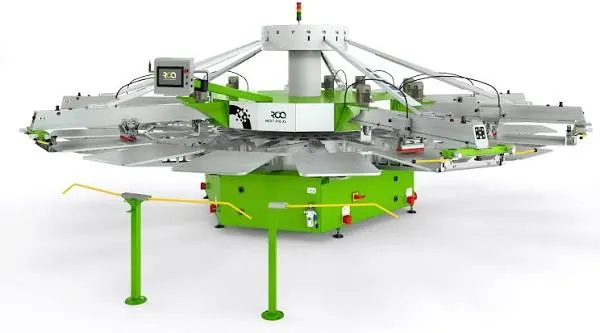
An automatic screen printing press (whether carousel or oval configuration) continuously rotates dozens of pallets past multiple print heads. To maintain perfect registration throughout the entire day, each pallet must come to a complete stop at the exact microscopic position under the print head during every single rotation. However, many older or cheaper entry-level machines use chain drives or pneumatic indexers.
The Pitfalls of Traditional Drive Mechanisms
- Chain Drives: Systems that rely on a chain or belt inevitably tend to stretch and wear out over time. This introduces ‘play’ (backlash) into the rotation. This means that the pallet no longer stops exactly on its pre-programmed dead center, but can easily shift half a millimeter or more back and forth under the print head.
- Pneumatic Indexers: Air-driven (pneumatic) indexing systems can vary significantly based on the prevailing air pressure in the shop’s compressor system, the temperature of the machine in the morning versus the afternoon, and the wear on the seals within the pneumatic cylinders. They are also often considerably less smooth in their movement, resulting in mechanical shocks that directly jeopardize the registration of the clamped screen frames.
As soon as play or vibration creeps into the system, it becomes almost impossible to produce a crisp wet-on-wet print without the ink bleeding outside its defined boundaries. The so-called ‘smudging’ of ink at the edges of the graphic design is very often the very first visual sign of a worn or inadequate indexing system.
ROQ’s Patented Indexer and Mechanical Locking
As an exclusive partner of ROQ, we at Dimix.Screen know better than anyone what true, uncompromising industrial quality looks and performs like. ROQ guarantees a mind-blowing registration accuracy of +/- 0.025 mm (measured at the outer edge of the pallet) on all its carousel and oval presses (like the ROQ Oval Evolution or the ROQ Eco). How do their engineers achieve this unprecedented micrometer precision that leaves the competition behind?
The Massive V-Block and Dual Centering Pins
This level of unparalleled precision is achieved through an extremely robust, patented mechanical indexing system. At the base of each individual print head sits a massive cast block. As the servo motor rotates the press and the pallet arrives roughly in its position under the print head, the ingenious mechanism slightly lifts the pallet arm and guides it flawlessly into a specially designed V-shaped block, equipped with hardened steel dual centering pins.
These heavy-duty pins grip the sides of the pallet arm and lock it absolutely, 100% free of play. Because the movement is purely mechanical (and not reliant on compressed air) and the critical wear parts are made of premium hardened steel, long-term wear and tear has virtually zero impact on the register. This extremely robust and well-thought-out design is the main reason why ROQ proudly offers a lifetime warranty on the registration of its print heads. A ROQ press remains just as accurate after ten years of intensive, daily three-shift operation as it was on the day of installation and calibration.
In-Depth Analysis of the Financial Impact of Misprints
The initial purchase of an advanced automatic screen printing press is obviously a significant capital investment, but the hidden and ongoing costs of an inaccurate or unreliable press are far higher in the long run and disastrous for your bottom line. Let’s crunch the numbers on the real, hard financial impact of misprints caused by simple registration drift.
Imagine you are running an order of 1,000 high-quality premium hoodies for a demanding clothing brand or e-commerce client. The wholesale cost of these premium hoodies is, for example, €15 each. Your print shop uses an older or entry-level machine with slight play in the indexing system, resulting in a seemingly ‘modest’ rejection rate (misprints) of 3% due to registration errors, unwanted white outlines, or annoying color shifts.
- Production Rejects: 3% of 1,000 pieces = 30 ruined hoodies that cannot be shipped.
- Direct Material Costs: 30 x €15 = €450 direct financial loss in blank apparel. On top of that, add the value of wasted ink, emulsion, and chemicals.
- Hidden Time Loss: The many hours of paid labor spent initially setting up the machine, printing the ultimately rejected garments, and the slow, manual inspection process afterward to fish out the bad prints.
- Major Production Disruption: Because you are suddenly short 30 hoodies for the agreed delivery to the client, you must rush order replacements (often with hefty overnight shipping fees), reset the screens (if the job was already torn down), and reprint that portion of the order. This easily costs several hundreds of euros in inefficient machine downtime.
On a single, fairly standard order of 1,000 items, poor registration easily costs you over €500 to €800 in hidden costs and lost revenue. Multiply this sobering calculation over an entire calendar year, with perhaps dozens of such orders per week, and you’ll quickly realize that an inaccurate machine creates tens of thousands of euros in hidden and entirely unnecessary losses.
By making the switch to an advanced press with +/- 0.025 mm precision, you reduce this unnecessary technical failure rate to almost absolute zero. Every successfully printed and approved garment thereby directly contributes, dollar for dollar, to your final gross margin.
The Absolute Necessity for Complex Halftones and CMYK
For highly simplified designs with a few large solid areas and simple, thick vector lines, a tiny deviation is sometimes somewhat acceptable or maskable with trapping and chokes in prepress. But as soon as we move to printing high-quality photorealistic designs, four-color process (CMYK), or simulated process colors with multiple spot colors, perfect and uncompromising registration is simply the absolute baseline requirement.
The Dreaded Moiré Trap and Abrupt Color Shifts
In complex halftone printing (the use of fine dot patterns), many tens of thousands of microscopic ink dots of different primary colors must fall exactly, down to the micrometer, next to and partially over each other. This is necessary to create optical illusions of thousands of different color shades and smooth gradients in the eye of the beholder. A very minimal mechanical deviation of the press instantly alters the complex way the different ink layers interact with each other on the fabric.
If, for example, the cyan screen in your CMYK setup shifts by just half a millimeter relative to the magenta or yellow base layer, the complete and final color blending of the print changes. What should have been a beautiful, clear blue summer sky suddenly turns a muddy, dirty green. Warm, natural skin tones suddenly become blotchy, zombie-like, or show unwanted purple spots.
Moreover, such registration errors almost immediately cause the dreaded ‘moiré effect’: a highly undesirable, disruptive, and visually vibrating wavy pattern in the textile print. This happens because the carefully calculated screen angles mathematically no longer align correctly relative to each other when the registration shifts.
Constant, reliable micrometer precision on a machine’s heavy-duty print heads guarantees that the thousandth print in the afternoon looks exactly, identical to the very first approved strike-off in the early morning. Your paying customer will therefore always get exactly what they signed off on and expect, without the slightest worrying color fluctuations or quality variations throughout the long production run.
Essential Best Practices for Perfect Registration in Your Print Shop
Purchasing a high-quality industrial screen printing press is a massive step in the right direction, but it is still only half the battle. To actually utilize the full and impressive +/- 0.025 mm hardware accuracy of a ROQ in practice, textile printers must also maniacally optimize their other process variables on the shop floor. Here are some crucial best practices:
- Invest heavily in retensionable frames (roller frames) or extremely high-quality static aluminum frames: A properly tensioned screen is essential. Proactively aim for a minimal, consistent mesh tension of 25 to even 35 Newtons. Screens with tight and evenly tensioned mesh will stretch significantly less during the physical squeegee stroke, keeping the design perfectly in place.
- Minimize and standardize off-contact: The greater the physical distance between the bottom of the screen frame and the garment on the pallet (off-contact or snap-off), the more the heavy polyurethane squeegee has to push down and stretch the mesh to successfully hit the shirt. A tight and well-tensioned screen allows you to print with a very minimal off-contact (typically just 1.5 to 3 mm), which directly results in significantly sharper and safer registration.
- Obsessively check squeegee angle, durometer, and applied pressure: Too much mechanical pressure on a squeegee that is too soft or worn out literally pushes and rubs the ink outside the open areas of the design and locally deforms the mesh. Always use sharp, well-maintained squeegees and consistently apply the technical principle of “shearing the ink” (cleanly slicing the ink column) into the open mesh instead of brutally “smashing” and forcing the ink deep into the fibers of the shirt with excessive force.
- Use an intelligent flash-cure unit with extreme precision: Heat is often the hidden enemy of registration. When ink and fabric get too hot during the necessary intermediate flashing (curing), the textile itself can start to shrink or slowly shift on the softened pallet adhesive. Advanced flashes, like those from ROQ, communicate seamlessly and digitally with the press’s operating system. This ensures the critical flash time is always perfectly optimized per station, temperature spikes are avoided, and the fabric remains dimensionally stable and perfectly in place.
- Choose and maintain Pallet Adhesive (Tack): Exclusively use the absolutely correct pallet adhesive (high-quality water-based adhesives or premium spray tack) and renew or reactivate it very regularly during production. If the fabric of the shirt moves or lifts even a single millimeter during the rapid rotation and indexing, even the most insanely accurate press in the world won’t help you at all.
Conclusion: Superior Precision is a Hard-Nosed Business Model
We cannot be clear enough: registration accuracy is no longer just a “nice-to-have” luxurious feature on a screen printing machine’s glossy spec sheet. Today, it is undeniably the fundamental, load-bearing cornerstone of your successful business model. The rapid shift in the textile printing industry towards “on-demand” printing and highly demanding retail-quality merchandise simply means that at the top tier, there is no margin or room left for sloppy, blurry, or inferior prints.
By investing strategically and wisely in robust machines with a completely flawless, lifetime-guaranteed mechanical indexing system—such as the automatic carousel and oval presses from the powerhouse ROQ—you permanently eliminate expensive material losses. Furthermore, you daily save oceans of valuable and unproductive setup downtime from your expensive operators. Finally, and most importantly, you consistently secure highly satisfied, loyal customers who are more than happy to return and willing to pay for those consistent, photorealistic, and truly perfectly registered prints. At the apex of commercial textile printing, true precision is absolutely not a cost center or an annoying luxury, but it is by far the most direct, reliable route to expansion and significantly higher, structural profitability.
Want to learn more about these screen printing solutions?
Explore the technical specifications of ROQ CTS and ROQ PRU or contact the specialists at Dimix.Screen for tailored advice or a live demonstration.
Featured & related machines
Discover the industrial systems and solutions related to this topic:
ROQ PRU
Positive Pattern Registration Unit reducing press setup and make-ready times by up to 80%.
ROQ OVAL EVOLUTION
Modular oval screen printing press for unlimited colors, expandability, and simultaneous print jobs.
ROQ ECO
The flagship automatic carousel with chainless direct servo drive and independently lifting print heads.