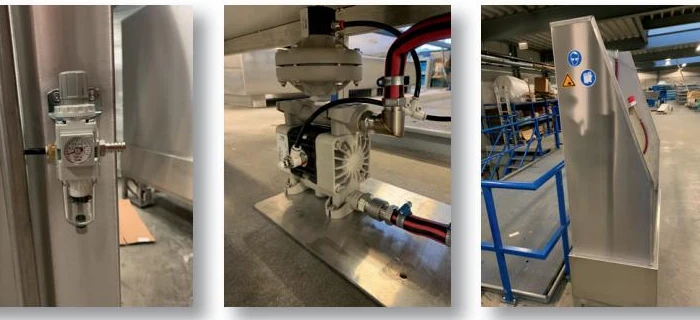
In the dynamic world of screen printing and transfer printing, efficiency, consistency, and quality are paramount. The pressure to deliver faster at competitive prices is constantly increasing. While many print shops heavily invest in the latest fully automatic screen printing presses or curing ovens, one department remarkably often lags behind in the modernization process: the washroom and prepress area. Preparing, developing, and reclaiming screen printing frames is still too frequently viewed as a necessary evil, a physically demanding and unpleasant chore. For startup or mid-sized print shops, fully automating this washroom is often a difficult choice. After all, large in-line systems take up an enormous amount of valuable space and require a substantial financial investment.
This is exactly where the INPRO Combi-Compact changes the playing field. Not every print shop has the space or the budget for a giant reclaiming installation. The Combi-Compact provides an intelligent, space-saving solution that brings together automatic developing and powerful high-pressure cleaning in one impressive machine with a footprint of just 2.2 meters.
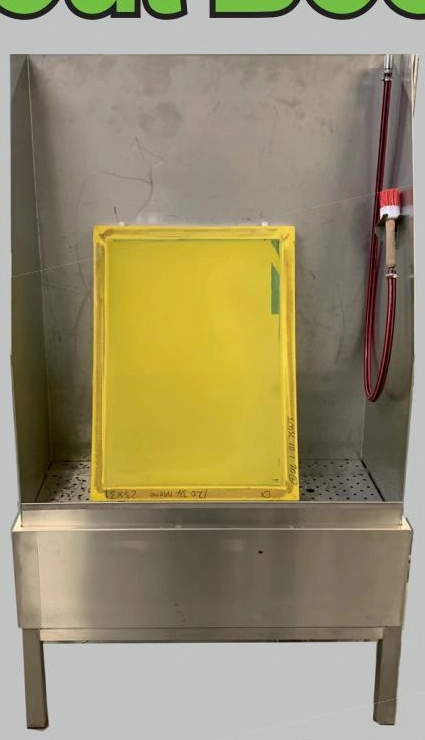
The Bottleneck of Manual Screen Processing
Before diving deeper into the technological advantages of the INPRO Combi-Compact, it is essential to understand why manual screen processing is so problematic for growing textile print shops.
First, there is the lack of consistency. When an operator manually washes out exposed screens with a spray gun, the water pressure and the distance to the emulsion vary with every movement. This inevitably leads to variations in stencil quality. This might not be noticeable with large solid blocks of color, but when printing fine halftones, thin lines (such as in complex transfer printing), or when using specific capillary films, the margin for error is minimal. A water jet that is too hard can blow out the fragile, partially dissolved emulsion, while a jet that is too soft results in incompletely opened mesh and consequently failed prints.
Secondly, there is the labor-intensive and unhealthy nature of the work. Handling a high-pressure washer for prolonged periods in a damp, noisy environment takes a physical toll. Furthermore, manual spraying creates many aerosols in the air – a mist of water mixed with ink residues, decoating chemicals, and emulsion particles. Even with good ventilation, this is far from an ideal working environment.
Finally, there is the element of time. The minutes an experienced prepress employee spends manually spraying out screens are minutes not spent on quality control, coating new screens, or actually setting up the printing press. Manual washing thus acts as a direct brake on the throughput speed and scalability of your production.
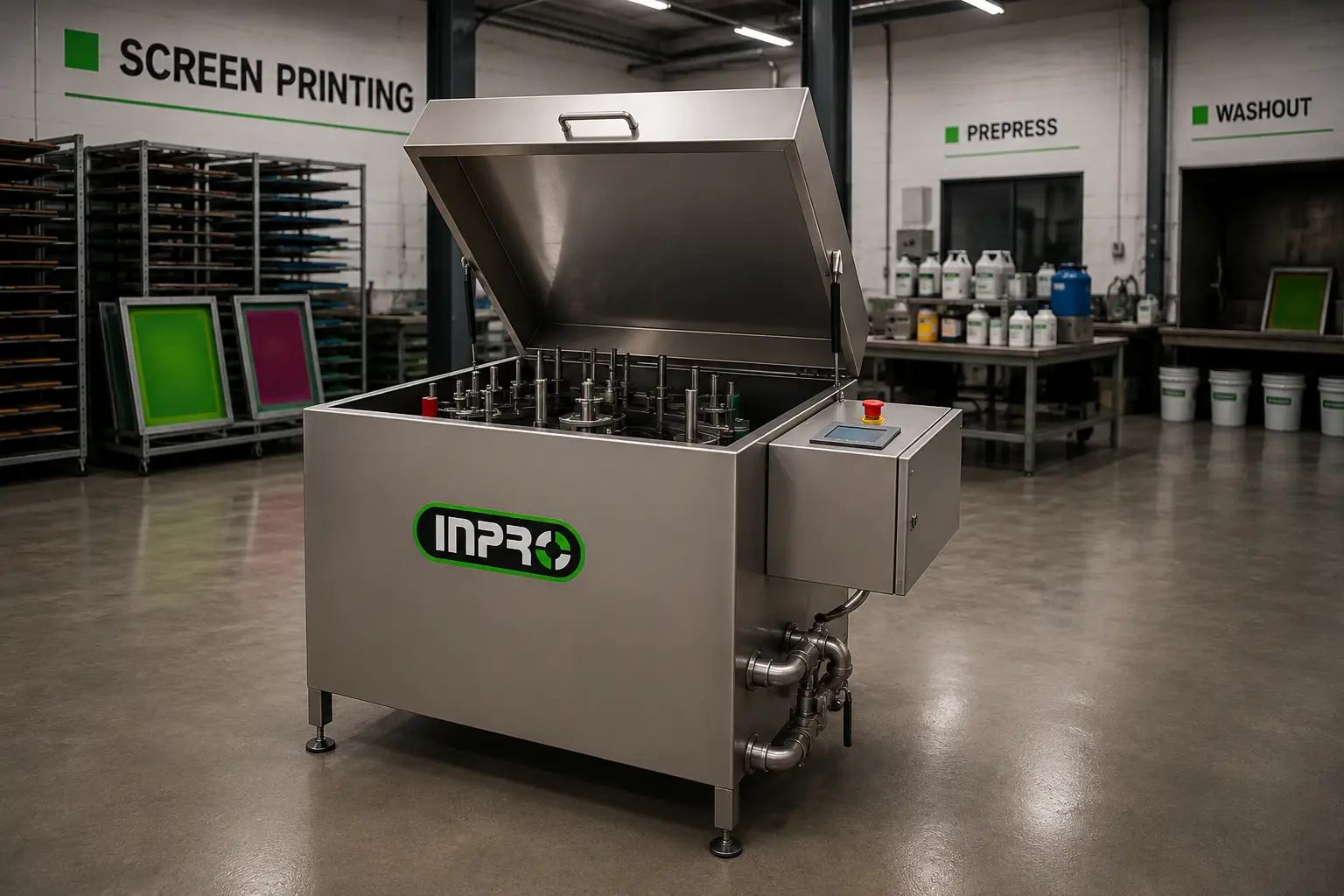
Deep Dive: What Makes the INPRO Combi-Compact Unique?
The INPRO Combi-Compact is designed from the philosophy that high-end automation should be accessible to the mid-sized market. With a length of approximately 220 centimeters, this machine easily fits into most existing prepress rooms. The construction is made of high-quality stainless steel, which is an absolute necessity given the exposure to water, aggressive chemicals, and continuous humidity.
The beating heart of the machine is the advanced, rail-mounted nozzle system. This spray system moves along the screen at a constant, adjustable speed, ensuring that every square inch of the screen mesh receives exactly the same treatment.
The operation is extremely user-friendly. With an intuitive panel, the operator can easily switch between the different programs. The machine automatically detects the position of the screen and optimizes the cycle to minimize water and energy consumption. Because the system is fully enclosed during washing, all splashing water remains neatly inside the cabin. No more wet floors and no more spreading of chemical mist throughout your workshop.
Process 1: Precision in Automatic Developing
The first crucial process for which the Combi-Compact is utilized is developing screen printing frames immediately after UV exposure. This is the moment of truth for any stencil.
Instead of having the operator stand in a dark, wet room, they simply place the exposed screen into the INPRO Combi-Compact. Upon activating the developing program, the machine completely takes over. First, the screen is often gently wetted so the unexposed (and thus soluble) emulsion can pre-soak. Then, the nozzle system uses a lower, perfectly tuned water pressure to wash out the image.
This controlled process is an absolute game-changer for high-quality printing. Because the jet always hits the mesh at the perfect distance and at the same angle, you are guaranteed razor-sharp edges (edge definition). Halftone dots of 60 or even 90 lines per inch (LPI) are flawlessly opened without damaging the surrounding, hardened emulsion. While the machine meticulously develops, your operator can immediately move on to exposing the next screen, drastically speeding up the workflow.
Process 2: Powerful Reclaiming and Cleaning
At the end of a stencil’s life cycle, when the print run is over, follows the ‘reclaiming’ or decoating of the screen. Ink residues must be removed, and the cured emulsion must be dissolved and blasted away so the mesh can be reused. This normally requires serious water pressure and a lot of elbow grease.
With the INPRO Combi-Compact, this process transforms from a heavy chore into a simple operation. The workflow is as follows: the operator removes the excess ink in a separate wash booth, applies a decoater (emulsion remover), and lets it sit briefly. Then, the screen is placed in the Combi-Compact.
Now the high-pressure program is activated. The internal pump delivers a powerful water jet that effortlessly and systematically blasts the dissolved emulsion out of the mesh. Once again, the rail with nozzles does the heavy lifting. The result is a screen that is consistently and thoroughly clean, ready for any potential ghost image treatment (haze removal) and subsequently for the drying rack and a fresh coat of emulsion. Because the process is so consistent, the lifespan of your screen mesh often increases as well; after all, it is no longer subjected to uneven, extreme pressure (like a dirt blaster nozzle) directed at one specific spot on the fragile mesh.
The Business Case: Return on Investment (ROI)
A frequently heard question is: “Can my print shop justify this investment?” Let’s look at the numbers. The ROI of the INPRO Combi-Compact lies not only in direct time savings but also in quality improvement and resource management.
- Direct Time Savings: A manual wash or develop session takes an average of 3 to 5 minutes per screen. With a consumption of 30 screens per day (very realistic for mid-sized companies), you are talking about 1.5 to 2.5 hours of pure washing time per shift. With the Combi-Compact, this active time is reduced to less than 30 seconds per screen (loading and unloading). This saves you 1 to 2 man-hours per day.
- Capacity Growth: The saved labor hours can be directly deployed on revenue-generating tasks. More time keeping the press running means more prints per day.
- Reduced Waste and Returns: How much does a failed print run cost because a halftone wasn’t properly washed out? The flawless, standardized development drastically reduces spoilage on the printing press.
- Water and Chemical Savings: Because the nozzles are precisely calibrated and move optimally across the screen, not a single liter of water or drop of chemical is unnecessarily wasted. Especially considering the rising costs of wastewater treatment, this is a directly measurable saving.
When you combine these factors, most print shops find that the INPRO Combi-Compact fully pays for itself within 12 to 24 months, depending on the production volume.
Best Practices for Optimal Use
To get the most out of your INPRO Combi-Compact, we are happy to share some professional tips:
- Workflow Optimization: Place the machine as close as possible to your exposure unit and decoating station. This minimizes walking back and forth and prevents dripping water on the floor.
- Proper Water Filtration: Ensure a correct sedimentation system (filtration tank) under or after the cabin. Because the machine washes out a lot of emulsion and potentially ink residues, it is crucial that your pipes do not get clogged and that you comply with environmental regulations.
- Nozzle Maintenance: Periodically check the spray nozzles. Although the machine operates with a self-cleaning logic, limescale or small particles can affect the spray jet in the long term. A quick cleaning of the nozzles guarantees that the machine remains in top condition for years.
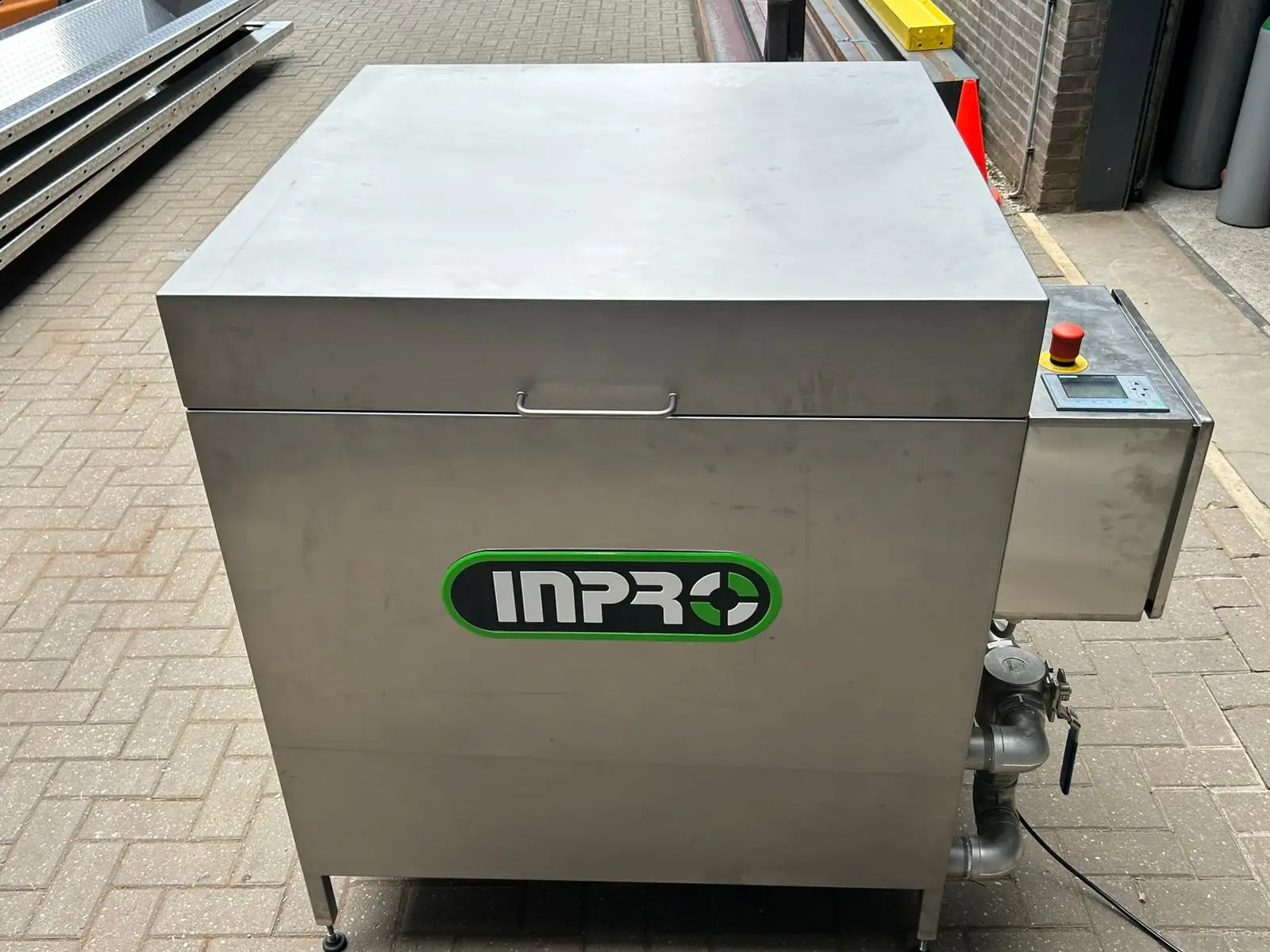
Conclusion
The transition from manual labor to automation is the key to scalability in the modern screen printing shop. The INPRO Combi-Compact masterfully bridges the gap between exhausting manual processes and unaffordable massive in-line systems. It offers your prepress department the consistency, safety, and speed required to handle today’s production demands.
It is simply a no-brainer for anyone who takes the professionalization of their print shop seriously. You are not just investing in a machine; you are investing in peace of mind, a cleaner working environment for your team, and a measurable increase in your final print quality.
Want to learn more about these screen printing solutions?
Explore the technical specifications of INPRO Combi-Compact and INPRO or contact the specialists at Dimix.Screen for tailored advice or a live demonstration.
Featured & related machines
Discover the industrial systems and solutions related to this topic:
INPRO Tigerclean Series
Modular custom industrial screen reclaiming lines with up to 5 modules for screen heights from 110 to 260 cm.
INPRO SqueegeeClean Pro
Fully automated squeegee and floodbar cleaning system: cleans, rinses, and dries up to 20 squeegees per cycle using safe, non-volatile chemistry.
INPRO Large Format Cutting Solutions (Rhino & Jumbo)
XXL industrial guillotine cutting systems (220 to 530 cm cutting width) with 360° inside-cutter sheet turning.